

Stock splits often generate excitement on Wall Street, particularly when they involve companies that have delivered extraordinary returns to shareholders. And Sandisk (SNDK) certainly fits that description. Since its separation from Western Digital (WDC) last year, the memory chipmaker has emerged as one of the biggest beneficiaries of the artificial intelligence (AI) boom, with surging demand for data storage fueling impressive growth in its business and stock price. Now, Sandisk is preparing for an 8-for-1 stock split, with its shares set to begin trading on a split-adjusted basis on Friday, Nov. 20.
But the timing of the split is far from ideal. After an extraordinary rally that sent SNDK shares soaring to record highs, the stock has suffered a brutal correction amid growing concerns about the sustainability of the AI spending boom. A combination of macroeconomic uncertainty, shifting political dynamics, and fresh challenges facing the semiconductor industry has made investors increasingly cautious about some of the market’s biggest AI winners. And for a company whose fortunes are closely tied to demand for memory chips, these developments raise important questions about whether its impressive growth trajectory can continue.
More Top Stocks Daily: Go behind Wall Street’s hottest headlines with Barchart’s Active Investor newsletter.
That leaves investors facing an interesting dilemma. Could the lower share price and recent selloff create an attractive opportunity to gain exposure to one of the AI boom’s standout performers, or are there deeper risks lurking beneath the company’s impressive financial results? And, more importantly, how should existing shareholders and prospective buyers approach SNDK stock as the split takes effect? Let’s take a closer look.
About Sandisk Stock
Sandisk is a leading developer and manufacturer of data storage devices and solutions based on NAND flash technology. The company was spun off from hard-drive manufacturer Western Digital last year. It offers products such as solid-state drives (SSDs), removable memory cards (SD, microSD, CompactFlash), USB flash drives, and embedded storage for mobile and automotive applications. Sandisk’s storage chips, known as NAND flash memory, have become increasingly vital in AI data centers and consumer devices, fueling unprecedented growth for the company. SNDK’s market cap currently stands at $113.4 billion.
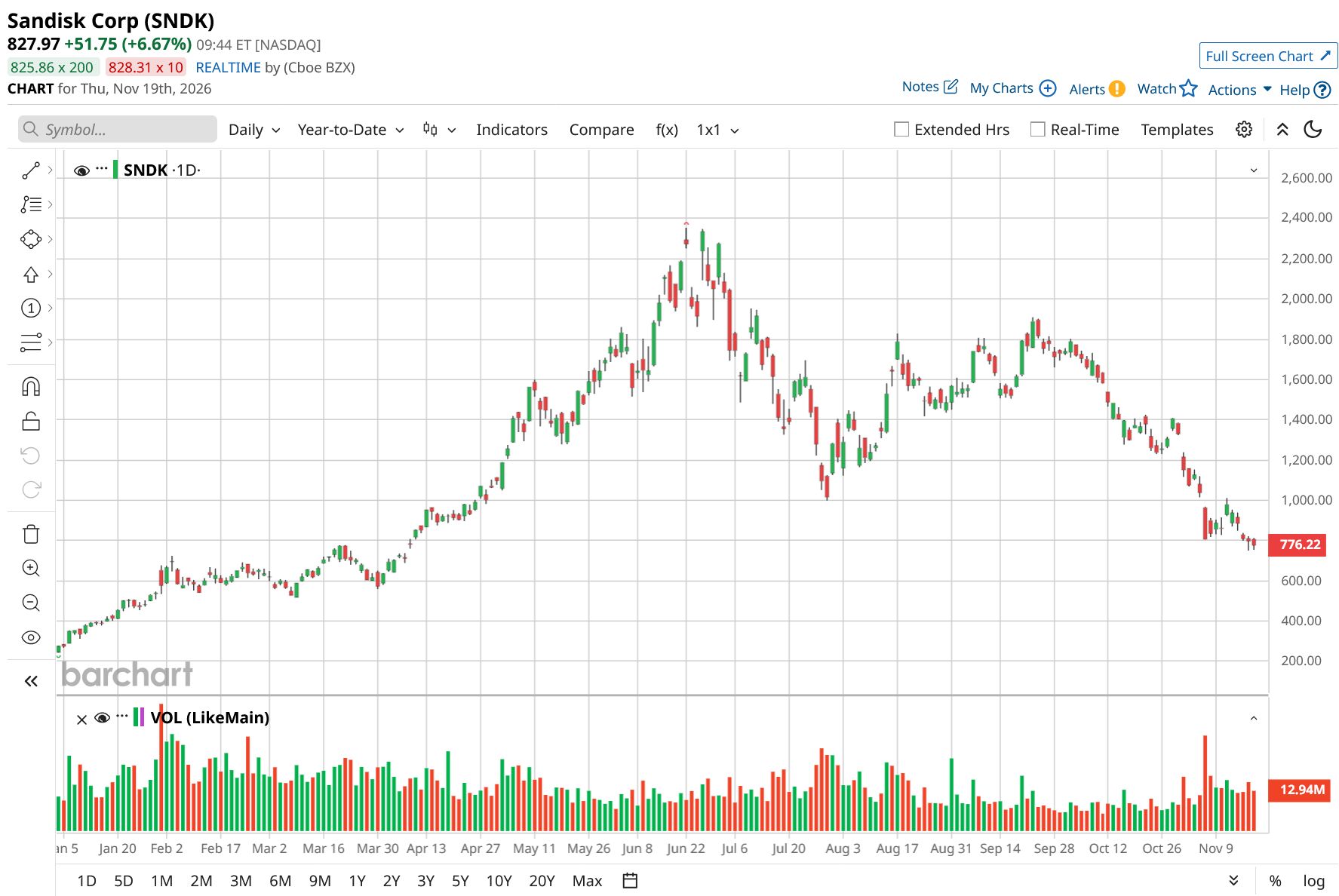
Shares of the memory supplier have soared 244% year-to-date (YTD), driven by booming demand for data storage. However, the stock has undergone a sharp correction since October, plunging from around $1,800 to below $850. The selloff came as concerns over the sustainability of AI spending mounted, fueled by expectations that U.S. interest rates would remain higher for longer and that a continued rise in memory prices could eventually weigh on demand. Capital spending updates from hyperscalers then added to the pressure. More recently, the Democrats’ sweeping victory in the U.S. midterm elections, Jensen Huang’s shock departure as Nvidia’s CEO, and new U.S. restrictions on China’s access to advanced AI chips further dampened investor sentiment.
 www.barchart.com
Sandisk’s 8-for-1 Stock Split: What Investors Need to Know
On Oct. 29, Sandisk announced an 8-for-1 forward stock split alongside its fiscal Q1 2027 results. That means Sandisk shareholders will end up owning more shares, though the split changes nothing from a fundamental standpoint.
Under the arrangement, shareholders will receive seven additional shares for each share they own as of the market close on Nov. 19, with SNDK set to begin trading on a split-adjusted basis when the Nasdaq opens on Friday, Nov. 20. For example, if the stock trades at $800 before the split, its post-split price would be $100, while an investor who owned one share would hold eight shares. With that, the market value of an investor’s SNDK holdings will remain unchanged after the split, with only the share price and number of shares changing.
Still, the lower share price could have some practical benefits. Sandisk itself noted that its shares had climbed significantly since its separation from Western Digital, making the split a way to improve accessibility. A lower share price could make the stock more approachable for retail investors and employees, particularly where fractional-share trading is unavailable or less convenient.
Under normal circumstances, the split would likely have provided a short-term boost to sentiment, but amid growing volatility in the AI trade, SNDK investors have much bigger questions to grapple with.
Record Gross Margins Raise Questions About the Memory Cycle
The main driver of explosive growth in Sandisk’s top and bottom lines is booming demand for high-capacity storage as AI infrastructure expands. AI applications require massive amounts of NAND flash storage to store datasets, model files, checkpoints, and information retrieved by AI systems. These rapidly improving fundamentals have been more than reflected in SNDK’s stock price, which has posted triple-digit gains so far this year.
However, the company’s surging profitability may have a downside, particularly given the boom-and-bust cycles that have historically defined the memory industry. As gross margins, among the most closely watched metrics for memory chipmakers, approach extreme levels, investors begin to question whether they are sustainable. That, in turn, raises the question of whether the cycle has reached its peak.
Sandisk reported a record non-GAAP gross margin of 85.1% in fiscal Q1. Meanwhile, management forecast a non-GAAP gross margin of 84.5% to 85.5% in fiscal Q2, with the 85% midpoint implying a slight sequential decline. Although the projected drop was just 10 basis points, it was enough to reignite concerns that the current memory cycle may be peaking.
Another important point is that Sandisk’s gross margins are driven primarily by market pricing and customer demand rather than fluctuations in manufacturing input costs. That means any slowdown in memory chip demand could put downward pressure on prices and squeeze the company’s gross margins, potentially signaling the start of a downturn in the industry’s cycle. This helps explain why SNDK stock has come under such intense pressure lately, weighed down by concerns about tighter AI regulation following the Democratic sweep, uncertainty over Nvidia’s role as the “AI central bank” after Huang’s downfall, and new U.S. restrictions on China’s access to advanced AI chips. All of these factors could ultimately weaken demand for memory chips.
To be sure, Sandisk executives have stressed that the NAND industry is undergoing a “structural shift,” with demand patterns “changing materially” from those seen in previous cycles. That argument has some backing, as management said on its latest earnings call that long-term agreements cover roughly 50% of fiscal 2027 bit supply and about two-thirds of fiscal 2028 bit supply. However, I believe that to meaningfully ease concerns about cyclicality, we would need to see at least 70% of supply locked in under long-term agreements for each of the next three years.
How to Play SNDK Stock After the Split
For existing shareholders, the stock split makes little difference. Their ownership stakes and the economic value of their holdings will remain the same. The more important question is whether Sandisk can sustain its exceptional margins in the face of mounting challenges.
For prospective investors, the lower post-split share price may make the stock feel more accessible, but it should not be mistaken for a cheaper valuation. And that same question is just as significant for anyone considering buying SNDK stock.
Still, I have to admit that the recent pullback makes the setup more interesting. Sandisk was recently trading within the $770–$800 support zone. We’ve already seen the importance of this zone, as the stock initially bounced from it to the $1,000 level. So far, it appears that the stock can hold this support and is already showing early signs of bullish momentum, at least during this morning's early trading. I believe the risk-reward could be favorable for initiating a new position or adding to an existing one to lower the average cost basis. And if the stock breaks below this zone, I would turn my attention to the $680–$700 area, applying the same logic.
On the date of publication, Oleksandr Pylypenko did not directly have a position in any of the securities mentioned in this article. All information and data in this article is solely for informational purposes. For more information please view the Barchart Disclosure Policy here.
More news from Barchart
How to Play SNDK Stock After Sandisk’s 8-for-1 Stock Split Why It’s Time to Buy the Pullback in Qualcomm Stock Ahead of Bending Spoons Earnings, Here's What Barchart Data Says Comes Next for BSP Stock Anthropic's $1.5 Trillion IPO Turns Ashton Kutcher's Fund Into a $7 Billion Winner — But Not Kutcher Himself