

Shares of Advanced Micro Devices (AMD) recently rallied on Nvidia's (NVDA) China scandal, but now AMD stock is crashing due to a similar issue. On Nov. 19, short seller Hunterbrook Capital announced it was short AMD stock while releasing a report titled “AMD Has Its Own China Problem.”
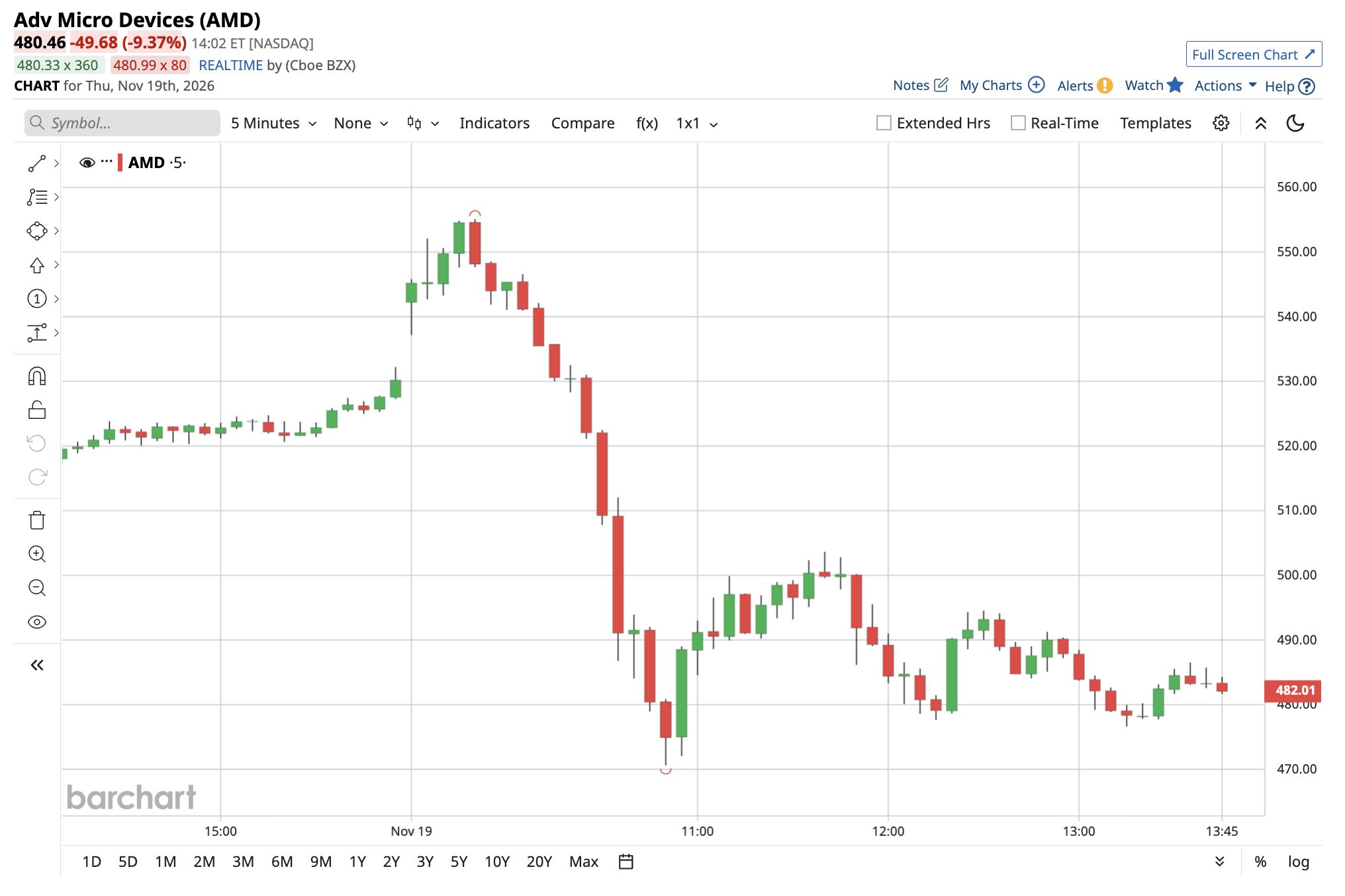
The report alleges that AMD has business ties to Chinese companies that are blacklisted by the United States. Shares of AMD stock slid 8% on Nov. 19 and 13% on Nov. 20. When Nvidia's China scandal came to light, AMD was one of the biggest winners, and I wrote at the time that the company could pull customers away from Nvidia. Just over a week later, however, AMD is the one answering questions about China.
More Top Stocks Daily: Go behind Wall Street’s hottest headlines with Barchart’s Active Investor newsletter.
One of Hunterbrook's main claims is that a Chinese server maker called IEIT Systems kept adding updated AMD firmware to its servers after being placed on the U.S. Commerce Department's Entity List. Firmware is basically the built-in software that makes chips and servers run. The report doesn't say how IEIT got the firmware or whether AMD was involved. Hunterbrook also claims that AMD reported licensing income traceable to two other Chinese chip ventures that were blacklisted back in 2019.
These allegations aren't proven yet, but they seem to be enough to make some investors turn on AMD stock. Let's take a closer look.
How Much AMD Depends on China
Investors are mainly worried about the size of Advanced Micro Devices' China exposure. AMD reportedly bills more than 20% of its revenue to customers in China and Hong Kong. So, if regulators decide to take a closer look at AMD or tighten rules further, a big chunk of the company's sales could be at risk.
China also plays a major role in how AMD's chips get made. According to Hunterbrook, most of the assembly, testing, and packaging is done by two ventures that are 85% owned by a Chinese company called Tongfu Microelectronics. If relations between the U.S. and China worsen, AMD's production could take a hit.
Just days before the short report, the U.S. made it harder to ship artificial intelligence (AI) chips to Indonesia, Malaysia, Singapore, Thailand, and Brazil. The U.S. is worried that Chinese firms can still use these chips by renting computing power from data centers in those countries. The new rules came shortly after reports of the Megaspeed investigation, wherein the Singapore-based cloud company is accused of helping Nvidia chips reach China. Former Megaspeed executive and alleged Chinese spy Alice Huang is also at the center of the scandal that cost Jensen Huang his job as Nvidia's CEO.
Although I understand investors' concerns, I believe things may not be as bad as they look. Short sellers profit from a falling stock, so their reports are written to push it lower. AMD also hasn't publicly responded to the claims yet, so there may be more to the story. The company's business is still booming, with the latest quarter showing revenue growth of 45% and record data-center sales, as well as big deals with OpenAI, Meta Platforms (META), and Anthropic (ANT).
About AMD Stock
AMD is a chipmaker that designs processors for PCs, servers, and AI data centers. Its products include Instinct GPUs, EPYC server processors, Ryzen PC chips, and its Helios AI server racks. Founded in 1969, Advanced Micro Devices is headquartered in Santa Clara, California.
AMD stock is up about 98% this year, well ahead of the VanEck Semiconductor ETF's (SMH) 11% gain on a year-to-date (YTD) basis. Most of that rally has come from the firm's big AI deals with OpenAI, Meta, and Anthropic, along with fast-growing data-center sales.
However, the stock has had a rough past few days. Shares fell after the U.S. announced new export rules on Nov. 16, then dropped about 8% on Nov. 19 after Hunterbrook's short report. The fresh export rules also took effect on the same day.
 www.barchart.com
AMD stock is expensive compared to its historical average. The forward price-to-earnings (P/E) ratio of 70.6 times is well above the five-year average of roughly 40 times. Meanwhile, its price-to-sales (P/S) ratio of 23.1 times also sits above its five-year average.
The EPS outlook explains why investors are willing to pay up. Analysts expect earnings to more than double this fiscal year before climbing 131% in fiscal 2027. The balance sheet is also strong, with AMD holding $15.8 billion in cash against roughly $9.2 billion in debt. So, there are factors to justify the premium, but AMD stock is nearly priced for perfection. If Hunterbrook's China claims lead to an investigation or tighter rules, growth could take a hit, and the stock has a lot further to fall from current levels.
What Do Analysts Expect for AMD Stock?
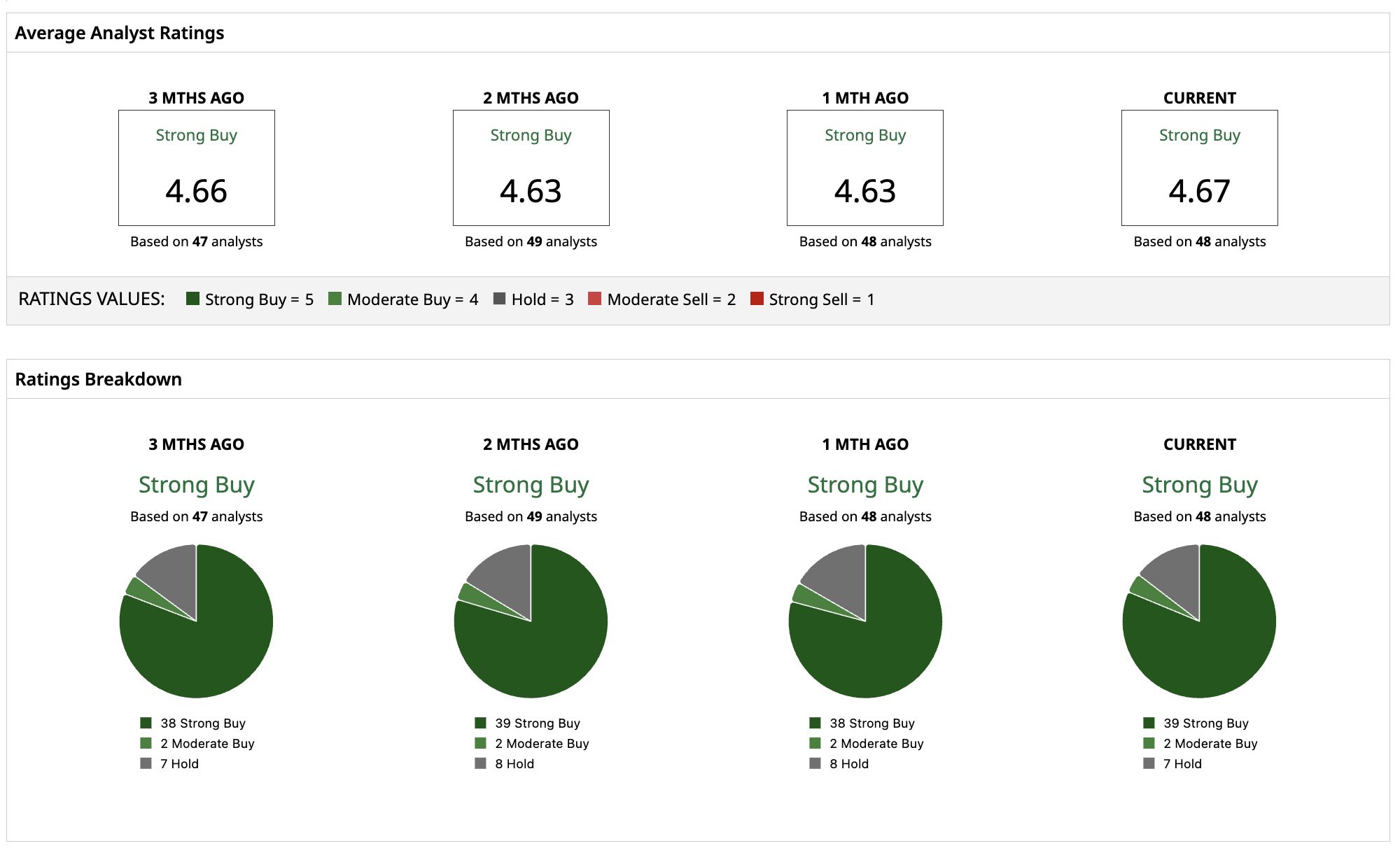
Based on 48 Wall Street analysts with coverage, AMD stock holds a consensus “Strong Buy” rating with a mean price target of $661.82 indicating potential upside of 56% from current levels. Some analyst price targets could be updated following the short report, though, so the actual potential upside may not be as high as it looks right now.
 www.barchart.com
On the date of publication, Jabran Kundi did not directly have a position in any of the securities mentioned in this article. All information and data in this article is solely for informational purposes. For more information please view the Barchart Disclosure Policy here.
More news from Barchart
AMD Gained From Nvidia’s China Scandal. Now a Short Seller Says AMD Has a China Problem Too. Leadership Risk vs. Record Numbers: Nvidia Posted $115 Billion in Revenue in Its First Report Without Jensen Huang. What It Means for NVDA Stock. Tech and AI Sentiment, Thanksgiving and Other Key Things to Watch this Week 2 Energy Stocks Bridgewater Associates Is Buying Right Now