


Globalstar, Inc. GSAT is advancing the development of its low Earth orbit (LEO) satellite network through the deployment of its HIBLEO-4 satellite replenishment mission. In May 2026, the company announced plans to launch the HIBLEO-4 replenishment satellites aboard a SpaceX Falcon 9 rocket as part of its ongoing efforts to maintain and enhance its current-generation satellite constellation. The mission is designed to replenish Globalstar’s existing LEO network and support the continued delivery of satellite communications services worldwide.
The HIBLEO-4 satellites are intended to strengthen the resilience and reliability of Globalstar’s satellite infrastructure. By replenishing the existing constellation, the company aims to ensure the continued performance of its network and maintain dependable connectivity across its range of satellite communication services. Management highlighted that the launch is an important step in sustaining the infrastructure that customers rely on daily and emphasized that constellation replenishment remains a key component of the company’s long-term strategy.
The mission forms part of Globalstar’s broader investment in satellite network development. Alongside the HIBLEO-4 replenishment effort, the company continues to advance its overall constellation roadmap. Globalstar expects replacement satellites for its second-generation constellation to be launched in 2026 while also progressing development of its third-generation, or C-3, constellation. The planned C-3 network, consisting of more than 50 satellites, is designed to expand network capacity, improve service durability and support growing demand across direct-to-device, Internet of Things (IoT), enterprise, government and defense applications.
Globalstar stated that the HIBLEO-4 mission is focused on reinforcing the company’s current-generation LEO constellation to support ongoing network resilience and service reliability. Although the launch originally scheduled for May 17, 2026, was postponed to provide additional preparation time for the satellites, the company stated that the mission’s objective remains unchanged. Through continued investment in replenishment satellites and next-generation network development, Globalstar is working to maintain reliable global connectivity across its satellite communications ecosystem.
Taking a Look at Globalstar’s Competitors
AST SpaceMobile, Inc. ASTS expands its BlueBird satellite constellation through new deployments and production efforts to support direct-to-smartphone connectivity and broader global coverage. Management is developing AI edge computing and spectrum management features intended for integration into next-generation BlueBird satellites in production by year-end. The company is expected to benefit from the recent collaborations with AT&T, Verizon and T-Mobile US, which focus on satellite-based mobile connectivity. Strong liquidity supports satellite deployment, technology investment and early commercialization plans.
Iridium Communications’ IRDM is gaining from momentum across its recurring service revenue model, rising IoT subscribers and government deals. Its new TriMode 9604 module, set for a June launch, combines satellite IoT, cellular IoT and GPS in a compact, low-cost solution that is driving strong partner interest while streamlining legacy services and reducing long-term sustainment costs. Engineering and support revenue are gaining from rapid SDA work and national security demand. For 2026, service revenue is expected to be flat to up 2%, reflecting continued IoT growth offset by moderation elsewhere, following 2025 service revenue of $634 million.
GSAT Price Performance, Valuation and Estimates
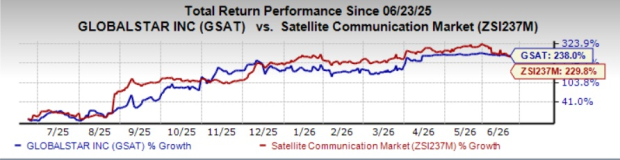
Shares of Globalstar have gained 238% in a year compared with the Zacks Satellite and Communication industry’s growth of 229.8%.
Image Source: Zacks Investment Research
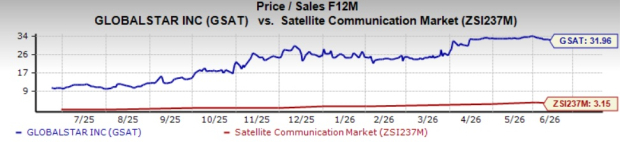
From a valuation standpoint, GSAT trades at a forward 12-month price-to-sales (P/S) of 31.96X, higher than the industry’s 3.15X.
Image Source: Zacks Investment Research
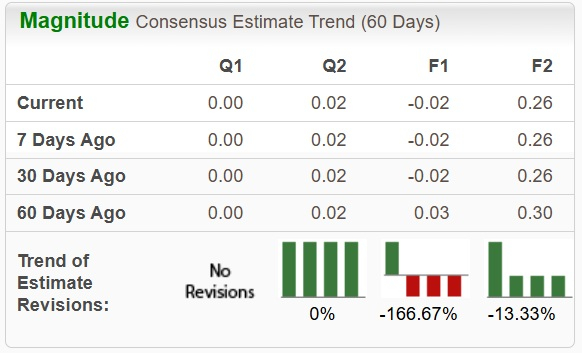
The Zacks Consensus Estimate for GSAT’s earnings for 2026 has been revised significantly downward over the past 60 days.
Image Source: Zacks Investment Research
Globalstar currently carries a Zacks Rank #5 (Strong Sell).
You can see the complete list of today’s Zacks #1 Rank (Strong Buy) stocks here.
Radical New Technology Could Hand Investors Huge Gains
Quantum Computing is the next technological revolution, and it could be even more advanced than AI.
While some believed the technology was years away, it is already present and moving fast. Large hyperscalers, such as Microsoft, Google, Amazon, Oracle, and even Meta and Tesla, are scrambling to integrate quantum computing into their infrastructure.
Senior Stock Strategist Kevin Cook reveals 7 carefully selected stocks poised to dominate the quantum computing landscape in his report, Beyond AI: The Quantum Leap in Computing Power .
Kevin was among the early experts who recognized NVIDIA's enormous potential back in 2016. Now, he has keyed in on what could be "the next big thing" in quantum computing supremacy. Today, you have a rare chance to position your portfolio at the forefront of this opportunity.
See Top Quantum Stocks Now >>Want the latest recommendations from Zacks Investment Research? Today, you can download 7 Best Stocks for the Next 30 Days. Click to get this free report
Iridium Communications Inc (IRDM): Free Stock Analysis Report
Globalstar, Inc. (GSAT): Free Stock Analysis Report
AST SpaceMobile, Inc. (ASTS): Free Stock Analysis Report
This article originally published on Zacks Investment Research (zacks.com).