


Novo Nordisk NVO and Eli Lilly LLY lead the diabetes and obesity market, driven by their blockbuster GLP-1 therapies. Lilly sells its dual GIP/GLP-1 agonist tirzepatide as Mounjaro for type II diabetes and as Zepbound for obesity. Novo Nordisk markets semaglutide as Ozempic and Rybelsus for type II diabetes, and as Wegovy for weight management.
In the first quarter of 2026, Eli Lilly's Cardiometabolic Health business, led by blockbuster drugs Mounjaro and Zepbound, generated approximately $15.8 billion in revenues. During the same period, Novo Nordisk's Diabetes and Obesity Care segment reported sales of DKK 91.4 billion (approximately $14.2 billion) in the quarter. Cardiometabolic therapies accounted for roughly 80% of Lilly's total first-quarter revenues of $19.8 billion, while Novo Nordisk remained significantly more dependent on this business, with its Diabetes and Obesity segment contributing about 94% of total first-quarter sales.
So, which stock looks more attractive now? A closer review of their financial strength, pipeline depth, competitive positioning and valuation can help investors decide.
The Case for Lilly Stock
Lilly's biggest strength is its dominance in the rapidly expanding obesity and diabetes markets. Its blockbuster drugs, Mounjaro and Zepbound, have become some of the fastest-growing medicines in pharmaceutical history, gaining from enormous global demand for GLP-1 therapies. These therapies account for more than 60% of the company’s total revenues, with sales expected to remain strong throughout 2026.
In addition to Mounjaro and Zepbound, Lilly has secured approvals for several other new therapies over the past few years. These include Omvoh, Jaypirca, Ebglyss and Kisunla. These newly approved drugs are also contributing to Lilly’s revenue growth.
To maintain leadership in the GLP-1 market, Lilly is developing several next-generation, more powerful and more convenient GLP-1–based treatments, including oral options and multi-acting candidates.
Foundayo, approved in April in the United States, offers the benefits of GLP-1 therapy in a pill form. Early launch data for Foundayo has been encouraging, and insurance coverage for the pill is expanding rapidly through major pharmacy benefit managers. It can prove to be a commercial game-changer for Lilly. Lilly expects to launch Foundayo in most international markets during 2027.
Oral pills will be a more convenient alternative to the currently available once-weekly injectable obesity treatments like Zepbound and Wegovy. Novo Nordisk had gained approval for an oral version of its obesity drug, Wegovy, in December 2025 and launched the pill in January 2026, which gave it a first-mover advantage over Foundayo. However, Lilly may be able to close the gap quickly now that it has launched Foundayo.
Lilly is evaluating Foundayo in six phase III studies for other diabetes and obesity-related diseases. For the type II diabetes indication, Lilly has filed regulatory applications in several countries.
In its GLP pipeline, retatrutide is one of Lilly’s most important late-stage candidates, as it targets three biological pathways — GLP-1, GIP and glucagon — potentially offering greater weight-loss and metabolic benefits than existing medicines, which mostly act on one or two biological pathways. The candidate has demonstrated approximately 28% weight loss in late-stage studies. Lilly plans to seek approval for retatrutide for obesity and knee osteoarthritis pain in 2026. If approved, retatrutide could become another multibillion-dollar product.
Lilly has also embarked on an aggressive M&A spree in 2026, acquiring and partnering with biotech companies across oncology, neuroscience, cardiovascular disease, gene editing and vaccines to diversify its long-term growth drivers beyond GLP-1 therapies. The company has announced more than $20 billion in biotech deals this year. In its most recent deal, Lilly announced a definitive agreement to acquire New York-based clinical-stage biotech AtaiBeckley ATAI for $2.8B upfront to strengthen its neuroscience pipeline.
Lilly has its share of problems. Prices of most of Lilly’s products are declining in the United States. Price is expected to continue to be a drag on top-line growth in the low to mid-teens percentage in 2026. Rising competition in the GLP-1 diabetes/obesity market is a key headwind. Also, sales of late-life cycle products like Trulicity, Taltz and Verzenio are expected to be flat to down in 2026.
The Case for NVO Stock
Like Lilly, Novo Nordisk has also seen explosive success of its GLP-1 medicines, Wegovy for obesity and Ozempic and Rybelsus for type II diabetes.
At the same time, semaglutide-based medicines continue to demonstrate benefits beyond blood sugar control and weight loss, including reducing cardiovascular risk, improving kidney disease outcomes and treating conditions such as sleep apnea. These additional indications could significantly expand the addressable market for Novo Nordisk's therapies over time.
In late December, the FDA approved NVO’s 25 mg oral semaglutide (Wegovy pill) for obesity and CV disease, which was subsequently launched in early January. Since launch, the pill has already surpassed three million prescriptions, suggesting solid traction. Wegovy pill was approved in the EU last week, which should further boost sales in the upcoming quarters.
In the first quarter of 2026, total Obesity care sales increased 27% year over year, primarily driven by higher Wegovy injection sales as well as incremental sales of the newly approved Wegovy pill.
Beyond its existing products, Novo Nordisk continues to invest heavily in next-generation obesity and metabolic disease therapies. The most advanced candidate in Novo Nordisk’s pipeline is CagriSema injection, a fixed-dose combination of a long-acting amylin analog, cagrilintide, and semaglutide. The company filed a new drug application with the FDA in December 2025 for CagriSema to treat obesity. A decision is expected in the fourth quarter. Another key candidate for type II diabetes and obesity is zenagamtide (formerly known as amycretin), a novel long-acting GLP-1 and amylin receptor agonist, in phase III.
However, after years of exceptional stock performance, shares have come under pressure due to intensifying competition and concerns over the company's next-generation pipeline.
The biggest challenge facing Novo Nordisk is the rapid rise of Lilly in the obesity market. Lilly's Mounjaro and Zepbound have demonstrated superior weight-loss efficacy in clinical studies, allowing the company to steadily gain market share. Investor confidence has also been shaken by disappointing clinical results from some of NVO's next-generation obesity programs.
Novo Nordisk's 2026 outlook is also weak, with the company expecting a decline in adjusted sales and operating profit. Pricing pressure in the United States, weaker prescription trends for injectable GLP-1 drugs, reduced Medicaid obesity coverage and intensifying competition continue to create significant operational and executional hurdles.
While Lilly remains the primary competitor, several other pharmaceutical companies are also developing next-generation obesity treatments. Companies including Amgen, Roche, AstraZeneca, Viking Therapeutics, Structure Therapeutics and others are advancing oral therapies, combination drugs and novel mechanisms that could further intensify competition over the next several years.
How Do Estimates Compare for LLY & NVO?
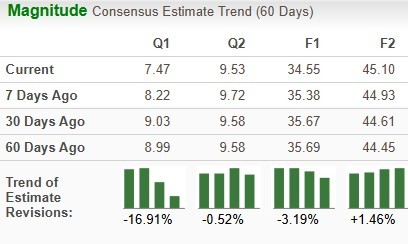
The Zacks Consensus Estimate for LLY’s 2026 sales and EPS implies a year-over-year increase of 31.6% and 42.7%, respectively. The Zacks Consensus Estimate for 2026 has declined from $35.69 to $34.55 per share over the past 60 days due to costs related to its various acquisitions, while that for 2027 has risen from $44.45 to $45.10 per share over the same timeframe.
LLY Estimate Movement
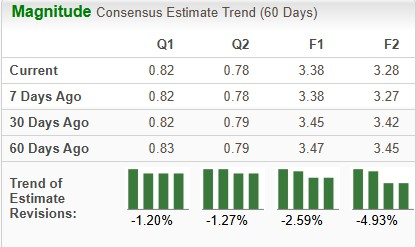
The Zacks Consensus Estimate for Novo Nordisk’s 2026 sales and EPS suggests a year-over-year decrease of 4.8% and 14.7%, respectively. EPS estimates for 2026 have declined from $3.47 to $3.38 over the past 60 days, while those for 2027 have declined from $3.45 to $3.28.
NVO Estimate Movement
Price Performance and Valuation of NVO & LLY
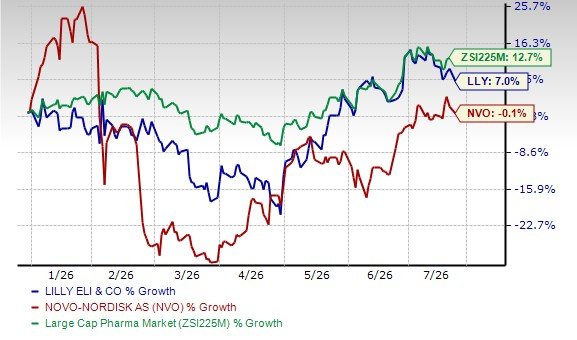
So far this year, while LLY’s stock has risen 7.0%, Novo Nordisk’s stock has declined 0.1%. The industry has risen 12.7% in the said time frame.
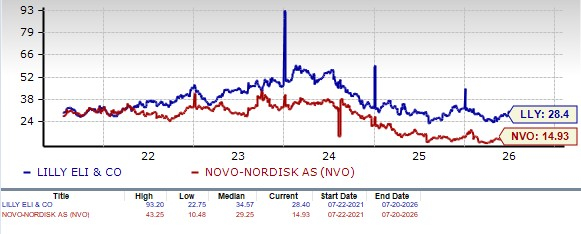
Lilly is more expensive than Novo Nordisk, going by the price/earnings ratio. LLY’s shares currently trade at 28.40 forward earnings, higher than 14.93 for NVO. LLY’s stock is also priced higher than the industry’s 18.88, while NVO trades below the same. LLY trades above its 5-year mean, while NVO trades below the same.
Lilly’s dividend yield is 0.6%, while NVO’s is much higher at around 3.5%.
LLY or NVO: Which is a Better Pick?
Lilly has a Zacks Rank #3 (Hold), while Novo Nordisk has a Zacks Rank #5 (Strong Sell), which clearly shows that Lilly is the winner.
You can see the complete list of today’s Zacks #1 Rank (Strong Buy) stocks here.
Softer prescription rates for injectable GLP-1s, intensifying competition, pricing pressure, rising costs and pipeline setbacks have resulted in NVO’s stock declining 23.3% in the past year.
In sharp contrast, Lilly’s bullish run does not seem to stop as its stock has risen 48.8% in the past year. Lilly remains one of the most compelling growth stories in the pharmaceutical industry, supported by its significant price appreciation, dominant position in the rapidly expanding obesity and diabetes markets, a diversified late-stage pipeline and strong financial performance.
Lilly is now the world's largest pharmaceutical company, with a market capitalization exceeding $1 trillion. It is also the only drugmaker whose shares trade above $1,000, gradually approaching the $1,200 mark. Overall, Lilly stands out as the stronger investment case compared with Novo Nordisk.
Zacks' Research Chief Names "Stock Most Likely to Double"
Our team of experts has just released the 5 stocks with the greatest probability of gaining +100% or more in the coming months. Of those 5, Director of Research Sheraz Mian highlights the one stock set to climb highest.
This top pick is a little-known satellite-based communications firm. Space is projected to become a trillion dollar industry, and this company's customer base is growing fast. Analysts have forecasted a major revenue breakout in 2025. Of course, all our elite picks aren't winners but this one could far surpass earlier Zacks' Stocks Set to Double like Hims & Hers Health, which shot up +209%.
Free: See Our Top Stock And 4 Runners UpWant the latest recommendations from Zacks Investment Research? Today, you can download 7 Best Stocks for the Next 30 Days. Click to get this free report
Novo Nordisk A/S (NVO): Free Stock Analysis Report
Eli Lilly and Company (LLY): Free Stock Analysis Report
AtaiBeckley Inc (ATAI): Free Stock Analysis Report
This article originally published on Zacks Investment Research (zacks.com).