


Shares of Bank of the James Financial Group, Inc. BOTJ have declined 2.7% since reporting second-quarter 2026 results, underperforming the S&P 500 index’s return of 2.6%. Despite the post-earnings weakness, the stock has performed well over the past month, rising 6.3% against the S&P 500’s 1% decline, indicating that investors have been constructive on the company’s broader operating momentum.
Bank of the James reported second-quarter 2026 net income of $3.24 million, up 19.8% from $2.70 million in the year-ago quarter. Earnings per share increased to 71 cents from 60 cents, reflecting stronger profitability.
Net interest income rose 12.2% year over year to $9.25 million, while net interest income after the provision for credit losses increased 1.4% to $8.90 million due to a higher credit-loss provision than a year earlier. Total interest income increased 5.6% to $12.29 million, while interest expenses declined 10.5% to $3.03 million. Non-interest income rose 9.8% to $4.48 million, supported by stronger fee-based businesses, while non-interest expenses declined 1.5% to $9.31 million, contributing to improved operating leverage.
Bank of the James Financial Group, Inc. Price, Consensus and EPS Surprise
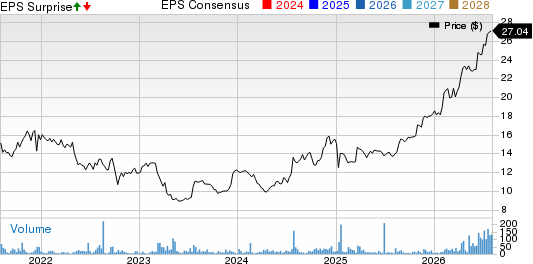
Bank of the James Financial Group, Inc. price-consensus-eps-surprise-chart | Bank of the James Financial Group, Inc. Quote
Balance Sheet & Operating Metrics
Bank of the James ended the quarter with total assets of $1.04 billion, up from $1 billion a year earlier. Net loans increased to $686.1 million from $649.1 million at June 30, 2025, while total deposits grew to $935.2 million from $910.5 million. Stockholders' equity rose to $83.2 million from $71.7 million a year ago, lifting book value per share to $18.30 from $15.77.
Asset quality remained solid. Non-performing loans declined to $1.09 million from $1.85 million a year earlier, reducing the ratio of non-performing loans to total loans to 0.16% from 0.28%. The allowance for credit losses totaled $6.60 million, providing coverage of more than six times non-performing loans. Meanwhile, the tax-equivalent net interest margin expanded to 3.71% from 3.45%, reflecting lower funding costs and improved asset yields. The efficiency ratio improved to 67.82% from 76.71%, indicating better expense control relative to revenue generation.
Revenue Drivers & Expense Trends
The company's revenue improvement was supported by multiple business lines. Wealth management fees generated through Pettyjohn, Wood & White increased 12.8% year over year to $1.47 million. Service charges, fees and commissions also increased, while gains from loan sales remained relatively stable. Management noted that lower deposit costs and the retirement of approximately $10 million in capital notes during the second quarter of 2025 helped reduce interest expenses, contributing to margin expansion. Lower rates on renewed certificates of deposit and disciplined pricing of interest-bearing transaction accounts also supported funding costs.
On the expense side, professional services and data processing costs declined, offsetting modest increases in salaries, employee benefits and occupancy-related expenses. Overall, non-interest expenses decreased despite continued investment in operations, helping improve profitability.
Management Commentary
Chief executive officer Robert R. Chapman III described the first half of 2026 as producing record results for Bank of the James. He attributed the performance to loan growth, diversified revenue generation and continued strong asset quality while emphasizing the bank's commitment to serving individuals and businesses across its markets, including underserved communities.
President Mike Syrek highlighted continued efforts to improve operating efficiency through disciplined expense management and operational enhancements. He said that these initiatives contributed to the stronger efficiency ratio and management continues to identify opportunities to operate more effectively while supporting long-term growth.
Syrek also pointed to robust loan growth during the second quarter, with loan balances increasing nearly $37 million. However, he cautioned that such growth is unlikely to be sustained every quarter because lending activity naturally fluctuates with originations, repayments and maturities. He added that management remains focused on originating attractive loans while maintaining disciplined underwriting standards, which has also supported improved asset quality.
Other Developments
Bank of the James' board of directors approved a quarterly cash dividend of 10 cents per common share on July 28, 2026. The dividend will be paid out on Sept. 4, 2026, to shareholders of record as of Aug. 21, 2026.
Management stated that it intends to build on the strong first-half performance while continuing to pursue lending opportunities and maintain disciplined underwriting and expense management. It also noted that quarterly loan growth is expected to vary, based on market activity and customer demand rather than continue at the exceptionally strong second-quarter pace.
Beyond Nvidia: AI's Second Wave Is Here
The AI revolution has already minted millionaires. But the stocks everyone knows about aren't likely to keep delivering the biggest profits. AI’s second wave is moving from infrastructure to implementation and these companies are at the forefront of this transition, positioned to become what Amazon and Google were to the internet era.
See Stocks Now >>Want the latest recommendations from Zacks Investment Research? Today, you can download 7 Best Stocks for the Next 30 Days. Click to get this free report
Bank of the James Financial Group, Inc. (BOTJ): Free Stock Analysis Report
This article originally published on Zacks Investment Research (zacks.com).