


Bank of America BAC has increasingly been using artificial intelligence (AI), digital adoption and branch optimization to improve operating leverage. With more than 69 million consumer and small-business clients, nearly 50 million active digital users, and 3,500 financial centers, BAC has the scale to shift routine servicing to lower-cost digital channels while using branches for higher-value advisory and relationship banking.
AI is central to this strategy. Erica, BAC’s AI-powered virtual assistant, has surpassed 3.2 billion client interactions, while generative AI-enabled EricaAssist supports more than 18,000 customer-service representatives. Greater automation across servicing and internal processes could reduce manual workloads, improve productivity and support stronger pretax margins.
Recent results already point to better operating leverage. In the second quarter of 2026, the company’s revenues rose 15% year over year to $31.6 billion, while non-interest expenses increased 8% to $18.6 billion. The efficiency ratio improved to 59.02% from 62.61%, net income climbed 27% and the return on average tangible common equity increased to 17.03% from 13.61%.
BAC is complementing its digital push with targeted branch expansion. It plans to open more than 150 financial centers across 60 markets by the end of 2027, while optimizing its existing footprint. This “phygital” strategy could support deposit growth, deepen client relationships and expand cross-selling opportunities without significantly increasing fixed costs. Its proposed investment of up to 49.9% in Jio Credit also provides exposure to India’s growing digital lending market.
Thus, investors may be tempted to buy the BAC stock to capitalize on improving operating leverage, AI-led productivity gains and branch optimization. However, the sustainability of these benefits will depend on BAC’s ability to convert technology investments into durable expense efficiencies, revenue growth and healthy returns on capital. Therefore, investors should assess the bank’s fundamentals and growth outlook before determining whether the stock offers meaningful upside.
Bank of America’s Key Fundamental Strengths
Robust Top-Line Growth: Bank of America has maintained a solid revenue growth trajectory over the past several years, supported by expanding loan balances, higher net interest income (NII) and steady growth in fee-based revenues.
The company’s net loans and leases saw a compound annual growth rate (CAGR) of 5.2% from 2020 to 2025. Aided by this loan growth and favorable balance-sheet positioning, NII witnessed a 6.7% CAGR over the same period despite declines in interest rates in 2024 and 2025.
Meanwhile, non-interest income saw a CAGR of 4.7%, helping total revenues see a 5.7% CAGR. The upward momentum in revenues continued in the first half of 2026.
Revenue Trend
Image Source: Zacks Investment Research
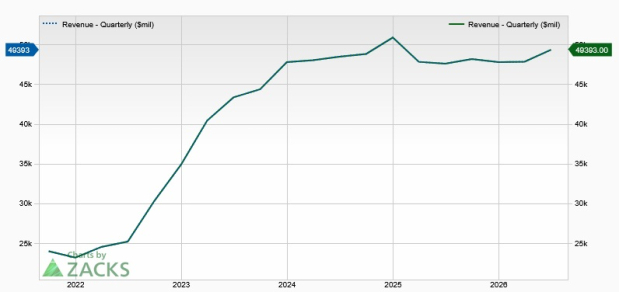
Looking ahead, BAC’s top-line growth prospects remain favorable. An elevated interest-rate environment, continued loan growth and the repricing of fixed-rate assets are expected to keep supporting NII in the near term. Management expects 2026 NII on an FTE basis to grow toward the upper end of 6-8%. Continued growth in fee-generating businesses should provide an additional revenue tailwind.
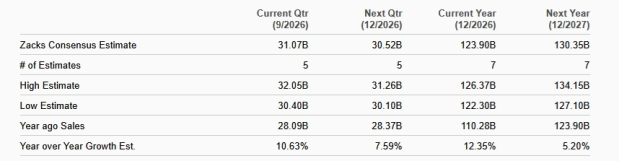
Reflecting these trends, the Zacks Consensus Estimate for BAC’s revenues is pegged at $123.9 billion for 2026 and $130.4 billion for 2027, implying year-over-year growth of 12.4% and 5.2%, respectively.
Revenue Growth Estimates
Image Source: Zacks Investment Research
Strong Recovery in Investment Banking (IB) Business: Bank of America’s IB business has regained strong momentum following the industry-wide slowdown in global deal-making during 2022-2023.
After IB fees declined 45.7% in 2022 and 2.4% in 2023, the franchise rebounded with 31.4% growth in 2024 and an 8.4% increase in 2025. The recovery accelerated in the first half of 2026, with IB fees rising 36.4% year over year, driven by a 61% surge in advisory revenues, a 52.8% increase in equity underwriting fees and a 10.9% rise in debt underwriting income.
With corporate confidence improving, capital markets reopening and Bank of America maintaining a robust investment banking pipeline, the company is well-positioned to sustain fee income growth and further diversify earnings beyond its traditional lending business.
Industry-Leading Deposit Franchise: Bank of America benefits from a large and well-diversified deposit base, which provides a stable and relatively low-cost source of funding. As of June 30, 2026, total deposits stood at $2.03 trillion, up 1% year over year.
These deposits are spread across consumer, wealth management and commercial banking clients, reducing reliance on any single funding source. The strength of this deposit franchise helps BAC keep funding costs under control, supports loan growth and provides stability to NII, particularly during periods of market or interest-rate volatility.
Strong Liquidity & Funding Profile: Despite carrying $732.1 billion of total debt as of June 30, 2026, Bank of America maintains a robust liquidity position, supported by $229.7 billion in cash and cash equivalents, one of the industry’s strongest deposit franchises and diversified funding sources. The bank also maintains substantial liquidity reserves well above regulatory requirements, providing financial flexibility across economic cycles.
Reinforcing its balance sheet strength, Bank of America continues to hold high investment-grade long-term credit ratings of A1 (Moody’s), A- (S&P Global Ratings) and AA- (Fitch Ratings), all with stable outlooks. These ratings ensure reliable access to capital markets at competitive funding costs, enabling the bank to meet its obligations and support business growth even during periods of market stress.
Robust Capital Returns Strategy: Bank of America continues to demonstrate its commitment to enhancing shareholder returns through consistent dividend growth and share repurchases. Following its successful performance in the 2026 Federal Reserve stress test, the bank increased its quarterly dividend 14.3% to 32 cents per share, marking its sixth consecutive annual dividend hike.
The company has also maintained an active capital return program, with $17 billion remaining under its $40-billion share repurchase authorization as of June 30, 2026. Supported by strong capital ratios, resilient earnings and excess capital generation, Bank of America is well-positioned to sustain attractive shareholder distributions while continuing to invest in long-term growth initiatives.
Analyzing Bank of America’s Price Performance & Valuation
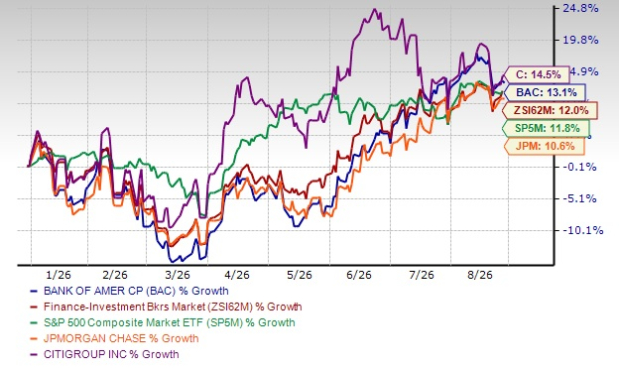
So far this year, shares of Bank of America have gained 13.1%, outperforming the S&P 500 Index’s 11.8% rally and the industry’s 12% growth.
If we look at BAC’s two key peers, JPMorgan JPM and Citigroup C, it appears that while BAC has outperformed JPM year to date, it has underperformed Citigroup.
Shares of JPMorgan have gained 10.6%, whereas the Citigroup stock has appreciated 14.5%.
YTD Price Performance
Image Source: Zacks Investment Research
Looking at Bank of America’s valuation, the stock is currently trading at a 12-month forward price-to-earnings (P/E) of 12.28X, which is below the industry’s 14.08X. This shows that BAC is currently trading at a discount relative to the industry average.
P/E (F12M) Ratio
Image Source: Zacks Investment Research
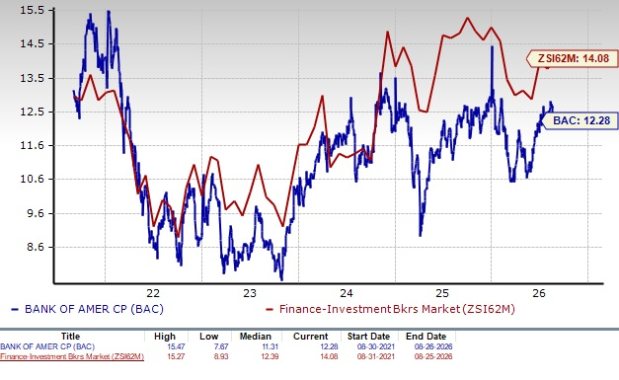
JPMorgan has a P/E (F12M) of 14.27X, while Citigroup’s ratio is 10.82X. Thus, currently, BAC is overvalued compared with Citigroup but undervalued compared with JPMorgan.
Final Verdict on Bank of America
BAC’s long-term investment case remains supported by its growing use of AI, extensive customer data and a strategy that combines digital efficiency with selective branch expansion. It also benefits from one of the largest and relatively low-cost deposit franchises in the U.S. banking industry. This stable funding base, together with loan growth, fixed-rate asset repricing and improving NII, should continue to support revenues and profitability.
The earnings outlook is also encouraging. Over the past 30 days, the Zacks Consensus Estimate for BAC’s 2026 and 2027 earnings has moved higher. The estimates imply year-over-year earnings growth of 22.8% for 2026 and 12.6% for 2027.
Earnings Estimate Revision
Image Source: Zacks Investment Research

Nonetheless, expense growth remains a key concern. BAC’s non-interest expenses saw a CAGR of 4.1% from 2019 to 2025, and costs are expected to remain elevated in the near term as the company continues investing in technology, people and its distribution network. Persistent expense pressure could limit the pace of margin expansion and partially offset the benefits of higher revenues and AI-driven productivity gains.
Therefore, despite solid revenue prospects, an improving earnings outlook and favorable long-term benefits from AI and branch optimization, the near-term risk-reward does not appear compelling enough to warrant fresh investment in BAC stock.
Existing shareholders, however, may consider retaining the stock, given the bank’s long-term efficiency potential. Bank of America currently carries a Zacks Rank #3 (Hold). You can see the complete list of today’s Zacks #1 Rank (Strong Buy) stocks here.
7 Best Stocks for the Next 30 Days
Just released: Experts distill 7 elite stocks from the current list of 220 Zacks Rank #1 Strong Buys. They deem these tickers "Most Likely for Early Price Pops."
Since 1988, the full list has beaten the market more than 2X over with an average gain of +23.9% per year. So be sure to give these hand picked 7 your immediate attention.
See them now >>Want the latest recommendations from Zacks Investment Research? Today, you can download 7 Best Stocks for the Next 30 Days. Click to get this free report
Bank of America Corporation (BAC): Free Stock Analysis Report
JPMorgan Chase & Co. (JPM): Free Stock Analysis Report
Citigroup Inc. (C): Free Stock Analysis Report
This article originally published on Zacks Investment Research (zacks.com).