


Oracle Corporation's ORCL database business is being repositioned around cloud consumption, raising a central question: can its historically lucrative database franchise sustain margins as delivery shifts from licenses to usage?
Oracle made Exadata Database Service on Exascale Infrastructure generally available on Oracle AI Database@AWS, extending Exadata-class performance with pay-per-use pricing. Oracle also signed an expanded long-term collaboration agreement with Amazon Web Services (“AWS”) to accelerate customer migrations. The service now spans 22 AWS Regions.
The momentum was evident in first-quarter fiscal 2027 results. Multicloud database revenues surged 353% year over year, while multicloud customers rose 180%, and Oracle completed its planned expansion across Azure and AWS, reaching 70 multicloud database regions.
The shift, however, carries margin trade-offs. Software revenues, home to the legacy license and support streams, declined 3% to $5.5 billion as customers kept migrating on-premise workloads to the cloud. Pay-per-use pricing widens the addressable market but lowers entry price points, while partner-hosted deployments rely on Oracle hardware placed inside AWS data centers, adding capital intensity absent from traditional support contracts.
Consolidated profitability has held firm so far. Total revenues rose 30% to $19.3 billion, while non-GAAP operating income climbed 31% to $8.2 billion, implying a margin of about 42%, roughly in line with the year-ago level. GAAP operating income jumped 57% to $6.7 billion. Yet capital expenditures reached $28.5 billion, leaving free cash flow at negative $5 billion. Oracle expects to raise about $40 billion through debt and equity in fiscal 2027.
Guidance points to continued scale. For the second quarter, Oracle projects revenue growth of 30-34%, cloud revenue growth of 65-71% and non-GAAP EPS of $1.85-$1.93. For fiscal 2027, it expects revenues of at least $90 billion and non-GAAP EPS of $8.10, supported by remaining performance obligations of $664 billion.
Whether database margins endure will depend on multicloud volumes outpacing the erosion of legacy software revenues, while infrastructure costs keep climbing.
MDB & SNOW Show Consumption Margins Scaling
MongoDB MDB and Snowflake SNOW offer a useful benchmark for consumption-based database economics. In second-quarter fiscal 2027, MongoDB’s revenues grew 30% to $771.8 million, with Atlas up about 29%, while its non-GAAP operating margin widened to 24% from 15%. MongoDB expects full-year margin expansion of roughly 250 basis points.
Snowflake’s product revenues increased 37% to $1.49 billion and non-GAAP operating margin improved to 15.3% from 11.1%. Snowflake raised its fiscal 2027 margin outlook to 14.5%. Both remain well below Oracle's roughly 42% non-GAAP operating margin, yet each is expanding profitability without the capital-intensive infrastructure buildout that is now weighing on Oracle's free cash flow.
ORCL’s Price Performance, Valuation & Estimates
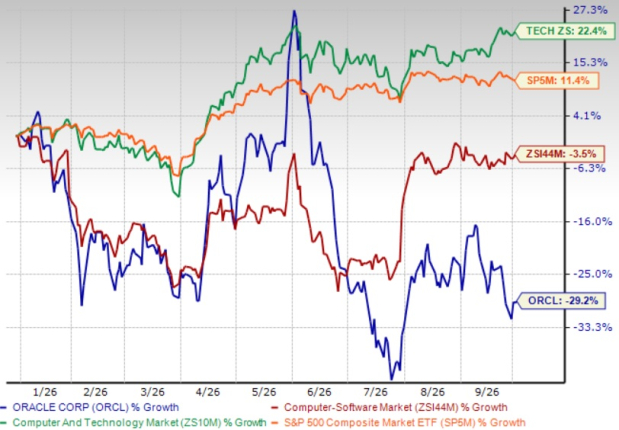
ORCL shares have plunged 29.2% year to date, underperforming the Zacks Computer and Technology sector’s growth of 22.4% and the Zacks Computer - Software industry’s decline of 3.5%.
ORCL’s YTD Price Performance
Image Source: Zacks Investment Research
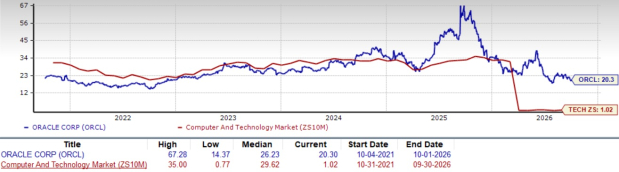
ORCL’s valuation remains relatively attractive, with the stock trading at a trailing 12-month P/E ratio of 20.3X, lower than the sector average of 1.02X. Oracle has a Value Score of C.
ORCL’s Valuation Chart
Image Source: Zacks Investment Research
The Zacks Consensus Estimate for ORCL’s fiscal 2027 earnings is currently pegged at $8.12 per share. The estimate implies 6.42% year-over-year earnings growth.
Oracle Corporation Price and Consensus
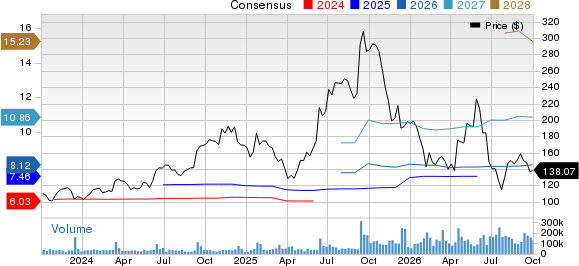
Oracle Corporation price-consensus-chart | Oracle Corporation Quote
ORCL currently carries a Zacks Rank #3 (Hold). You can see the complete list of today’s Zacks #1 Rank (Strong Buy) stocks here.
7 Best Stocks for the Next 30 Days
Just released: Experts distill 7 elite stocks from the current list of 220 Zacks Rank #1 Strong Buys. They deem these tickers "Most Likely for Early Price Pops."
Since 1988, the full list has beaten the market more than 2X over with an average gain of +23.9% per year. So be sure to give these hand picked 7 your immediate attention.
See them now >>Want the latest recommendations from Zacks Investment Research? Today, you can download 7 Best Stocks for the Next 30 Days. Click to get this free report
Oracle Corporation (ORCL): Free Stock Analysis Report
Snowflake Inc. (SNOW): Free Stock Analysis Report
MongoDB, Inc. (MDB): Free Stock Analysis Report
This article originally published on Zacks Investment Research (zacks.com).