


October is observed as Breast Cancer Awareness Month to promote early detection, improve access to screening and support advances in prevention and treatment. Despite progress in breast cancer care, the disease remains a major global health challenge, with outcomes varying widely based on access to timely diagnosis and effective treatment.
Advances in targeted therapies, antibody-drug conjugates and treatment combinations are creating new opportunities in breast cancer care. For pharmaceutical companies, these developments offer potential growth through new drug approvals and expanded indications, although intense competition, clinical setbacks and regulatory risks remain key considerations for investors.
Against this backdrop, AstraZeneca AZN, Roche RHHBY, Puma Biotechnology PBYI and Olema Oncology OLMA offer exposure to different parts of the breast cancer treatment landscape. The four picks provide a mix of established large-cap pharmaceutical companies, a smaller commercial-stage biotechnology company and a clinical-stage developer. Their investment cases span growing sales from approved treatments, opportunities to expand established drugs into additional settings and clinical milestones that could influence future commercial prospects. While AZN, PBYI and OLMA currently carry a Zacks Rank #3 (Hold), RHHBY carries a Zacks Rank #4 (Sell) at present. You can see the complete list of today’s Zacks #1 Rank (Strong Buy) stocks here.
AstraZeneca
AstraZeneca’s breast cancer portfolio includes Enhertu (trastuzumab deruxtecan), Truqap (capivasertib), Lynparza (olaparib), Datroway (datopotamab deruxtecan) and Etcamah (camizestrant). Enhertu is approved across multiple HER2-positive and HER2-low breast cancer settings, including first-line treatment of HER2-positive metastatic disease in combination with pertuzumab and certain early-stage settings. Truqap with Faslodex (fulvestrant) treats advanced HR-positive, HER2-negative breast cancer with PIK3CA, AKT1 or PTEN alterations after endocrine therapy. At the same time, Lynparza targets certain high-risk early-stage and metastatic HER2-negative cancers with germline BRCA mutations.
AstraZeneca PLC Price and Consensus
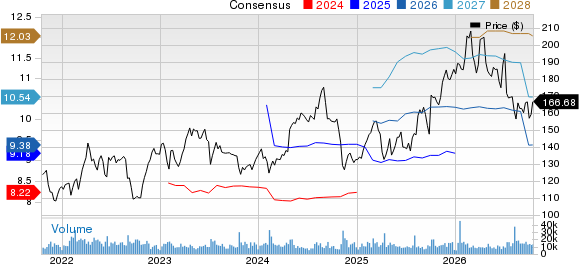
AstraZeneca PLC price-consensus-chart | AstraZeneca PLC Quote
Datroway has approvals in previously treated HR-positive, HER2-negative metastatic disease and first-line metastatic triple-negative breast cancer (TNBC) for patients who cannot receive immunotherapy. Last month, Etcamah received accelerated FDA approval with a CDK4/6 inhibitor for HR-positive, HER2-negative advanced breast cancer with emerging ESR1 mutations during first-line endocrine therapy, before disease progression. In the first half of 2026, AstraZeneca reported $1.72 billion in total revenues associated with Enhertu, up 32% at CER, while Truqap revenues rose 41% at CER to $431 million. AstraZeneca’s partnered drug with Daiichi Sankyo, Datroway, generated $98 million in revenues in first-half 2026, up from $14 million a year earlier, driven by uptake in breast and lung cancer.
Beyond its commercial portfolio, AstraZeneca continues to pursue additional breast cancer opportunities. Etcamah is being evaluated in the phase III CAMBRIA-1 study as an extended adjuvant therapy for patients with HR-positive, HER2-negative early breast cancer who remain recurrence-free after at least two years of endocrine therapy and in the phase III CAMBRIA-2 study as adjuvant therapy for patients with the same cancer subtype at intermediate-high or high risk of recurrence after surgery.
However, the phase III SERENA-4 study evaluating Etcamah plus palbociclib for first-line ER-positive, HER2-negative advanced breast cancer failed to meet its primary progression-free survival endpoint in September, highlighting the clinical uncertainty surrounding further label expansion. Separately, AstraZeneca and Daiichi Sankyo announced a collaboration with Summit Therapeutics in October 2026 to evaluate Datroway with ivonescimab in a planned phase III first-line TNBC study. These programs could broaden AstraZeneca’s reach, although future growth will depend on clinical differentiation, regulatory outcomes and continued uptake of recently approved treatments.
Roche Holding AG
Roche markets several breast cancer drugs, including Perjeta (pertuzumab), Phesgo (pertuzumab, trastuzumab and hyaluronidase-zzxf), Kadcyla (ado-trastuzumab emtansine) and Herceptin (trastuzumab). These therapies target HER2-positive breast cancer across early-stage and metastatic settings. Phesgo is a key growth driver for Roche, with sales rising 18% at CER to $1.68 billion (CHF 1.32 billion) in first-half 2026, supported by continued uptake and patient switches from Perjeta in Europe. During the same period, Perjeta, Kadcyla and Herceptin contributed $1.77 billion (CHF 1.39 billion), $1.16 billion (CHF 916 million) and $587 million (CHF 462 million), respectively.
Roche Holding AG Price and Consensus
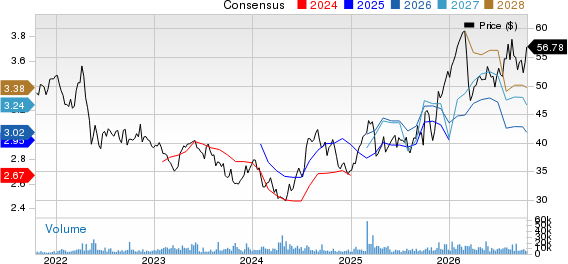
Roche Holding AG price-consensus-chart | Roche Holding AG Quote
Roche’s pipeline offers further growth opportunities through giredestrant, an investigational oral selective estrogen receptor degrader being developed for ER-positive, HER2-negative breast cancer. In the phase III lidERA study, adjuvant giredestrant reduced the risk of invasive disease recurrence or death by 30% compared with standard endocrine therapy. The FDA accepted Roche’s regulatory application for the candidate under Priority Review, with a decision expected by Nov. 30, 2026. In the phase III evERA study, giredestrant plus everolimus reduced the risk of disease progression or death by 44% in the overall population and 62% in patients with ESR1-mutated tumors versus standard endocrine therapy plus everolimus. The FDA decision on the combination for eligible patients with ESR1-mutated, ER-positive, HER2-negative advanced breast cancer is expected by Dec. 18, 2026. These potential approvals could expand Roche’s presence in hormone receptor-positive breast cancer.
Puma Biotechnology
Puma markets Nerlynx (neratinib) for the extended adjuvant treatment of adults with early-stage HER2-positive breast cancer following trastuzumab-based therapy. In combination with capecitabine, it is also approved for adults with advanced or metastatic HER2-positive breast cancer who have received at least two prior anti-HER2 regimens in the metastatic setting. Nerlynx remains Puma’s commercial foundation, making prescription demand and revenue trends particularly important to its investment story. Nerlynx net product revenues reached $95.5 million in the first six months of 2026, up 3.5% year over year. Following stronger second-quarter demand, management raised its 2026 net product revenue guidance to $205-$209 million from $202-$206 million. Sustaining demand and accelerating sales growth will be key to meeting the higher outlook.
Puma Biotechnology, Inc. Price and Consensus
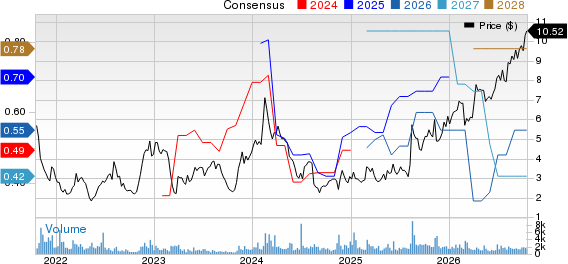
Puma Biotechnology, Inc. price-consensus-chart | Puma Biotechnology, Inc. Quote
Puma’s pipeline offers a potential additional growth driver through alisertib, an investigational Aurora kinase A inhibitor, being evaluated in the phase II ALISCA-Breast1 study in combination with endocrine therapy for chemotherapy-naïve patients with HER2-negative, HR-positive metastatic breast cancer. Puma plans to expand mid-stage study enrollment in the second half of 2026 and expects to report updated data by the end of 2026, with a focus on biomarker-defined patient populations. Positive results could support further development and diversify Puma’s growth opportunities beyond Nerlynx.
Nevertheless, alisertib remains in mid-stage development, and additional studies would be needed before it could contribute commercial revenues. The study results are therefore an important catalyst, but also a source of clinical risk.
Olema Oncology
Olema Oncology is a clinical-stage biopharmaceutical company focused on breast cancer and has no marketed products. Its lead candidate, palazestrant (OP-1250), is an oral complete estrogen receptor antagonist and selective estrogen receptor degrader being developed for ER-positive, HER2-negative advanced or metastatic breast cancer. In the phase III OPERA-01 study, palazestrant monotherapy is being evaluated in patients in the second- or third-line setting. Olema completed enrollment in the study in the second quarter of 2026 and expects top-line results in first-quarter 2027, rather than fall 2026. The readout could be a key catalyst for palazestrant’s regulatory and commercial prospects. Until the data are available, however, Olema remains highly dependent on clinical execution and the performance of its lead candidate.
Olema Pharmaceuticals, Inc. Price and Consensus
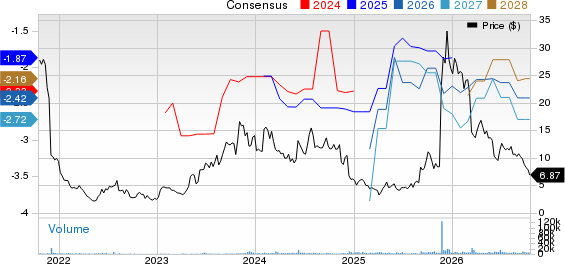
Olema Pharmaceuticals, Inc. price-consensus-chart | Olema Pharmaceuticals, Inc. Quote
Olema is also evaluating palazestrant in the phase III OPERA-02 study, in combination with ribociclib, as a first-line treatment for ER-positive, HER2-negative metastatic breast cancer. A separate phase Ib/II study is evaluating palazestrant with atirmociclib, an investigational CDK4 inhibitor, for ER-positive, HER2-negative metastatic breast cancer. Beyond palazestrant, Olema is developing OP-3136, an investigational KAT6 inhibitor in phase I. Initial monotherapy data presented in May 2026 showed acceptable tolerability and preliminary antitumor activity across multiple solid tumor types, supporting continued evaluation, including in combination with fulvestrant and palazestrant for ER-positive, HER2-negative breast cancer. Olema ended the second quarter with $461.1 million in cash, cash equivalents and marketable securities, providing cash runway for its ongoing clinical development programs.
Beyond Nvidia: AI's Second Wave Is Here
The AI revolution has already minted millionaires. But the stocks everyone knows about aren't likely to keep delivering the biggest profits. AI’s second wave is moving from infrastructure to implementation and these companies are at the forefront of this transition, positioned to become what Amazon and Google were to the internet era.
See Stocks Now >>Want the latest recommendations from Zacks Investment Research? Today, you can download 7 Best Stocks for the Next 30 Days. Click to get this free report
AstraZeneca PLC (AZN): Free Stock Analysis Report
Roche Holding AG (RHHBY): Free Stock Analysis Report
Puma Biotechnology, Inc. (PBYI): Free Stock Analysis Report
Olema Pharmaceuticals, Inc. (OLMA): Free Stock Analysis Report
This article originally published on Zacks Investment Research (zacks.com).