


The race to build artificial intelligence infrastructure is increasingly about securing electricity, completing data centers and turning commitments into steady revenues. IREN Limited IREN and TeraWulf WULF share that challenge. Both have roots in Bitcoin mining, access to large power sites and plans to repurpose infrastructure for AI and high-performance computing. Both also rely on major customer agreements to support expensive construction programs.
Their approaches, however, are different. IREN is developing an integrated AI cloud business that supplies data centers, GPUs and software services directly to customers. TeraWulf focuses primarily on leasing powered data center capacity under long-term contracts, leaving much of the computing hardware to tenants. IREN's approach offers more ways to generate revenues but requires heavier equipment spending. TeraWulf's leases provide contractual visibility, yet substantial capacity must still be built.
For investors assessing risk, the important questions are how quickly each company can deliver capacity, secure financing and convert contracts into reliable cash flow.
The Case for IREN
IREN's strongest advantage is that its AI business is moving beyond a development plan. The company reported $4 billion in contracted annualized run-rate revenues for 2026 capacity, with $1 billion operating as of late August. Its first 50-megawatt Horizon deployment for Microsoft was delivered, while three further phases were targeted for completion before year-end. Those milestones offer clearer evidence of commercial progress than a pipeline alone.
Customer reach is also widening. Agreements with Cohere, Perplexity, Figure AI and other developers complement its hyperscaler relationships. The acquisition of Mirantis adds managed services and software, giving IREN opportunities to serve customers that need more than raw computing power. Compared with TeraWulf's leasing model, this wider service mix could support deeper customer relationships, although it also adds operating complexity.
IREN's infrastructure footprint provides an advantage. Its development portfolio exceeds five gigawatts, while the Sweetwater hub was conditionally included as base load in ERCOT's Batch Zero process. In October, the company also secured a civil works license for its planned 300-megawatt Spanish campus, supporting expansion beyond North America. These projects still face construction and approval risks.
Funding remains the main concern. Management expects $25 billion to $30 billion of fiscal 2027 capital spending, far above its existing resources. Still, $14 billion of cash, committed equipment financing and customer prepayments provide a starting point. Customer advances and GPU-backed financing reduce funding pressure. With AI cloud revenues growing, IREN offers a more credible route from customer demand to delivered computing services, provided execution remains disciplined.
The Case for WULF
TeraWulf's AI opportunity faces a wide gap between contracted capacity and operating assets. Long-term leases attracted Fluidstack and Anthropic. The latter signed a 20-year agreement covering 401 megawatts at the Justified campus, representing approximately $19 billion of contracted revenues. These long-term commitments improve future revenue visibility without eliminating delivery risk.
At Lake Mariner, only 102 megawatts of critical IT capacity was generating lease revenues by early July, and another 336 megawatts remained under construction. This compares with 839 megawatts contracted across the platform. Electrical labor constraints and design changes have disrupted schedules. Unlike IREN's integrated cloud deployments, TeraWulf depends heavily on completing tenant-ready buildings before lease income can expand meaningfully.
Kentucky regulators have approved a 482-megawatt power agreement for Justified, while an October amendment increased contracted electric service at Muskie to one gigawatt. Muskie's phases are targeted for 2028 and 2029, subject to approvals and utility construction. Securing power is valuable but converting it into occupied facilities takes time.
Financing makes that timetable important. TeraWulf reported approximately $5.7 billion of debt and $2.7 billion of net debt at June-end. Justified alone requires an estimated $4 billion to $4.5 billion of development investment. Google's credit support for Fluidstack and the planned Abernathy sale provide protection, but funding costs, customer concentration and phased construction remain significant concerns. Compared with IREN, more of TeraWulf's investment case rests on projects becoming operational over several years rather than an expanding cloud service already being reliably delivered.
How Do Estimates Compare for IREN & WULF?
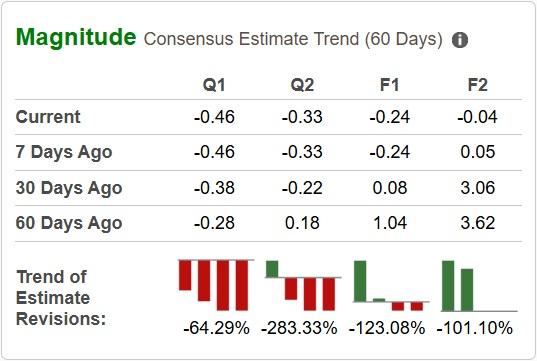
The Zacks Consensus Estimate for IREN’s fiscal 2027 and 2028 sales implies year-over-year growth of 291.67% and 207.07%, respectively. The consensus mark for IREN’s 2027 and 2028 earnings has been revised southward in the past 30 days.
For IREN:
Image Source: Zacks Investment Research
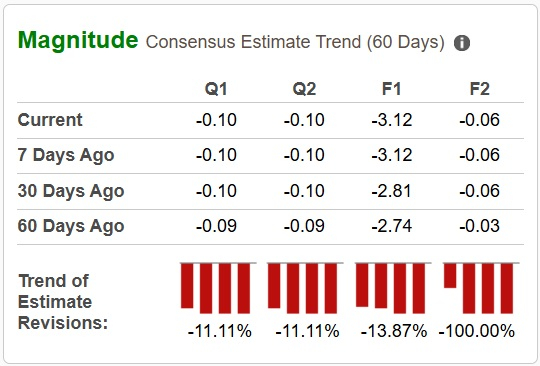
The Zacks Consensus Estimate for WULF’s 2026 and 2027 sales calls for a year-over-year increase of 67.15% and 205.21%, respectively. However, over the past 60 days, earnings estimates for both 2026 and 2027 have been revised downward, signaling a bearish outlook from analysts.
For WULF:
Image Source: Zacks Investment Research
Price Performance and Valuation of IREN & WULF
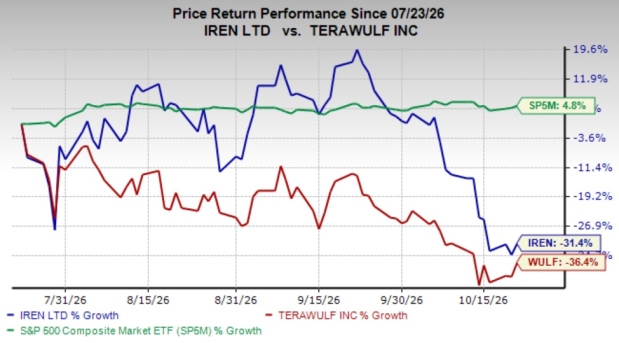
Over the past three months, IREN shares have declined 31.4%, while WULF shares have plunged 36.4%. In comparison, the S&P 500 composite has advanced 4.8% in the same time frame.
Image Source: Zacks Investment Research
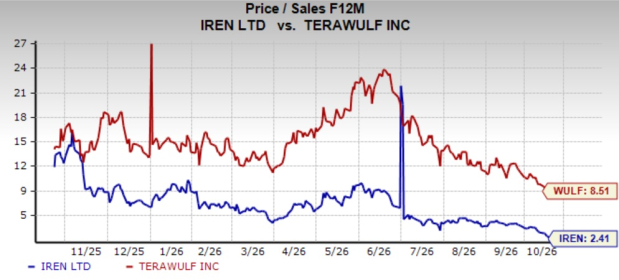
On a forward 12-month price-to-sales basis, IREN currently looks less demanding than WULF. IREN trades at 2.41X forward 12-month price-to-sales versus 8.51X for WULF.
IREN is not inexpensive in absolute terms, and its projected sales require timely GPU deployment and customer acceptance. However, its lower multiple offers more room for execution setbacks. TeraWulf's premium leaves less room for delays, higher financing costs or slower conversion of signed leases into recognized revenues.
Valuation: IREN & WULF
Image Source: Zacks Investment Research
Conclusion
Neither IREN nor TeraWulf is a low-risk way to invest in AI infrastructure. Both require substantial capital, reliable power and timely project delivery. However, IREN combines operating cloud revenues, a broader customer base and software capabilities with a more modest forward sales multiple. Its spending plans remain demanding, making careful monitoring essential. TeraWulf benefits from long-duration leases and utility agreements, but construction requirements, leverage and the delayed ramp-up at new campuses create greater uncertainty.
For investors weighing the two, IREN presents a stronger case for retaining exposure, whereas TeraWulf's risks favor stepping aside until more capacity generates reliable cash flow.
While IREN carries a Zacks Rank #3 (Hold), WULF has a Zacks Rank #4 (Sell).
You can see the complete list of today’s Zacks #1 Rank (Strong Buy) stocks here.
7 Best Stocks for the Next 30 Days
Just released: Experts distill 7 elite stocks from the current list of 220 Zacks Rank #1 Strong Buys. They deem these tickers "Most Likely for Early Price Pops."
Since 1988, the full list has beaten the market more than 2X over with an average gain of +23.9% per year. So be sure to give these hand picked 7 your immediate attention.
See them now >>Want the latest recommendations from Zacks Investment Research? Today, you can download 7 Best Stocks for the Next 30 Days. Click to get this free report
IREN Limited (IREN): Free Stock Analysis Report
TeraWulf Inc. (WULF): Free Stock Analysis Report
This article originally published on Zacks Investment Research (zacks.com).