


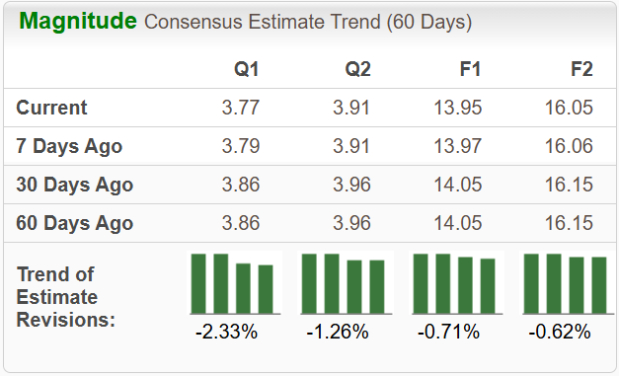
AbbVie ABBV is set to report third-quarter 2026 earnings on Oct. 30, before the opening bell. The Zacks Consensus Estimate for the to-be-reported quarter’s sales is pinned at $17.37 billion, while earnings per share (EPS) are estimated at $3.77. Both metrics indicate an increase from the year-ago period.
Over the past 30 days, the Zacks Consensus Estimate for 2026 EPS has declined from $14.05 to $13.95, while the 2027 estimate has fallen from $16.15 to $16.05. The near-term decline is primarily attributed to the impact of acquired IPR&D and milestone expenses totaling $216 million, which the company expects to have been recorded in the quarter, as noted in an SEC filing released earlier this month.
Image Source: Zacks Investment Research
ABBV’s Earnings Surprise History
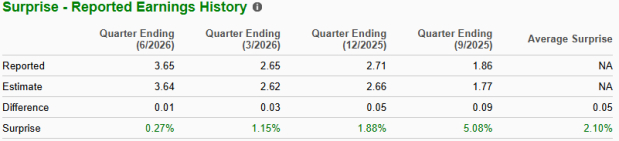
AbbVie’s performance has been impressive, with its earnings exceeding expectations in each of the trailing four quarters. It has delivered a trailing four-quarter average earnings surprise of 2.10%. In the last reported quarter, the pharma giant delivered an earnings surprise of 0.27%.
Image Source: Zacks Investment Research
What Our Model Predicts for ABBV
Per our proven model, companies with the combination of a positive Earnings ESP and a Zacks Rank #1 (Strong Buy), 2 (Buy) or 3 (Hold) have a good chance of delivering an earnings beat. This is not the case here. You can uncover the best stocks to buy or sell before they’re reported with our Earnings ESP Filter.
AbbVie currently has an Earnings ESP of -0.33% and a Zacks Rank #4 (Sell). You can see the complete list of today’s Zacks #1 Rank stocks here.
Factors Likely to Shape AbbVie’s Upcoming Results
For the third quarter of 2026, AbbVie expects adjusted earnings to be in the range of $3.73-$3.77 per share. The company expects net revenues of approximately $17.2 billion. Currency is expected to have an unfavorable impact of around 0.4% on sales.
AbbVie’s top-line growth in the third quarter is likely to have been driven by higher sales of immunology drugs Skyrizi and Rinvoq. Strong volume growth and market share gains across approved indications have been driving sales of both drugs. During the third quarter, Rinvoq’s label was expanded in the EU across three indications — vitiligo, alopecia areata and active polyarticular juvenile idiopathic arthritis. This expansion might have further boosted sales in the third quarter. The Zacks Consensus Estimate for Skyrizi sales is pegged at $5.72 billion, while the same for Rinvoq is pinned at $2.73 billion.
Sales of the company’s flagship drug Humira are likely to have continued their downward trend due to biosimilar erosion. The Zacks Consensus Estimate for the drug’s sales is pegged at $695 million.
Within AbbVie’s oncology franchise, sales of J&J JNJ-partnered Imbruvica are expected to continue their downward trajectory, reflecting intensifying competition from newer oral therapies. The decline is likely to have accelerated in the to-be-reported quarter, as IRA-driven pricing changes that took effect at the beginning of the year are expected to have put additional pressure on sales. The Zacks Consensus Estimate for Imbruvica sales is pegged at approximately $530 million.
In contrast, sales of Roche RHHBY-partnered Venclexta are expected to have risen during the to-be-reported quarter, driven by sustained demand in the chronic lymphocytic leukemia (CLL), particularly due to its use in combination with BTK inhibitors. The Zacks Consensus Estimate for Venclexta sales is pegged at $793 million.
Overall, the Zacks Consensus Estimate for oncology revenues is pegged at $1.68 billion, indicating relatively flat year over year. While the anticipated weakness in Imbruvica sales is expected to weigh on the franchise’s performance, growth in Venclexta and contributions from AbbVie’s newer oncology products are likely to offset this pressure.
AbbVie’s neuroscience franchise has delivered strong growth in recent quarters, a trend that is expected to have continued in the to-be-reported quarter. Growth is likely to have been driven by higher sales of Botox Therapeutic, the depression drug Vraylar and the migraine treatments — Ubrelvy and Qulipta. The Parkinson’s disease drug Vyalev is also expected to have contributed to the franchise’s performance during the quarter. The Zacks Consensus Estimate for neuroscience product sales is pinned at approximately $3.29 billion.
In the aesthetics franchise, sales are expected to have shown signs of recovery following sluggish performance in recent quarters, primarily due to softness in Botox Cosmetic and Juvederm filler sales. The anticipated improvement is likely to have been supported by stabilizing demand in the U.S. facial injectable market and easing macroeconomic pressures, which may have helped improve consumer sentiment. The Zacks Consensus Estimate for aesthetics product sales is pegged at $1.20 billion, indicating relatively flat year-over-year.
Nonetheless, a single quarter’s results are not so important for long-term investors. Let us delve deeper to understand whether to buy, sell or hold the stock at present.
ABBV’s Stock Price Performance & Valuation
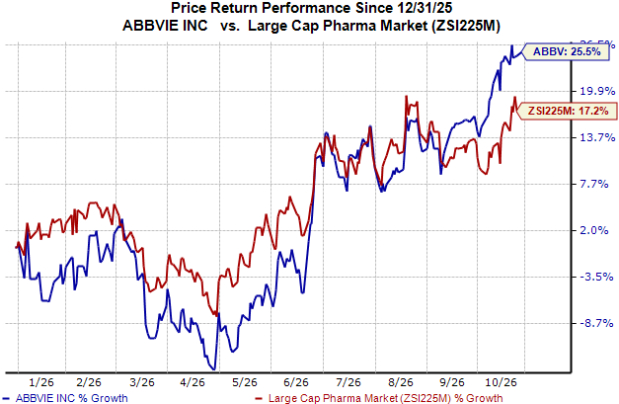
Year to date, shares of the company have risen 25.5% compared with the industry’s 17.2% growth.
Image Source: Zacks Investment Research
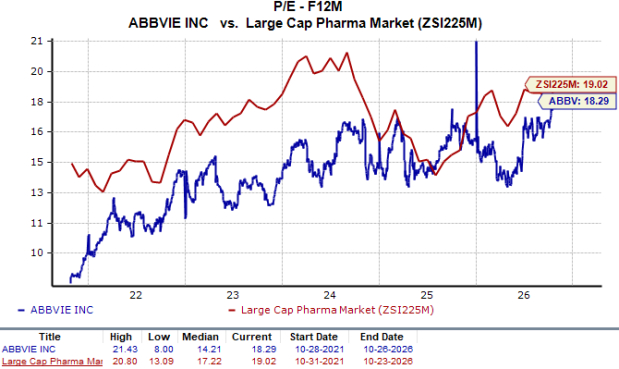
From a valuation standpoint, AbbVie is trading at a discount to the industry. Based on the price/earnings (P/E) ratio, the shares currently trade at 18.29 times forward earnings, lower than the industry’s 19.02 times. Yet, compared to some of its peers like Pfizer PFE and Sanofi, the stock is trading at a premium.
Image Source: Zacks Investment Research
Our Investment Thesis on ABBV Stock
AbbVie has navigated Humira’s biosimilar erosion relatively well, with Skyrizi and Rinvoq emerging as its primary growth drivers. Strong demand, market-share gains and label expansions across existing and newer indications have helped the company offset declining Humira sales and strengthen its position in the immunology market. However, competition is intensifying, with J&J’s newly approved oral immunology drug Icotyde potentially posing a longer-term threat to Skyrizi if its use expands into additional indications.
The growing neuroscience franchise, driven by Botox Therapeutic, Vraylar and migraine drugs, along with an expanding oncology portfolio, also supports its long-term growth prospects. However, declining Imbruvica sales amid intensifying competition and continued weakness in the aesthetics business remain key headwinds.
Meanwhile, AbbVie’s aggressive business development strategy is strengthening its long-term growth prospects but weighing on near-term earnings. The company recently completed its $10.9 billion acquisition of Apogee Therapeutics, further expanding its immunology pipeline. However, the deal is expected to have diluted adjusted EPS by 14 cents in 2026 and approximately 46 cents in 2027, with accretion anticipated beginning in 2032. Additionally, $216 million in acquired IPR&D and milestone expenses is expected to have reduced third-quarter adjusted EPS by $0.11. These costs have contributed to downward revisions in earnings estimates, adding to near-term profitability concerns.
While AbbVie’s core growth drivers and pipeline investments support its longer-term outlook, elevated expenses, declining near-term earnings estimates and intensifying competition warrant caution. The company must demonstrate that its investments can translate into sustainable earnings growth to restore near-term investor confidence.
How to Play the Stock?
Given AbbVie’s Zacks Rank #4, negative Earnings ESP and recent downward revisions in earnings estimates, short-term investors may consider exiting ABBV stock, as near-term earnings uncertainty could limit further upside.
However, long-term investors may choose to stay invested, as continued growth in Skyrizi, Rinvoq and other key therapies, along with an expanding pipeline, supports the company’s long-term growth prospects.
Radical New Technology Could Hand Investors Huge Gains
Quantum Computing is the next technological revolution, and it could be even more advanced than AI.
While some believed the technology was years away, it is already present and moving fast. Large hyperscalers, such as Microsoft, Google, Amazon, Oracle, and even Meta and Tesla, are scrambling to integrate quantum computing into their infrastructure.
Senior Stock Strategist Kevin Cook reveals 7 carefully selected stocks poised to dominate the quantum computing landscape in his report, Beyond AI: The Quantum Leap in Computing Power .
Kevin was among the early experts who recognized NVIDIA's enormous potential back in 2016. Now, he has keyed in on what could be "the next big thing" in quantum computing supremacy. Today, you have a rare chance to position your portfolio at the forefront of this opportunity.
See Top Quantum Stocks Now >>Want the latest recommendations from Zacks Investment Research? Today, you can download 7 Best Stocks for the Next 30 Days. Click to get this free report
AbbVie Inc. (ABBV): Free Stock Analysis Report
Roche Holding AG (RHHBY): Free Stock Analysis Report
Johnson & Johnson (JNJ): Free Stock Analysis Report
Pfizer Inc. (PFE): Free Stock Analysis Report
This article originally published on Zacks Investment Research (zacks.com).