


Novo NVO announced that the FDA has approved a label expansion for its once-weekly growth hormone treatment, Sogroya (somapacitan-beco), for children aged 2.5 years and older with growth failure associated with Turner syndrome (TS). The approval makes Sogroya the first and only once-weekly, long-acting growth hormone authorized for this indication in the United States. Sogroya is already FDA-approved for pediatric growth hormone deficiency (GHD), idiopathic short stature, growth failure associated with Noonan syndrome and short stature in children born small for gestational age who have not caught up in growth by age two. It is also approved for adults with GHD.
Sogroya is a long-acting human growth hormone analog administered as a subcutaneous injection once a week, rather than every day. Available in 5-mg, 10-mg and 15-mg presentations, the therapy is designed to provide an alternative to daily growth hormone injections, which can be challenging to maintain over extended treatment periods. With the latest authorization, the drug's pediatric label spans five distinct growth-related disorders. The broader label gives physicians another dosing option for eligible children and further expands Novo's reach in the treatment of growth disorders.
The Rationale Behind the Label Expansion of NVO's Sogroya
Turner syndrome is a chromosomal condition affecting females in which one X chromosome is absent or altered. It is estimated to occur in approximately one in 2,000 female newborns and often causes short stature. Patients may also experience fertility problems, congenital heart defects or kidney abnormalities, adding to their overall care requirements. Growth hormone treatment can continue for several years, making the frequency of injections an important practical consideration. The availability of a once-weekly option may help simplify treatment routines for families managing the condition alongside other medical needs. However, improved adherence has not been established by the approval itself.
The FDA's decision was supported by data from Novo’s Phase III REAL8 study comparing Sogroya with daily somatropin. The Turner syndrome cohort enrolled 105 growth hormone treatment-naive, prepubertal children aged 2.5 to 10 years. Participants were randomized 2:1 to receive once-weekly Sogroya at 0.24 mg/kg (68 patients) or daily somatropin at 0.05 mg/kg (37 patients) over 52 weeks. The study is part of a broader basket study assessing children with different growth-related conditions under a unified randomized framework, rather than through separate studies for each diagnosis. Notably, the comparator's dose was below the maximum US-approved daily somatropin dose of 0.067 mg/kg for children with Turner syndrome.
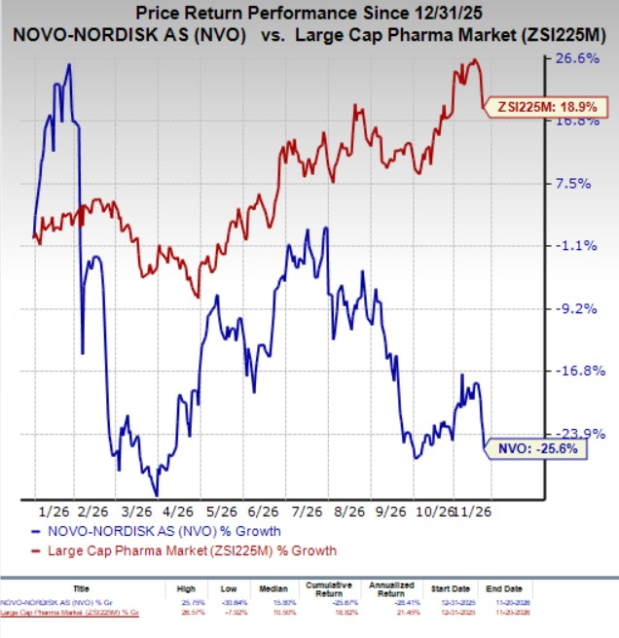
Novo shares have lost 25.6% year to date against the industry’s 18.9% growth.
Image Source: Zacks Investment Research
The REAL8 study’s primary efficacy endpoint was annualized height velocity at week 52. Per Novo, children receiving once-weekly Sogroya demonstrated a growth rate comparable to those treated with daily somatropin. The mean annualized height velocity was 8.9 cm per year in the Sogroya arm compared with 9.7 cm per year in the somatropin arm, reflecting an estimated treatment difference of minus 0.8 cm per year. The supportive secondary endpoint, change in height standard deviation score from baseline, was also similar between the groups at 0.77 for Sogroya and 0.86 for somatropin. Baseline height scores were minus 2.8 and minus 3.0, respectively. These efficacy findings supported the FDA's decision to expand Sogroya's label to include pediatric patients with Turner syndrome.
Safety findings from REAL8 also informed the decision. Adverse reactions reported in at least 10% of Sogroya-treated children with Turner syndrome included respiratory tract infections, nasopharyngitis, ear infections, fever, diarrhea, vomiting and injection-site reactions.
Patients are continuing in a two-year safety extension following the initial 52-week treatment period, allowing additional follow-up on longer-term outcomes. This follow-up is relevant because growth hormone therapy can be used for years, making sustained safety and tolerability important considerations. For eligible children, weekly dosing translates into 313 days each year without a scheduled growth hormone injection compared with a daily regimen. That reduction in injection frequency is the principal practical distinction of Sogroya's newly expanded label, while its long-term impact on adherence remains to be determined.
Novo Nordisk A/S Price and Consensus
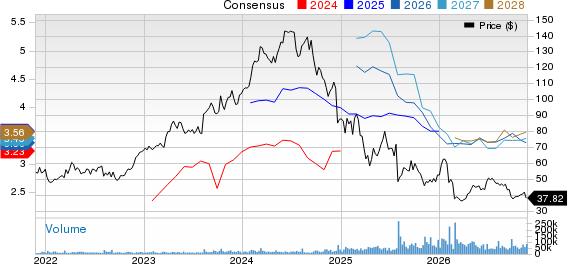
Novo Nordisk A/S price-consensus-chart | Novo Nordisk A/S Quote
NVO’s Zacks Rank & Stocks to Consider
Novo currently has a Zacks Rank #3 (Hold).
Some better-ranked stocks in the biotech sector are Amneal Pharmaceuticals AMRX, AC Immune ACIU and Adaptive Biotechnologies ADPT, carrying a Zacks Rank #2 (Buy) each. You can see the complete list of today’s Zacks #1 (Strong Buy) Rank stocks here.
Over the past 30 days, earnings per share estimates for Amneal Pharmaceuticals have increased from $1.03 to $1.06 for 2026. Over the same period, estimates for 2027 earnings per share have risen from $1.16 to $1.21. AMRX’s shares have surged 67.6% year to date.
Amneal Pharmaceuticals’ earnings beat estimates in each of the trailing four quarters, delivering an average surprise of 27.21%.
Over the past 30 days, loss per share estimates for AC Immune have narrowed from 60 cents to 54 cents for 2026. Over the same period, estimates for 2027 earnings per share have increased from 17 cents to 43 cents. ACIU’s shares have plunged 37.9% year to date.
AC Immune’s earnings beat estimates in each of the trailing four quarters, with an average surprise of 37.79%.
Over the past 30 days, loss per share estimates for Adaptive Biotechnologies have narrowed from 55 cents to 39 cents for 2026. Over the same period, estimates for 2027 loss per share have also improved from 19 cents to 3 cents. ADPT’s shares have surged 72% year to date.
Adaptive Biotechnologies’ earnings beat estimates in each of the trailing four quarters, delivering an average surprise of 53.62%.
Zacks' Research Chief Names "Stock Most Likely to Double"
Our team of experts has just released the 5 stocks with the greatest probability of gaining +100% or more in the coming months. Of those 5, Director of Research Sheraz Mian highlights the one stock set to climb highest.
This innovative software-as-a-service firm upped its user base +22% year over year. That rate is increasing and margins are expanding as AI efficiencies take effect. Of course, all our elite picks aren't winners, but this one could far surpass earlier Zacks' Stocks Set to Double like D-Wave Quantum, which shot up +680.1%.
Free: See Our Top Stock And 4 Runners UpWant the latest recommendations from Zacks Investment Research? Today, you can download 7 Best Stocks for the Next 30 Days. Click to get this free report
Novo Nordisk A/S (NVO): Free Stock Analysis Report
Adaptive Biotechnologies Corporation (ADPT): Free Stock Analysis Report
AC Immune (ACIU): Free Stock Analysis Report
AMNEAL PHARMACEUTICALS, INC. (AMRX): Free Stock Analysis Report
This article originally published on Zacks Investment Research (zacks.com).