

The ceasefire between the U.S. and Iran has brought a sense of relief, but in the flurry of peaceful headlines, many may have overlooked the recent warning about the global food supply from the International Monetary Fund (IMF). IMF Managing Director Kristalina Georgieva directly stated at the height of the conflict that escalation would likely lead to problems with global food supplies.
To the average person, such statements often sound like political noise. What does it matter to a hypothetical farmer in Latin America or a buyer in a European supermarket if rockets are flying over the Persian Gulf? However, the economy is a cynical and extremely interconnected system. Geopolitical conflict can have ripple effects across various sectors and markets.
Join 200K+ Subscribers: Find out why the midday Barchart Brief newsletter is a must-read for thousands daily.
To understand why the IMF is sounding the alarm, we need to look not at the halls of power but at ordinary agricultural fields and gas-processing factories. Yes, the war has ceased for now, but the consequences of it have not disappeared.
Anatomy of the Harvest: The Hidden Price of Food
When we think about the connection between the energy sector and agriculture, the first thing that may come to mind is fuel for tractors and combine harvesters. Undoubtedly, expensive oil (CBM26) drives up the cost of logistics and sowing campaigns. However, the bigger pain point is harder for the average person to see; it's nitrogen fertilizers.
Modern agriculture has long since ceased to be a lottery system, dependent exclusively on the weather. Today, agriculture is a high-tech industry built on strict mathematical calculations. The earth is not capable of endlessly providing high yields if it is not fed. A golden rule of agronomy is that the volume of the harvest you gather in autumn depends directly on the nutrients — primarily nitrogen — that you return to the soil.
Nitrogen fertilizers are the building blocks for plants, significantly increasing their mass and fruit-bearing capacity. But what does the situation in the Middle East have to do with this? The fact is that nitrogen fertilizers are not created from thin air — although nitrogen itself is taken from the air. Binding atmospheric nitrogen and turning it into fertilizer requires a colossal amount of energy and hydrogen.
This brings us to the main point: natural gas (NGK26) is the primary source for the global chemical industry. In the production cost of nitrogen fertilizers, gas expenses can reach an overwhelming 80%. It turns out that gas is the very foundation of modern food.
The Iranian Factor: Why This Crisis Isn't Over
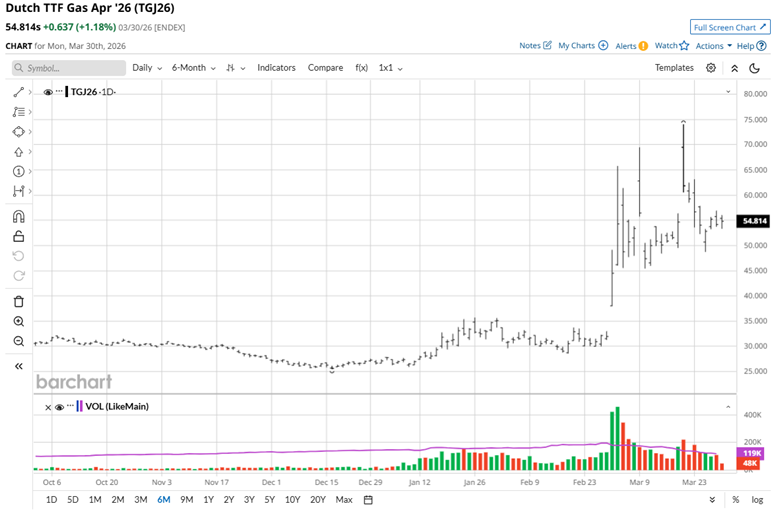
Let's now return to the current situation and the news of the ceasefire. While grain markets may rejoice at peace agreements, the reality is that the conflict has already inflicted serious physical damage on the region's gas processing infrastructure.
Strikes on liquefied natural gas (LNG) facilities in the Gulf are not simply a temporary suspension of exchange trades. These are complex technological chains taken out of commission. Restoring LNG deliveries is impossible to do quickly. Destroyed factories do not fix themselves overnight; repairing and relaunching infrastructure will likely require years.
This means that the global gas market has already entered a phase of severe deficit. There is physically less gas, it will be expensive, and fertilizer prices have spiked in tandem.
 www.barchart.com
 Global Inequality and the Law of Empty Fields
When fertilizers become expensive, the global agrarian sector splits into two. Richer states — European countries, North America, and developed Asian economies — will undoubtedly suffer from inflation. Their farmers will be forced to buy expensive fertilizers, passing these costs on to the end consumer. Bread, meat (since livestock eat grain), and milk on store shelves will become more expensive, but a food shortage likely won't occur.
However, a dire situation will unfold in poor, developing countries that critically depend on food and chemical imports. Local farmers, faced with astronomical fertilizer prices, will take the only option available to them: they will simply apply less fertilizer to the soil, or they will not apply it at all.
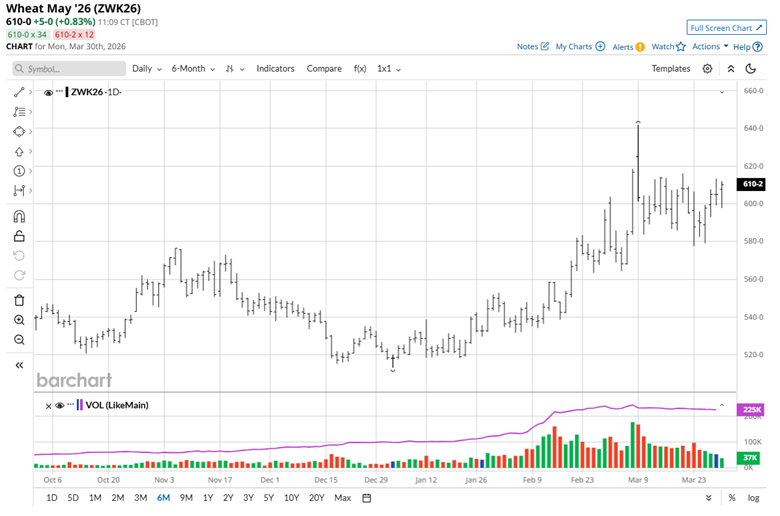
The consequence of this is bound to be painful. Lower fertilizer volumes mean a radical fall in crop yields in the next sowing campaign. The global economy will miss millions of tons of wheat (ZWK26), corn (ZCK26), and soy (ZSK26). At the same time, global food demand will not disappear.
 www.barchart.com
 A Shaky Equilibrium and the Climatic Trigger
We live under a system of global capitalism, and the economy responds to any deficit with a universal instrument: price. The problem is not that food on the planet will suddenly disappear. Thanks in large part to the ceasefire, the system will likely hold out, and the world is not currently threatened by a catastrophic famine. There will be food. But the price of it could skyrocket to such a level that the poorest segments of the population in developing countries simply will not be able to afford it.
The current situation has created a shaky equilibrium. The system has not collapsed, but it is on the very edge and lacks any margin of safety. The main danger is that if another catalyst arises, it could tip the situation for the worse.
Weather could present such a trigger if, for example, an El Niño takes shape later this year, as meteorologists have warned about. While this weather event is not a given, if we imagine the effect of such a situation against the backdrop of expensive gas and underfed fields in developing countries, the potential outcome of the food supply is clear. This cumulative effect is exactly what the IMF warned about.
The Market Impact
In addition, commodity markets are extremely sensitive to such fundamental shifts. For investors and traders, the current situation creates obvious opportunities. Given the long-term consequences of the conflict for infrastructure and a food system balancing on the edge due to weather risks, crops such as wheat or corn may come under scrutiny. Purchasing futures for these commodities right now looks like more than just speculation — it is a logical hedge against global food inflation.
While the geopolitical storm in the Middle East has already reached our plates in the form of higher food prices, the crisis isn't over just because of the ceasefire. As long as gas infrastructure remains in ruins, hopes for cheap food remain an illusion.
However, it is necessary to acknowledge a time lag. Gas issues have presumably not yet affected the current spring sowing campaign, as fertilizers were purchased in advance, but by autumn, the fertilizer problem will begin to exert its negative influence. This is an unavoidable reality.
On the date of publication, Mikhail Fedorov did not have (either directly or indirectly) positions in any of the securities mentioned in this article. All information and data in this article is solely for informational purposes. For more information please view the Barchart Disclosure Policy here.
More news from Barchart
Why the Food Crisis Is Only Postponed — Not Canceled — Amid U.S.-Iran Ceasefire The Death of the Bear Market: Why Classic Recessions Are a Thing of the Past and Inflation Is the New Norm Stocks Slip Before the Open as Oil Rebounds Amid Fragile U.S.-Iran Ceasefire, PCE Inflation and GDP Data in Focus 1 Trade to Make Now as U.S., Iran Agree to 2-Week Ceasefire