


Moderna MRNA kicked off 2026 with encouraging first-quarter results, beating estimates for earnings and sales.
The company’s total revenues surged 260% year over year to $389 million. Nearly 80% of this figure was generated from international markets. Moderna also reiterated its full-year 2026 revenue guidance, projecting growth of up to 10% over 2025 levels, with the split between the domestic and international operations to be nearly equal.
Year to date, shares of Moderna have increased 79% against the industry’s decline of 3%.
Image Source: Zacks Investment Research
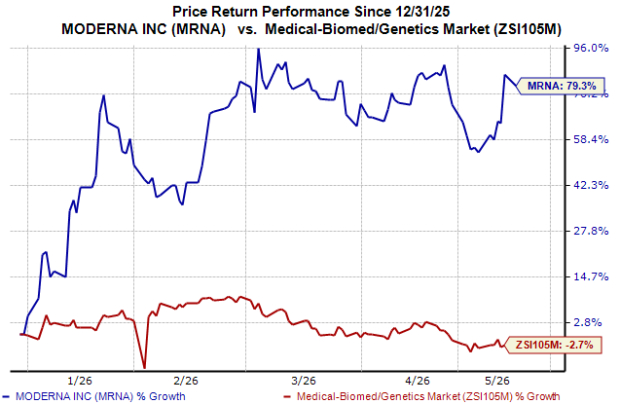
Strong Ex-U.S. Sales Drive MRNA’s Top Line
Moderna generated sales from three marketed vaccines during the quarter — COVID-19 vaccines Spikevax and mNexspike, and RSV vaccine mResvia. Overall product sales rose more than 300% year over year to $352 million. Though the company did not disclose an individual breakdown of product sales, the majority of the figure was generated from COVID-19 vaccines. The reported figure also beat the Zacks Consensus Estimate of $238 million.
A key highlight of the first quarter results was the company’s ex-U.S. sales performance. Management said on the earnings call that the strong performance was primarily driven by execution under its long-term strategic partnership with the U.K. government. Moderna delivered its first shipment under this partnership during the quarter, supporting the U.K.’s spring vaccination campaign. The company indicated that a second campaign is planned for the fall, which could support additional deliveries later this year.
However, the quarter’s strong international sales reflect the timing of government contract deliveries, which can make revenues uneven from quarter to quarter. Moderna expects second-quarter revenues to be in the range of $50-$100 million, highlighting the seasonal nature of its commercial business.
Moderna’s Cost Discipline Remains in Focus
The company continued to make progress with its cost-reduction efforts in the first quarter. Both research and development (R&D) expenses as well as selling, general and administrative expenses declined 24% and 18%, respectively, from the year-ago period. This was largely attributable to lower clinical development and manufacturing costs, as well as reduced marketing costs and lower consulting and external services across several functions.
While quarterly results were weighed down due to non-recurring charges of $0.9 billion tied to a litigation settlement with Genevant Sciences and Arbutus Biopharma ABUS, the adjusted loss per share stood at $1.18 — an improvement over the year-ago period’s loss of $2.52. As this payment is expected to be made in the third quarter of 2026, it did not impact first-quarter cash flow.
These cost cuts are part of Moderna’s long-term target to break even on an operating cash cost basis by 2028.
Regulatory Wins Strengthen Moderna’s Respiratory Portfolio
Moderna made meaningful progress across its respiratory vaccine portfolio during the quarter. Last month, the company secured European Commission approval for mCombriax, the first combination vaccine for active immunization against COVID-19 and influenza. This marks the fourth marketed product in the company’s portfolio. While a similar regulatory filing for the vaccine is under review in Australia and Canada, the company is awaiting further guidance from the FDA for a potential re-filing.
Moderna secured EU approval for mNexspike and expanded the EU approval for mResvia to include adults aged 18 and older.
The company’s standalone seasonal flu vaccine, mRNA-1010, is under regulatory review in the United States, Europe, Canada and Australia. A final decision from the FDA is expected by Aug. 5, 2026. If approved, the vaccine could become Moderna’s fifth marketed product and support the company’s broader respiratory vaccine strategy.
Notably, Moderna’s 2026 revenue guidance does not include any contribution from mRNA-1010 or mCombriax, meaning potential approvals and launches of these products could provide upside beyond the company’s current outlook.
These approvals mark an important step in Moderna’s plan to diversify beyond its original COVID-19 vaccine franchise. Management expects mNexspike and mCombriax to become important growth drivers in Europe starting in 2027, when Moderna anticipates broader market reopening opportunities.
MRNA’s Pipeline Progress Holds Potential
Beyond respiratory vaccines, Moderna continues to advance a broad mRNA-based pipeline across oncology, infectious diseases and rare diseases.
An important candidate in Moderna’s pipeline is intismeran autogene, a personalized cancer therapy which is being developed in collaboration with Merck MRK. Both companies are currently evaluating this therapy across nine ongoing phase II and phase III studies, including melanoma, non-small cell lung cancer (NSCLC), bladder cancer and renal cell carcinoma. An update on the adjuvant melanoma study is expected later this year.
Moderna has further expanded its oncology pipeline with an investigational checkpoint adaptive immune modulation therapy called mRNA-4359, which is currently being evaluated in early-to-mid-stage clinical studies for first-line melanoma and first-line metastatic NSCLC.
In infectious diseases, Moderna’s phase III norovirus vaccine study is fully enrolled in its second Northern Hemisphere season, with data expected later this year (subject to case accruals). Across rare diseases, the company’s propionic acidemia candidate, mRNA-3927, has reached target enrollment in a registrational study, with potential data also expected in 2026.
Conclusion
Moderna’s first-quarter results show encouraging signs of commercial stabilization after a difficult post-pandemic transition. Strong international COVID-19 vaccine sales helped the company deliver a sizable revenue beat, while ongoing cost reductions narrowed its adjusted loss.
However, risks remain as revenues are still heavily tied to COVID-19 vaccines and government contracts, while newer products like mResvia have yet to meaningfully diversify the top line. The company’s long-term growth story will depend on whether it can convert regulatory wins and late-stage pipeline progress into a broader and more sustainable revenue base.
Moderna, Inc. Price
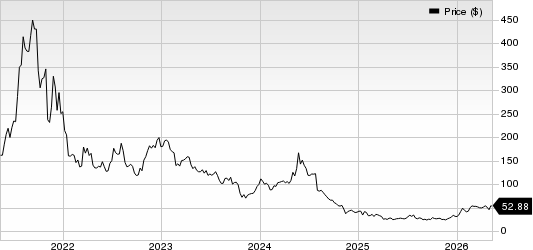
Moderna, Inc. price | Moderna, Inc. Quote
MRNA’s Zacks Rank
Moderna currently carries a Zacks Rank #3 (Hold). You can see the complete list of today’s Zacks #1 Rank (Strong Buy) stocks here.
Radical New Technology Could Hand Investors Huge Gains
Quantum Computing is the next technological revolution, and it could be even more advanced than AI.
While some believed the technology was years away, it is already present and moving fast. Large hyperscalers, such as Microsoft, Google, Amazon, Oracle, and even Meta and Tesla, are scrambling to integrate quantum computing into their infrastructure.
Senior Stock Strategist Kevin Cook reveals 7 carefully selected stocks poised to dominate the quantum computing landscape in his report, Beyond AI: The Quantum Leap in Computing Power .
Kevin was among the early experts who recognized NVIDIA's enormous potential back in 2016. Now, he has keyed in on what could be "the next big thing" in quantum computing supremacy. Today, you have a rare chance to position your portfolio at the forefront of this opportunity.
See Top Quantum Stocks Now >>Want the latest recommendations from Zacks Investment Research? Today, you can download 7 Best Stocks for the Next 30 Days. Click to get this free report
Merck & Co., Inc. (MRK): Free Stock Analysis Report
Moderna, Inc. (MRNA): Free Stock Analysis Report
Arbutus Biopharma Corporation (ABUS): Free Stock Analysis Report
This article originally published on Zacks Investment Research (zacks.com).