

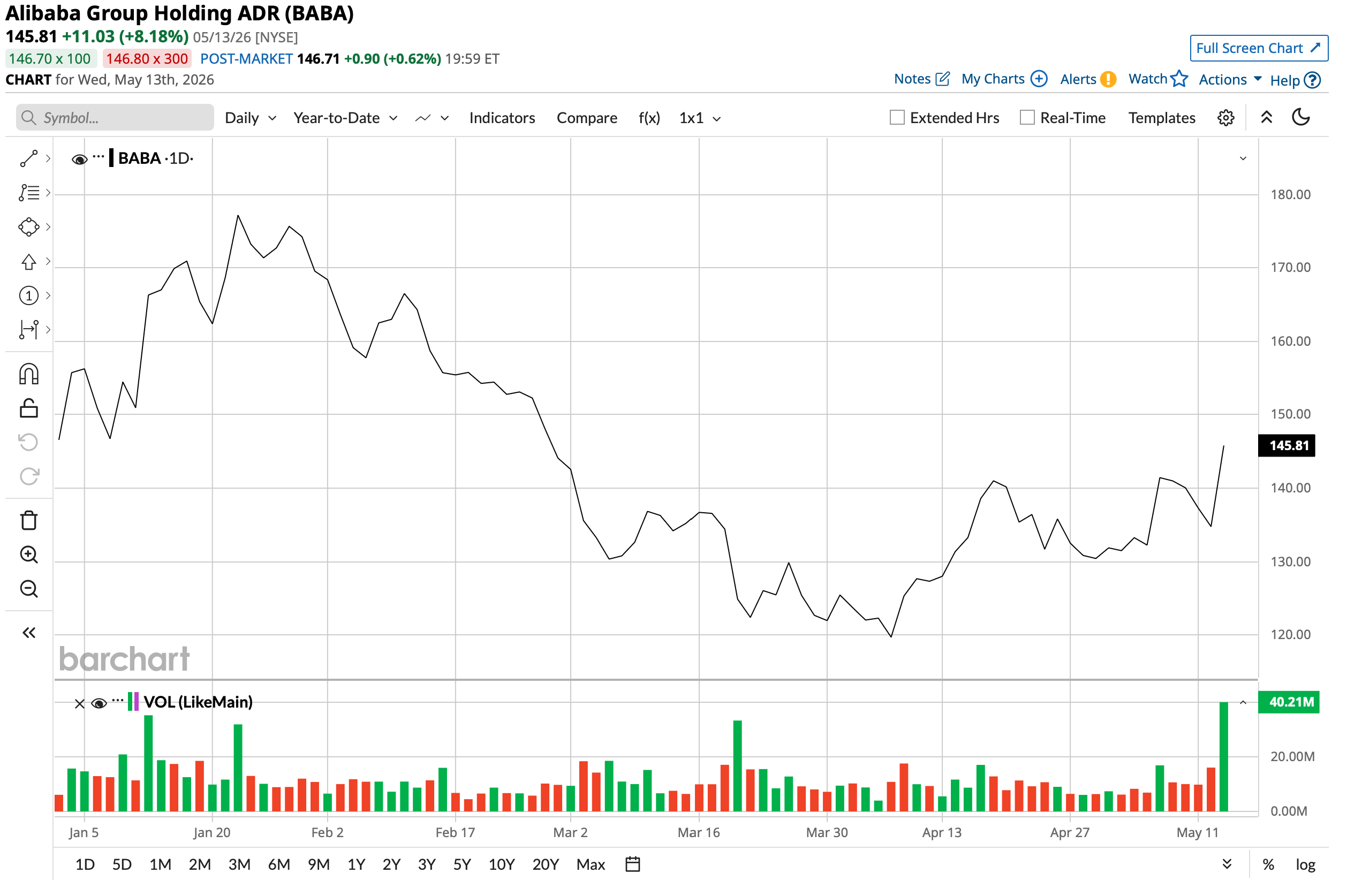
The headline about Alibaba (BABA) above could make one feel that shares must have nosedived following a disappointing set of results for Q4. The reality could not have been more different, as BABA stock surged by more than 8% as the market looked past the company's dwindling profits and found its increased AI spending favorable.
About Alibaba
Founded in 1999 by a team that included Jack Ma, Alibaba is a conglomerate spanning e-commerce, cloud computing, logistics, payments ecosystem, digital media, and now increasingly AI.
More Top Stocks Daily: Go behind Wall Street’s hottest headlines with Barchart’s Active Investor newsletter.
Valued at a market cap of about $340 billion, the BABA stock is down 3% on a YTD basis.
 www.barchart.com
 So, what to make of BABA as an investment? Let's find out.
Massive Dip in Earnings Yet BABA Is Rocking
For its Q4 2026 numbers, Alibaba's numbers were not exciting at the very core.
Revenues grew by just 3% from the previous year to $35.3 billion USD, while earnings fell by a shocking 95% YoY to $0.09 per share, far away from the consensus estimate of $0.90 per share.
However, amid the AI rush, what stood out was the 38% YoY rise in revenues to $6 billion by the company's cloud segment. The management was particularly bullish about it, revealing that 30% of the segment's revenues came from AI-related products, headlined by its Qwen LLM, which displayed impressive performance in reasoning and coding.
Meanwhile, net cash from operating activities dropped sharply to $1.4 billion, a 66% decrease from the year-ago period. Overall, Alibaba ended the March 2026 quarter with a cash balance of $19 billion, much higher than its short-term debt levels of R$4 billion.
Notably, BABA stock is also trading at overvalued levels, with forward P/E, P/S, and P/CF of about 27.07x, 2.02x, and 17.94x being all above the sector medians of 15.26x, 1.2x, and 15x, respectively.
Alibaba Is Doubling Down On AI
When the Western world is being wary of China's AI prowess, Alibaba has got a lot to do with it.
Unsurprisingly, the company's cloud business is a vital cog in Alibaba's AI machine, and management has been methodical about expanding both the depth and reach of what that segment offers. A recent addition to the product lineup is Alibaba Cloud Linux, a next-generation AI infrastructure operating system built to handle cloud-based AI workloads. The company claims it is capable of supporting the training of models operating at the trillion-parameter scale. Beyond the product itself, Alibaba has continued to extend its geographic footprint, with the cloud platform now active across 92 availability zones spanning 29 regions around the world.
On the model front, the company released Qwen 3.6 27B in April, positioning it as a response to Gemini 2.5 and GPT-5. The model use hybrid linear architecture and a sparse mixture of experts design to support a context window of up to 1 million tokens. Its pricing structure alone makes it a serious contender on the global stage. Qwen is also much cheaper than Claude or GPT at $1.30 per million input tokens and $7.80 per million output tokens. Performance benchmarks add further weight to the case, with Qwen 3.6 Plus clocking inference speeds up to 3x faster than Claude Opus 4.6, a gap that Qwen's model is largely responsible for producing.
Thus, should Alibaba succeed in addressing lingering concerns around safety and data privacy while also closing the gap on coding performance, the runway for Qwen to establish itself as the dominant large language model globally is considerable.
Cost discipline has also been a priority within the cloud segment, and the company has developed a suite of proprietary technologies to keep resource consumption in check as workloads scale. Among the most notable is Aegaeon, a scheduling and memory management system that has delivered an 82% reduction in GPU resource requirements for inferencing workloads that involve running multiple models simultaneously. By enabling a single GPU to carry tens of models at once and shifting data offloading to host memory, the technology has effectively mitigated the physical memory constraints that previously left thousands of GPUs sitting idle, a meaningful efficiency gain with direct implications for the segment's cost structure.
Investment in T-Head Semiconductor, Alibaba's internal chip design subsidiary, continues to compound these advantages. Management described the unit as scaling at an accelerating pace, and with its proprietary GPU now in full-scale production, T-Head has begun contributing in a tangible way to the company's cloud infrastructure supply chain rather than functioning purely as a research and development operation.
The final piece of the cloud narrative, however, concerns agentic AI, a category that management views as the most consequential expansion of the cloud services addressable market in the years ahead. Alibaba's entry into this space comes through Wukong, an AI native platform designed specifically for enterprise use.
Unlike a conventional personal assistant, Wukong functions as an orchestration layer, coordinating networks of specialized agents to manage complex workflows that unfold across multiple steps and systems. Management's conviction here is that as these agents begin absorbing meaningful portions of routine corporate work, the share of business revenue directed toward cloud and software services will expand by multiples relative to where it stands today, a dynamic that would reshape the growth trajectory of the segment considerably.
Analyst Opinion on BABA Stock
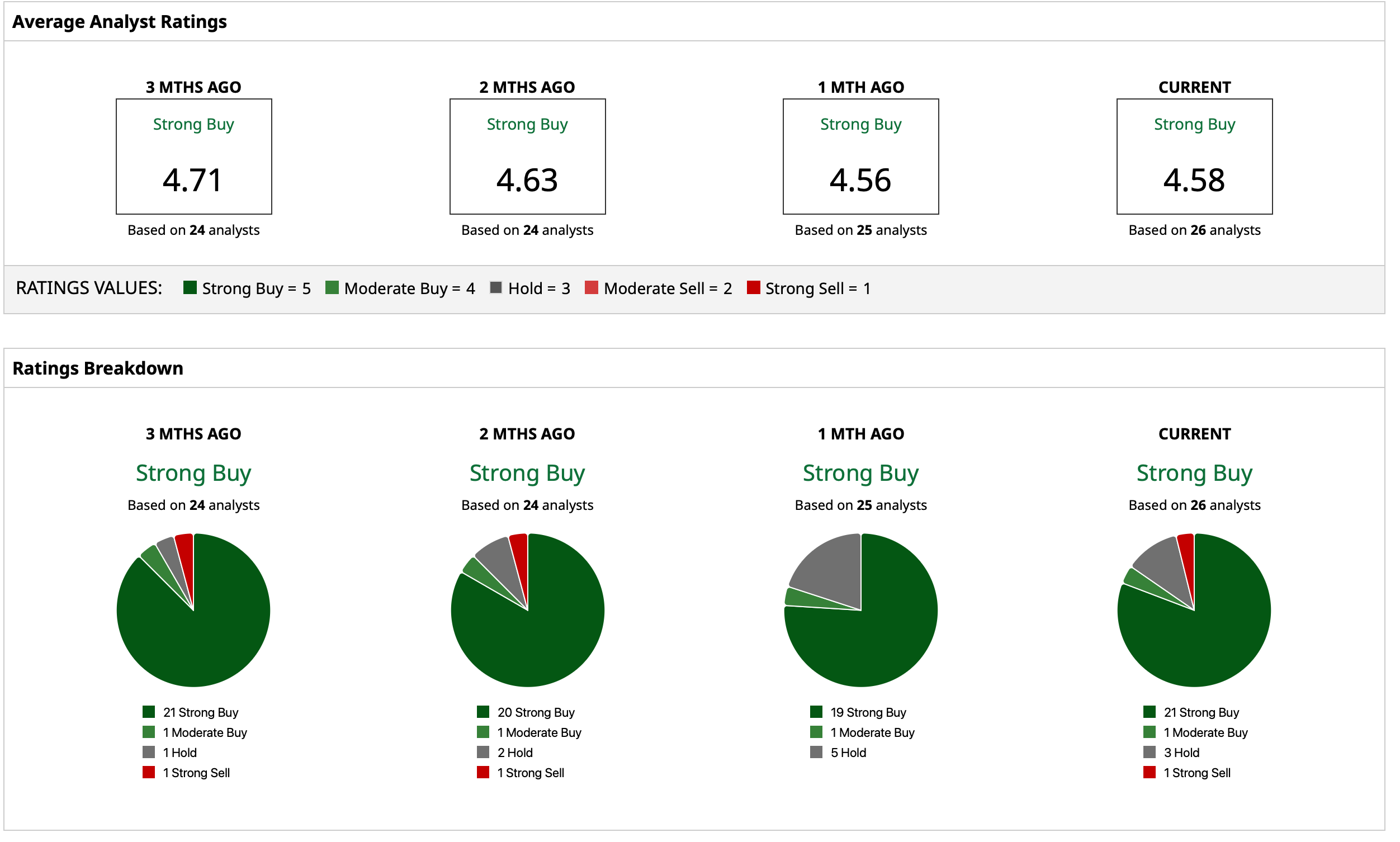
Analysts have deemed BABA stock to be a “Strong Buy,” with a mean target price of $183. This denotes an upside potential of about 30% from recent levels. Out of 26 analysts covering the stock, 21 have a “Strong Buy” rating, one has a “Moderate Buy” rating, three have a “Hold” rating, and one has a “Strong Sell” rating.
 www.barchart.com
 On the date of publication, Pathikrit Bose did not have (either directly or indirectly) positions in any of the securities mentioned in this article. All information and data in this article is solely for informational purposes. For more information please view the Barchart Disclosure Policy here.
More news from Barchart
NVDA Stock Jumps on Reports of Nvidia H200 Chip Sales to China Elon Musk’s Terafab Could Make Intel Stock More Exciting for Long-Term Investors Than Wall Street Ever Thought Was Possible AI Spending Hurts Alibaba's Q4 Profits. BABA Stock Is Still Rocking Higher. Microsoft Stock Is a Buy as Its AI Business’ Annual Revenue Run Rate Swells