

ASML Holding N.V. (ASML) holds one of the most critical positions in the global semiconductor supply chain. As the world’s sole supplier of extreme ultraviolet lithography machines, the Dutch chip equipment giant plays an indispensable role in producing the most advanced chips used in artificial intelligence (AI), high-performance computing, smartphones, data centers, and increasingly, autonomous systems.
That importance was underscored recently when Tesla (TSLA) and SpaceX (SPCX) CEO Elon Musk virtually attended an internal ASML event to discuss Terafab, his ambitious chipmaking initiative. The project is designed to bring advanced semiconductor production deeper into Musk’s industrial ecosystem, supporting future demand from Tesla’s self-driving vehicles, Optimus humanoid robots, and SpaceX’s space-based data centers. More importantly for ASML, any serious effort to manufacture cutting-edge chips will require access to the company’s extreme ultraviolet lithography systems—the machines widely regarded as the most critical tools in advanced semiconductor production.
More Top Stocks Daily: Go behind Wall Street’s hottest headlines with Barchart’s Active Investor newsletter.
So, while Musk’s Terafab ambitions reinforce ASML’s strategic importance, the more important question for investors is whether the opportunity is still compelling at current levels. Is ASML stock still a buy after its strong year-to-date (YTD) rally, or has much of the AI-driven upside already been priced in? Let’s take a closer look.
About ASML Holding N.V. Stock
Valued at $725.5 billion, ASML Holding N.V. is a Dutch multinational corporation and the world’s leading manufacturer of advanced semiconductor manufacturing equipment. ASML is best known for its extreme ultraviolet (EUV) lithography systems, which are essential for producing the most advanced chips used in AI, high-performance computing, smartphones, and data centers. The company is the only manufacturer in the world capable of supplying commercial EUV lithography machines, giving it a critical position in the global semiconductor supply chain.
Founded in 1984 as a joint venture between Philips (PHG) and ASM International, ASML has grown into Europe’s most valuable company. Its customers include Taiwan Semiconductor Manufacturing Company (TSM) , Intel Corporation (INTC), and Samsung Electronics.
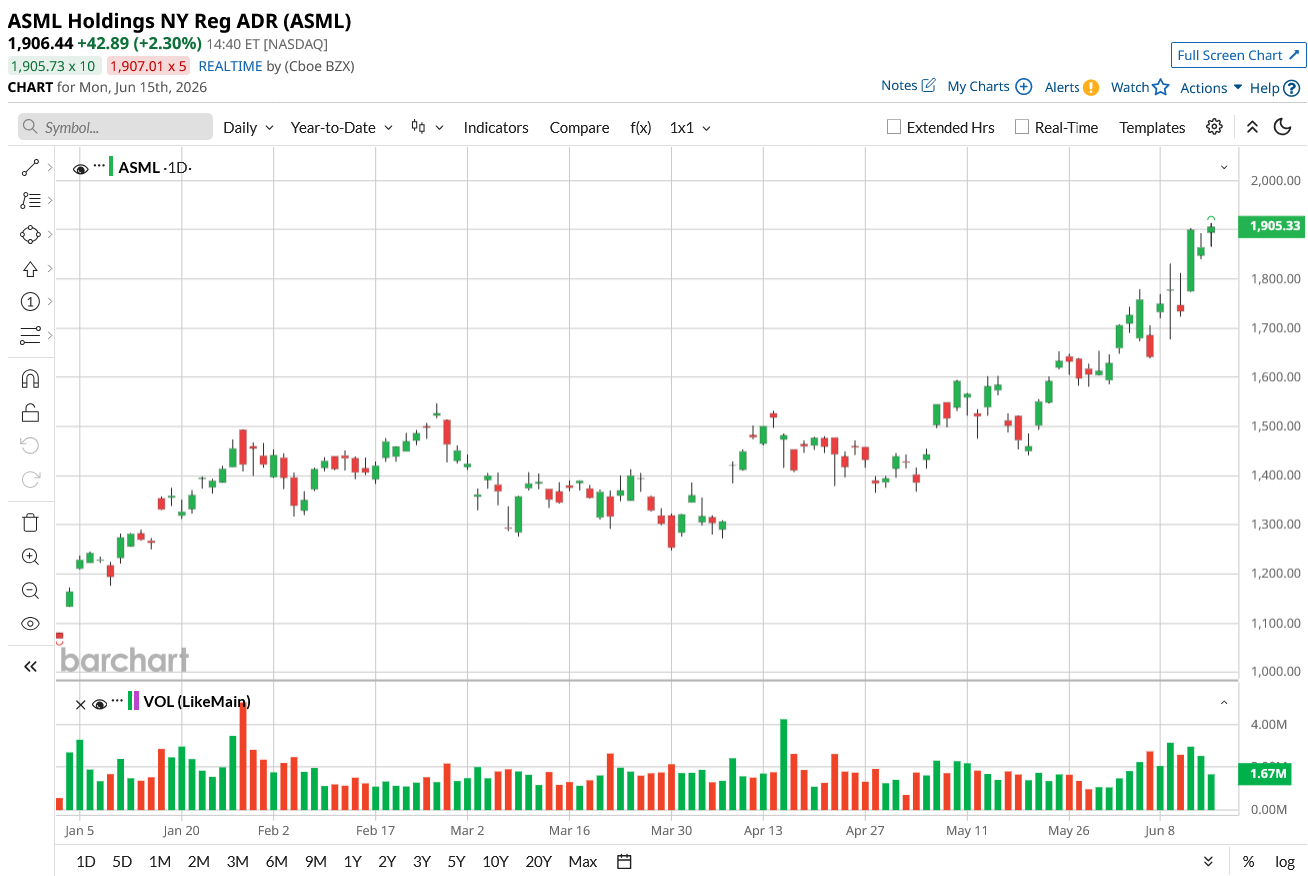
Shares of the chip-machine supplier have rallied 78% on a year-to-date (YTD) basis, fueled by the boom in AI spending that is driving demand for its machines.
 www.barchart.com
 Elon Musk Praises ASML as Tesla and SpaceX Push Into Chipmaking
Tesla and SpaceX CEO Elon Musk joined ASML’s annual Technology Conference via video last Thursday, participating in a fireside chat with ASML CEO Christophe Fouquet. The event was open only to employees, but the company confirmed Musk’s appearance. His appearance at the conference came shortly after he posted on X that ASML was “arguably the greatest company in Europe” and should be “treasured and supported.”
Bloomberg reported that ASML invited Musk to speak to employees about Terafab, a joint venture between SpaceX and Tesla focused on producing advanced chips for robotics, AI, and space-based data centers. According to Dutch media, Musk was given fifty minutes to present his plans. Musk officially unveiled plans for Terafab in March, a project aimed at bringing every stage of chip production, including design, fabrication, and advanced packaging, under one roof to produce more than 1 terawatt of AI computing capacity per year.
Musk has said the Terafab project is necessary because the semiconductor industry is not moving fast enough to meet the level of chip demand he expects in the future. Specifically, Musk expects his companies to require tons of advanced chips for self-driving vehicles, Optimus humanoid robots, and space-based data centers—a demand that he believes will eventually dwarf current global chip production. SpaceX’s S-1 filing stated that chip production remains one of the key bottlenecks to AI’s continued growth, adding that the Terafab initiative is intended to extend the company’s control over the full physical AI stack down to the foundational processor layer. The facility would target production of 2-nanometer chips, representing the cutting edge of current semiconductor technology.
And ASML is critical to Musk’s ambitions. ASML is the world’s sole supplier of EUV lithography machines, as well as the more advanced High-NA EUV systems needed for the latest chipmaking processes, with each machine costing hundreds of millions of dollars. So, it is clear that ASML will be a supplier of EUV machines for Terafab, which is expected to require a lot of them.
ASML CEO Fouquet said last month that he has held discussions with Musk regarding Terafab. Fouquet also stated that he views the project as a “serious endeavor.” “Musk and his team are becoming part of the broader semiconductor ecosystem, and many companies, including ASML, will collaborate on this initiative,” ASML said.
How Much Revenue Could Terafab Generate for ASML?
At this point, let’s take a closer look at what Musk’s Terafab initiative could mean for ASML financially.
SpaceX and its Terafab partner, Tesla, will initially invest $55 billion in the project. Terafab’s total estimated capital investment could reach $119 billion if additional phases are completed. The project would begin with a smaller advanced fabrication facility capable of designing and testing a broad range of chips, with plans to eventually expand into a much larger operation.
Now, let’s turn to the most interesting part. Lithography equipment typically accounts for about one-fifth of the cost of an advanced semiconductor plant. By doing simple math, we can estimate that lithography equipment for the Terafab project could cost from $11 billion to $23.8 billion. These figures represent a potential revenue opportunity for ASML spread over many years and do not even include the additional recurring revenue from services and upgrades once the tools are installed. With that, the Terafab initiative is highly attractive for the company from a financial standpoint.
However, investors should keep execution risk in mind, as the project is still in its early stages. Building a leading-edge fab from scratch is immensely complex and will require massive investment, cutting-edge technology, and rare technical expertise. Moreover, many of Musk’s largest projects have experienced delays or changes in scope.
ASML’s AI Tailwinds Are Powerful, But Is the Stock Still Attractive?
Stepping back from the Terafab project, ASML is already doing quite well, as chipmakers continue to pour billions of dollars into its machines to produce increasingly advanced AI chips. In mid-April, ASML raised its full-year revenue guidance to reflect rising demand for its products. The company now expects sales of between 36 billion and 40 billion euros ($42.56 billion to $47.29 billion), up from its previous guidance range of 34 billion to 39 billion euros.
“Demand for chips is outpacing supply. In response, our customers are accelerating their capacity expansion plans for 2026 and beyond, supported by long-term agreements with their customers,” CEO Fouquet said. “In the past months, our customers have increased their expected short- and medium-term demand for our products.”
Meanwhile, UBS analysts recently noted that ASML Holding’s lithography machines are likely to generate more revenue than previously expected in the coming years as customers ramp up production of memory and logic chips. The analysts expect revenue from ASML’s extreme ultraviolet lithography machines to increase 37% YoY in 2027 and 10% YoY in 2028, compared with previous forecasts calling for 26% growth in 2027 and a 1% drop in 2028. They also expect revenue from the company’s deep ultraviolet lithography systems to rise 28% in 2027 and 24% in 2028, up from prior forecasts of 16% and 17% growth, respectively.
Putting it all together, ASML Holding’s growth outlook remains quite positive as the ongoing AI boom drives strong demand for its lithography machines. Still, I do not view ASML stock as particularly attractive at current levels. After a strong YTD rally, the stock is currently trading at 51.29x forward adjusted earnings, representing a premium of more than 36% to its five-year average. I view this valuation as stretched, leaving little to no margin of error. For this reason, I trimmed my ASML position by half last week.
On the date of publication, Oleksandr Pylypenko had a position in: ASML , SPCX . All information and data in this article is solely for informational purposes. For more information please view the Barchart Disclosure Policy here.
More news from Barchart
Momentus Stock Is Up 145% In 2026. How to Play MNTS After the SpaceX IPO. NVDA Stock Alert: Nvidia Aims to Raise $20 Billion From Bond Offering Elon Musk Needs ASML for Terafab. You Don’t Need ASML Stock in Your Portfolio. If You’re Looking for the ‘Next Big Thing’ Before the OpenAI and Anthropic IPOs, Try This Barchart Stock Screener