

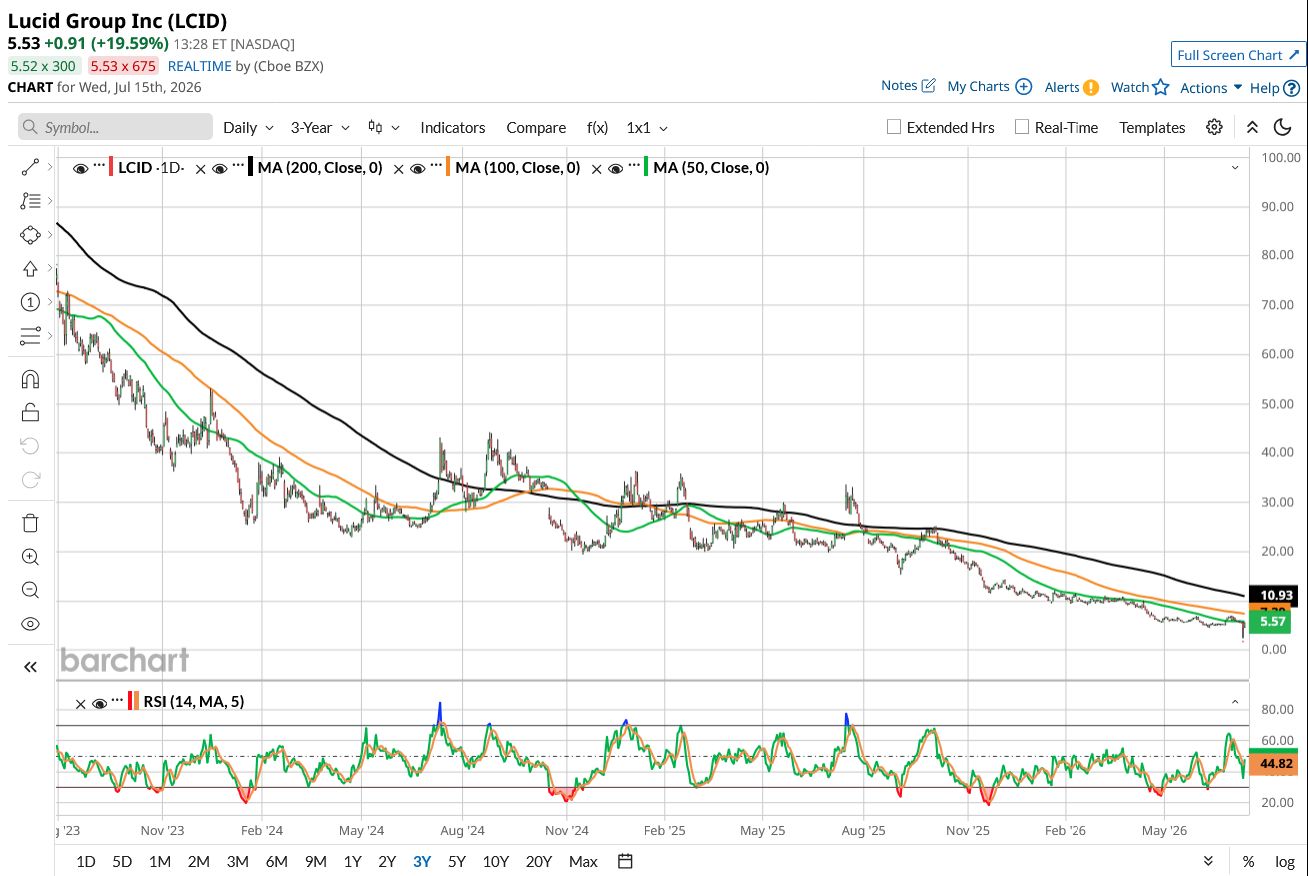
Lucid Group (LCID) stock whipsawed yesterday, July 14, amid reports that the company is considering going private or filing for Chapter 11 bankruptcy. LCID fell to an all-time low of $2.37 amid the rumors, and while it recovered after the company categorically denied these reports, it still fell over 16% and closed below $5, which is the SEC’s threshold for penny stocks. LCID stock has since rebounded today, up about 20% in afternoon trading to around $5.50.
Incidentally, if not for the 1-for-10 reverse stock split effective Aug. 29, 2025, Lucid would have been a penny stock anyway. It trades at a tiny fraction of its 2021 highs, when it nearly became a $100 billion market-cap company amid the euphoria around electric vehicle (EV) stocks. Despite the rebound from the lows, Lucid’s market cap is below $2 billion as of yesterday’s closing prices. As for all-time lows, they have been a perennial event for LCID stock, which has closed in the red in every year since its 2021 listing and has been slumping from one record low to another.
More Top Stocks Daily: Go behind Wall Street’s hottest headlines with Barchart’s Active Investor newsletter.
 www.barchart.com
PIF Has Lost Billions of Dollars in Lucid Motors
While numerous investors, including myself, have lost a lot of money betting on Lucid Motors, the biggest loser in absolute terms is Saudi Arabia’s Public Investment Fund (PIF), which first invested in the company in 2018 and has since participated in all its capital raises. Apart from infusing money as equity, PIF has also opened a credit line for Lucid, which has been burning cash at an alarming pace.
In my previous article, I noted that Saudi fund infusion alone won’t solve all of Lucid’s woes. Notably, if PIF were not the sovereign wealth fund of the world's richest kingdom and were instead a professionally managed hedge fund, more than a few heads would have rolled given the kind of wealth destruction Lucid has done for the fund.
That said, the partnership with Lucid wasn’t only meant to boost PIF’s profits, but the investment also aligns with the Saudi leadership's intention to diversify from oil revenues. Lucid built the Kingdom’s first car manufacturing facility and is now building the second one, which, unlike the first one, would actually build cars instead of only assembling them. Apart from backing Lucid with the humongous petrodollars that it generates, Saudi Arabia has also agreed to buy up to 100,000 Lucid vehicles. That, for context, is four times the lower end of Lucid’s now withdrawn 2026 production guidance.
Is LCID Stock a Buy or a Sell?
I was bearish on LCID stock for much of its history as a publicly traded company, even though the company came up with a good product proposition in its first model, the Air sedan. However, at some time I saw the valuations getting attractive and took positions in the stock, which in hindsight was a blunder. My investing premise was based on the assumption that, unlike most other EV startups, Lucid had a quality product. Also, the PIF backing has been ensuring the company’s survival, unlike most EV startups where investors pulled the plug after a point.
However, while the frequent capital raises have helped Lucid survive, it should not be a reason to buy the stock, as eventually it has to thrive by becoming a sustainably profitable business that does not need to rely on external funding until perpetuity.
That, however, hasn’t been the case, and Lucid’s sales have failed to take off. While the tepid sales of the Air sedan could be partially blamed on apathy towards sedans in general, even the sales of the Gravity SUV haven’t really been all that impressive. The company has been producing more cars than it can sell, which has left it with a bloated inventory. It hasn’t helped that its cars have faced quality and software issues. Lucid also recently faced a supplier issue and is facing a lawsuit over allegedly concealing the issue that halted the deliveries of the Gravity SUV for 29 days during Q1 2026.
I exited Lucid late last month and would steer clear of the stock even though there could be a relief rally. The EV industry is a troubled space to start with, and Lucid has a new C-suite in place that is relying heavily on the success of its upcoming midsize platform to revive the company. It won't be an easy sailing for that program given the flurry of low-cost models expected to hit the market over the next two years.
To sum it up, there are simply too many uncertainties associated with Lucid that I find it tough to build a buying case even at these depressed valuations.
On the date of publication, Mohit Oberoi did not have (either directly or indirectly) positions in any of the securities mentioned in this article. All information and data in this article is solely for informational purposes. For more information please view the Barchart Disclosure Policy here.
More news from Barchart
Lucid Motors Denied the Bankruptcy Rumors, But That's Not Enough to Make LCID Stock a Buy Applied Materials CEO Just Reinforced the AI Investment Thesis. How to Play AMAT Stock Here. Huge, Unusual Put Options Volume in Nvidia - Are Investors Bullish or Bearish on NVDA? The $3.5 Billion Reason TeraWulf Stock Is in Focus Today