


Artificial intelligence has reshaped the stock market over the past two years, rewarding companies building the infrastructure behind the next generation of computing. Data centers, chips, power systems, and cloud platforms became the picks-and-shovels businesses of the AI boom. But history has shown that markets eventually separate real earnings power from expensive promises. Companies that spend aggressively during a technology transition can create enormous opportunities—but they can also leave investors questioning whether growth will justify the bill.
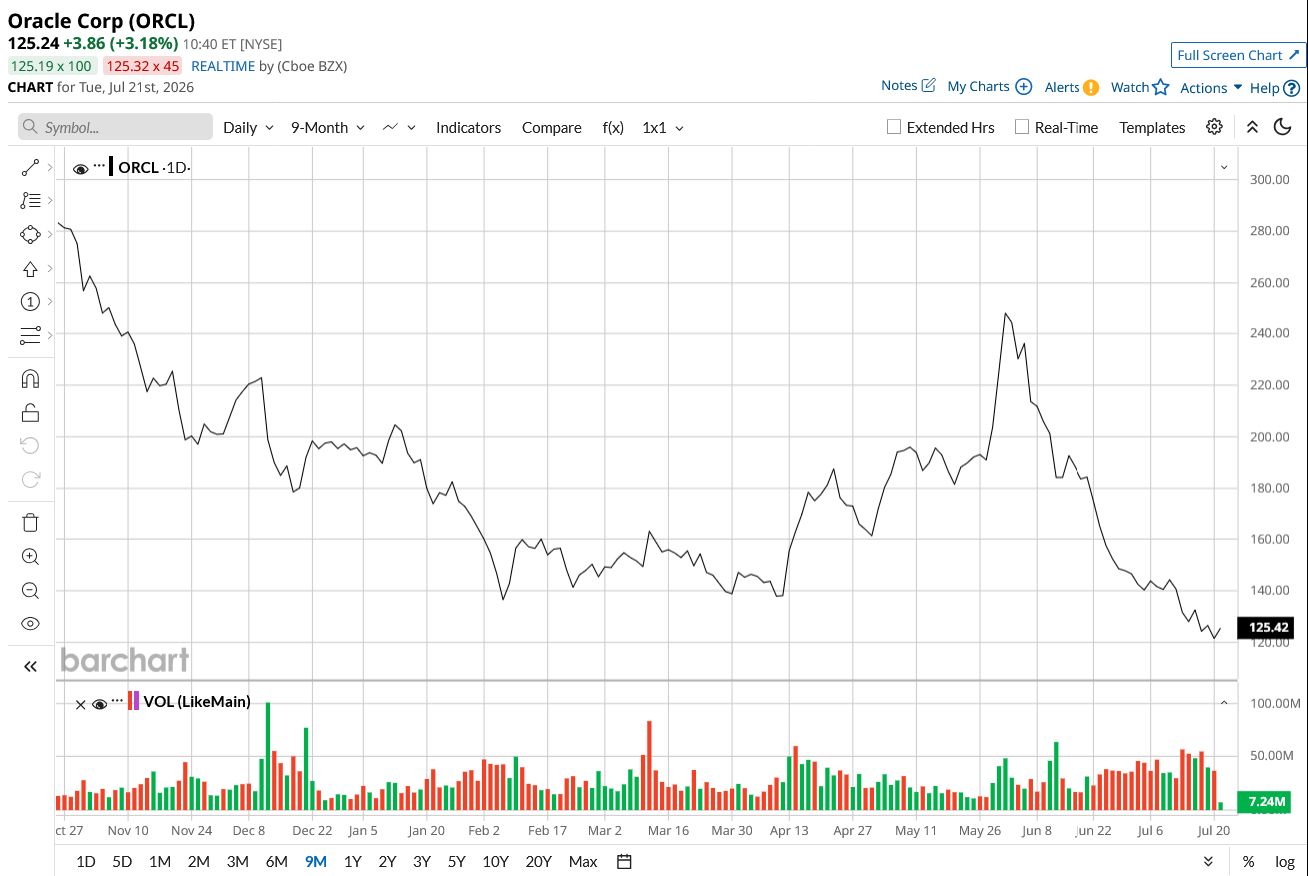
Few companies have experienced that shift more dramatically than Oracle (ORCL). After riding the AI wave to an all-time high of $345.72 in September 2025, the database and cloud giant has entered one of the steepest declines in its modern history.
More Top Stocks Daily: Go behind Wall Street’s hottest headlines with Barchart’s Active Investor newsletter.
Oracle’s AI Boom Turned Into an AI Spending Test
Oracle became one of the biggest beneficiaries of the AI infrastructure race after announcing massive cloud commitments tied to artificial intelligence workloads.
The company’s partnership with OpenAI and involvement in the Stargate Project—a multibillion-dollar AI infrastructure initiative—pushed investors to view Oracle as a critical player in the AI buildout. Its remaining performance obligations, a measure of contracted future revenue, reached $638 billion in fiscal 2026.
But the same numbers that fueled the rally eventually became a source of concern. Investors began questioning whether Oracle could finance the enormous capital spending required to deliver those contracts. The company has committed billions of dollars toward data centers, including Project Jupiter, while taking on additional debt to fund expansion.
The concern is straightforward: AI infrastructure requires massive upfront investment, while the financial payoff arrives over years. Oracle’s balance sheet reflects that pressure, as it carries more than $122 billion in long-term debt while investing heavily in property and equipment.
The risk became more visible because roughly half of Oracle’s enormous backlog is connected to OpenAI, concentrating a large portion of future expectations around one customer.
 www.barchart.com
 A 65% Collapse That Rivals The Dot-Com Era
The market’s verdict has been severe. ORCL stock has fallen 65% from its September peak, recently trading near $125 per share. That decline represents Oracle’s worst peak-to-trough drop since the dot-com bust.
The only larger decline came between 2000 and 2002, when Oracle shares plunged approximately 84% as the technology bubble collapsed. It has had other notable drawdowns, such as in the 1990s and in 2008, and while significant, they were generally smaller than the current one in the post-2000 era.
Moreover, the 84% dot-com collapse unfolded over roughly two years, but the current downturn has erased 77% of the value lost during that decline and done so in less than a year. Only about 22% more downside from the current decline would match Oracle’s worst-ever drawdown.
That speed matters. Markets can forgive aggressive spending when growth expectations remain intact. They become less forgiving when investors question whether returns will justify the investment.
Oracle's New Data Center Problems Add to Investor Concerns
Oracle’s latest setback came from outside the earnings report. New Mexico regulators rejected permits for the second time for a pipeline needed to support its Project Jupiter data center. The decision adds another obstacle to the company’s ambitious AI infrastructure expansion.
Data centers require more than servers and chips. They need electricity, water, land, and supporting infrastructure. Any delay can push back revenue generation while leaving companies carrying the cost of construction.
That said, Oracle’s business is not collapsing. The company remains a profitable enterprise software provider with decades of database dominance and a growing cloud business. Its challenge is proving that AI spending will generate returns that justify the scale of investment.
ORCL Stock: Key Takeaway
In short, Oracle’s 65% decline is historic, but the stock’s future depends less on its past and more on whether its AI investments produce durable cash flow. The market is no longer rewarding Oracle simply for having AI exposure. Investors want evidence that the company can turn a massive backlog, including OpenAI-related commitments, into profitable growth.
For long-term investors, the selloff creates a critical question: Is Oracle experiencing a temporary reset similar to other technology transitions, or is the market repricing an AI spending model that demands too much capital?
The answer will come from cash flow, margins, and execution. Until Oracle proves that its AI infrastructure investments generate returns, shareholders should expect the stock to remain tied to those doubts.
On the date of publication, Rich Duprey did not have (either directly or indirectly) positions in any of the securities mentioned in this article. All information and data in this article is solely for informational purposes. For more information please view the Barchart Disclosure Policy here.
More news from Barchart
Oracle’s Worst Stock Crash in 25 Years: Only Time Will Tell If It Can Recover from Its AI Spending Gamble Tesla Earnings Iron Condor Could See a 67% Return in 3 Days Nasdaq Futures Slip as Chip Rally Falters Ahead of Alphabet Earnings This High-Yield Bank Stock Just Raised Its Dividend by 11%