


Shares of data-storage company Seagate Technology (STX) moved higher following the company's better-than-expected fourth-quarter results reported on July 28. Revenue and earnings came in above consensus estimates, while Seagate also delivered on guidance.
Will the solid Q4 print add to STX stock's already-searing rally so far this year? Or are there any signs of derailment? Let's take a closer look.
More Top Stocks Daily: Go behind Wall Street’s hottest headlines with Barchart’s Active Investor newsletter.
About Seagate Technology Stock
Seagate Technology is one of the world's dominant manufacturers of hard disk drives (HDDs) and a critical supplier of mass-capacity storage. Alongside Western Digital (WDC), the company sits at the center of the global HDD industry, with its products used in hyperscale cloud data centers, enterprise storage, network-attached storage, video and image applications, and consumer devices.
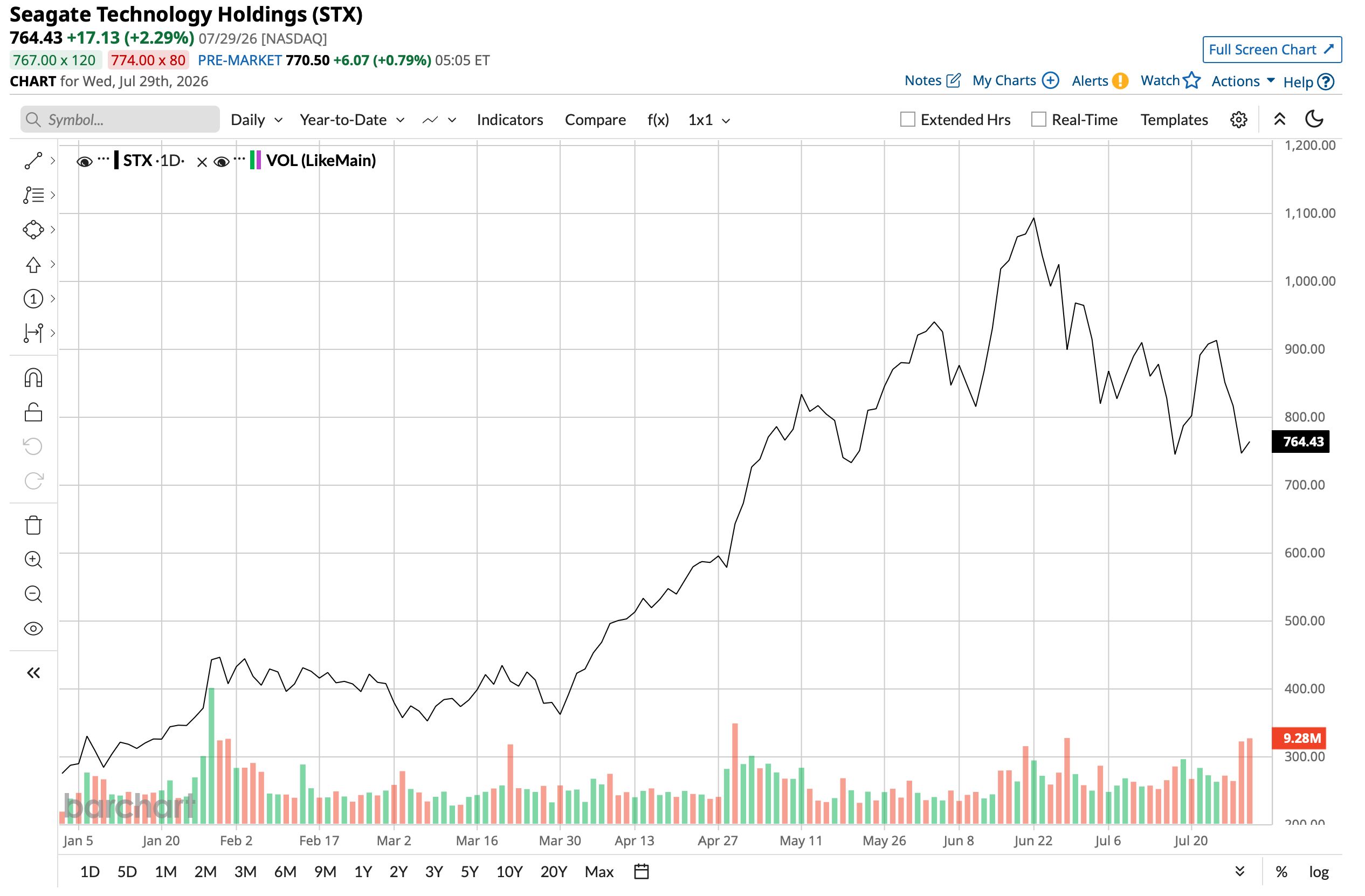
Valued at a market capitalization of $191.9 billion, STX stock has been on a tear this year. Shares are up 211% on a year-to-date (YTD) basis. Further, the stock offers a dividend yield of 0.35%.
 www.barchart.com
 Seagate Reports Solid Q4 Results With AI-Driven Growth Drivers
The Q4 numbers reinforced that the primary growth driver for Seagate remains “robust cloud data center demand,” as revenue and earnings witnessed sharp moves upward from the previous year. The company reported revenue of $3.63 billion during the quarter, up 49% year-over-year (YOY). Gross margin came in at 52.7% and crossed the 50% threshold, reflecting the firm's solid competitive position in the mass-storage market. That was up from a non-GAAP gross margin of 37.9% in fiscal Q4 2025. Moreover, Q4 marked the 13th consecutive quarter of gross margin expansion from the company.
Data-center revenue grew 57% YOY to $2.9 billion, accounting for about 80% of total revenue and underscoring how critical the segment has become to the company's operations. This also explains a key operational metric for Seagate: HDD exabyte capacity shipped. This metric shows how much storage capacity the company sold and is therefore a reflection of demand for Seagate's products. Nearline HDD exabyte capacity shipped — the storage capacity sold to hyperscalers — saw impressive YOY growth of 43% to 195 exabytes, making clear where the demand is coming from. On the other hand, non-nearline HDD exabyte capacity shipped dropped 10% YOY to 23 exabytes as consumer demand remains weak.
Meanwhile, EPS more than doubled to $5.71, exceeding analysts' expectation of $5.10 per share. Notably, Q4 marked the ninth consecutive quarter showing an earnings beat from the company.
For Q1 2027, Seagate expects revenue in the range of $4 billion to $4.2 billion, which is higher than estimates of $3.8 billion. Similarly, the company's Q1 earnings forecast of $7.10 to $7.50 per share is above the analyst consensus estimate of $5.85 per share.
Coming to cash flows, for the fiscal year ended July 3, 2026, net cash from operating activities jumped to $3.67 billion from $1.08 billion in the year-ago period. Free cash flow grew by an even sharper YOY rate to $3.11 billion, up from just $818 million. Overall, the company closed the quarter with a cash balance of $1.7 billion, which was much higher than its short-term debt levels of $185 million. Net debt at the end of Q4 was $1.9 billion, down from $4.2 billion in the year-ago period.
However, as with any name that has experienced a stupendous rally, valuation concerns remain for STX stock. The forward price-to-earnings (P/E) ratio, price-to-sales (P/S) ratio, and price-to-cash flow (P/CF) multiple of 30.1 times, 15.6 times, and 52.1 times are all well above the respective sector medians.
Mozaic 5 Promises Growth
In my most recent analysis of Seagate, I established that the company was a leader in mass storage. Seagate's competitive advantages stem from its heat-assisted magnetic recording (HAMR) technology, combined with its Mozaic platform.
CEO Dave Mosley hammered that point home in the company's latest earnings release. “As AI accelerates data generation and its value, we see durable long-term demand for mass capacity storage,” he said. "Seagate is well positioned to address strengthening exabyte demand through our Mozaic platform and differentiated HAMR technology roadmap, enabling customers to scale efficiently while supporting our ability to drive profitable growth and value creation.”
The next stop in the roadmap will be Mozaic 5. At roughly 5 terabytes per platter, the platform is expected to go live in late 2027 or early 2028, pushing drive capacities into the 50TB tier. In terms of improvement, Mozaic 5 is expected to bring in a stack of incremental gains across finer magnetic layers on each platter, sharper accuracy for track alignment, and continued refinement of the vertically integrated photonics for Seagate's HAMR technology. The company expects customers to prefer Mozaic 5 because every additional terabyte packed into the same physical drive footprint lowers the cost per terabyte and the power draw per terabyte simultaneously.
Seagate has quantified this before, noting that its Mozaic platform “improves infrastructure efficiency by approximately 47%” in a one-exabyte deployment compared to standard 30TB drives. Each successive generation should widen that efficiency gap rather than narrow it.
All of that brings us to revenue. Seagate's backlog for nearline exabyte capacity is reportedly full through calendar 2028 under build-to-order agreements, meaning pricing discipline is already locked in well ahead of the next generation shipping, and every terabyte increase per platter effectively raises average selling prices without a proportional rise in manufacturing cost. Consequently, a path toward further margin expansion seems clear.
What Do Analysts Think of STX Stock?
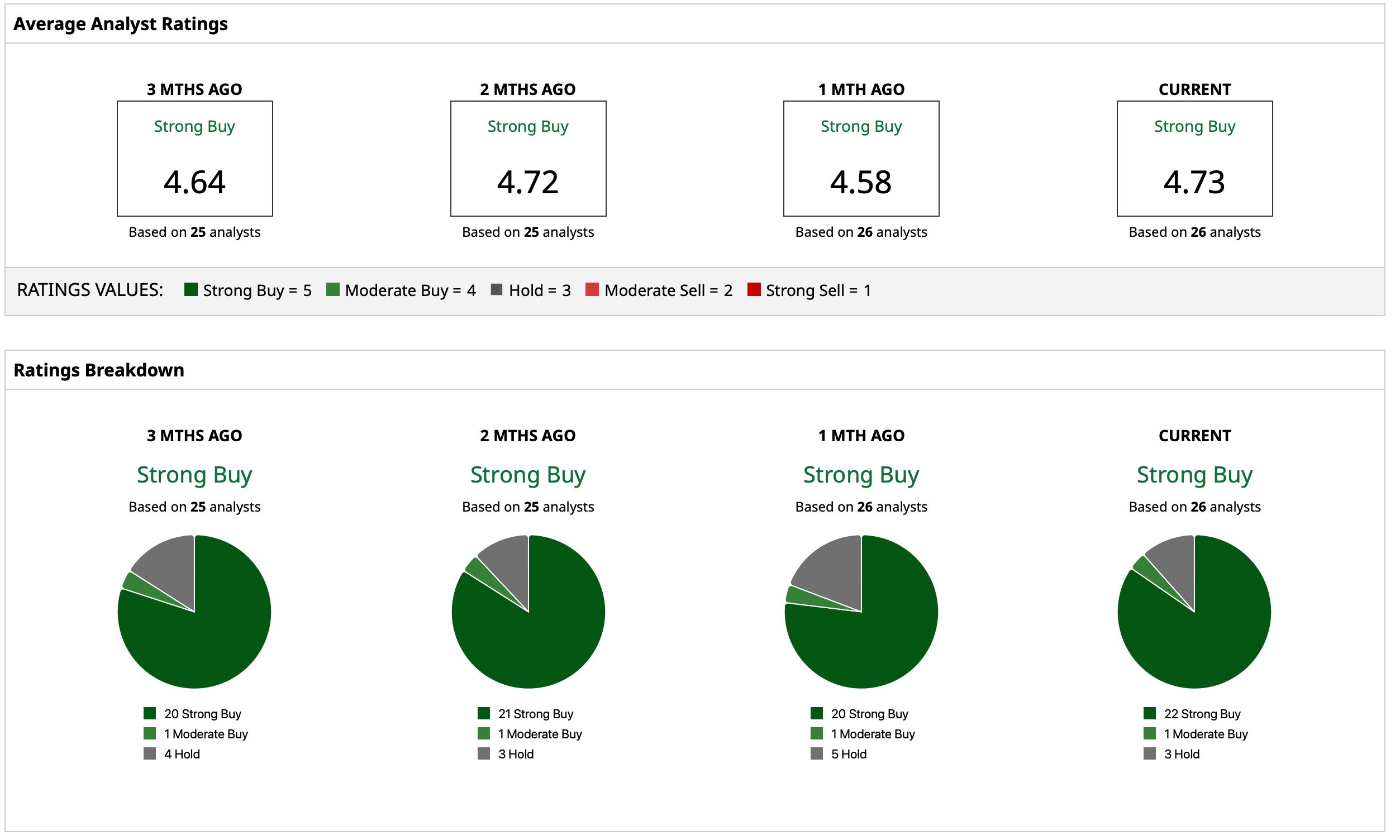
Overall, analysts have a consensus “Strong Buy” rating for STX stock. Out of 26 analysts covering the stock, 22 have a “Strong Buy” rating, one has a “Moderate Buy” rating, and three have a “Hold” rating. The mean target price of $1,123.52 denotes potential upside of 31% from current levels
 www.barchart.com
 On the date of publication, Pathikrit Bose did not have (either directly or indirectly) positions in any of the securities mentioned in this article. All information and data in this article is solely for informational purposes. For more information please view the Barchart Disclosure Policy here.
More news from Barchart
After a More Than 20% Sell-Off on Earnings, Corning Stock Is Still a ‘Buy’ for the AI Infrastructure Trade Wedbush Flags Near-Term Risks From Nvidia’s Alleged OpenAI Data Center Support Seagate Rallies on Strong Q4 Results and Guidance. What Does This Mean for STX Stock Here. Apple Delivers Strong Free Cash Flow, But What is the Best AAPL Play?