

Intel Corporation (INTC) is making a huge bet on its comeback, and Wall Street is watching closely. Last week, the chip giant revealed it plans to raise about $15 billion through a new share offering, but strong investor demand led it to increase the offering to $20 billion. Including the 30-day option given to underwriters to purchase additional shares, Intel ultimately raised about $23 billion. The timing is hard to ignore. Intel has spent years playing catch-up as rivals pulled ahead in technology and manufacturing, but CEO Lip-Bu Tan is now pushing the company to regain its competitive edge.
The fresh capital gives Intel more room to do just that, with the proceeds earmarked for “general corporate purposes,” including capital expenditures and working capital. A big part of Intel’s comeback depends on Intel Foundry. The company is pouring money into new manufacturing facilities as it works to expand its foundry business and support efforts to bring more chip production back to the United States. Meanwhile, expanding data center build-outs are driving demand for CPUs, giving the company another reason to step up investment.
More Top Stocks Daily: Go behind Wall Street’s hottest headlines with Barchart’s Active Investor newsletter.
Wall Street analysts are taking notice, too. GF Securities said Intel’s $23 billion capital raise could signal progress in its all-important foundry business and a potentially expanding customer base. That could be an important development for a stock that has already delivered a massive rally in 2026. With Intel now armed with billions in fresh capital and its foundry ambitions gaining traction, investors are watching to see whether the company can turn its comeback story into sustainable growth. Here’s a closer look at Intel’s stock and what could be next.
About Intel Stock
Intel has been through a lot in recent years, but the semiconductor giant is starting to look very different from the company investors had grown accustomed to. Founded in 1968 and headquartered in Santa Clara, California, Intel built its legacy around the processors powering PCs. Today, its ambitions extend far beyond that core business, with operations spanning client computing, data center and artificial intelligence (AI) processors, networking and edge computing, and Intel Foundry Services (IFS), its growing contract manufacturing business.
The shift comes as AI and advanced computing create a new battleground for semiconductor companies. Intel is now trying to rebuild its position on two fronts, as a leading chip designer and as a major semiconductor manufacturer. It’s a bold strategy, especially after years of slowing growth, declining margins and earnings, and weakening investor confidence allowed rivals such as Nvidia Corporation (NVDA) and Advanced Micro Devices (AMD) to take the lead in AI.
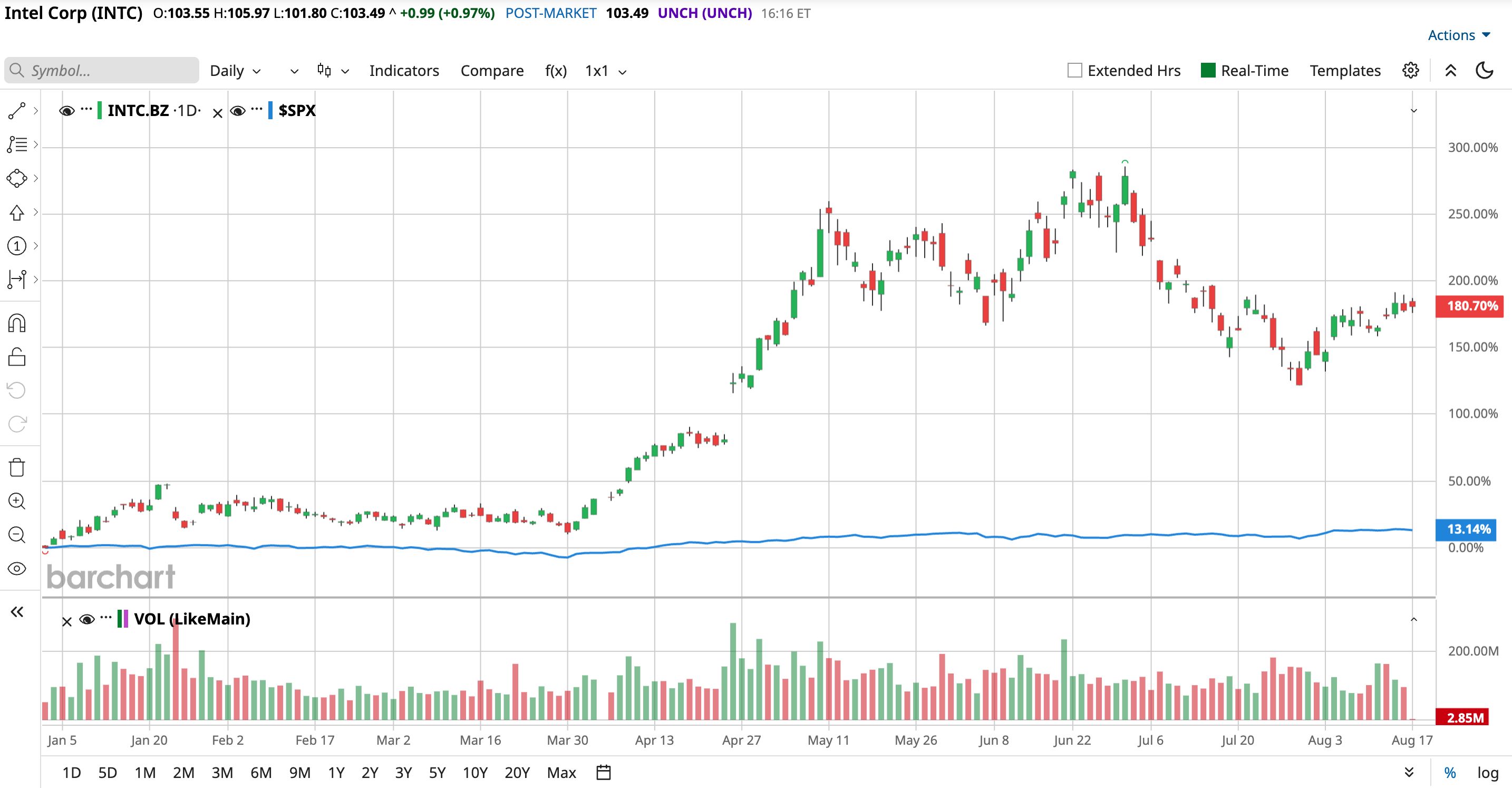
For now, investors appear increasingly willing to bet on the comeback. Intel’s market capitalization stands at $517 billion, while the stock has surged 323.6% over the past year, compared with a 20.2% gain for the S&P 500 Index ($SPX). The 2026 rally has also remained strong, with INTC up 182%, dramatically ahead of the broader market’s 13.3% advance.
That kind of rally has also raised expectations. Intel shares reached a record $142.35 on June 30 before giving back 27.3% from that peak. With the stock still sitting on enormous gains, the focus is now shifting from whether Intel can rally to whether the company can deliver the business improvements needed to support those gains.
 www.barchart.com
 Inside Intel’s Q2 Earnings Report
Intel delivered another strong quarterly performance on July 23, with its fiscal 2026 second-quarter results comfortably beating Wall Street expectations on both the top and bottom lines. Revenue came in at $16.1 billion, up 25% year-over-year (YOY), marking the company’s strongest revenue growth in more than 15 years. The performance was driven by greater speed, accountability, and customer focus, while revenue also easily topped Wall Street’s estimate of $14.43 billion.
Non-GAAP earnings per share (EPS) came in at $0.42, nearly double the consensus estimate of $0.22 and a sharp turnaround from the $0.10 non-GAAP loss reported in the same quarter a year earlier. Intel’s core businesses also delivered strong results. Revenue from the Client Computing Group, which makes chips for PCs, rose 13% to $8.9 billion, keeping it as the company’s largest business. However, the stronger growth came from Intel’s data center business, where revenue jumped 59% to $6.3 billion.
Higher demand for enterprise hardware and robust adoption of the Xeon 6+ lineup helped drive operating profit for the segment to $2.5 billion. Intel Foundry was another bright spot, with revenue climbing 31% YOY to $5.8 billion. The company continued advancing its Intel 18A family, with Intel 18A-P entering risk production on schedule and meeting the timeline previously shared with customers and partners. The platform is being expanded with improvements in performance, power, and thermal resistance.
The improvement extended beyond revenue, with profitability metrics strengthening significantly. Non-GAAP gross margin reached 41.8%, more than 12 percentage points higher than in the second quarter of 2025. Intel also generated $7 billion in cash from operations during the quarter. Intel CFO Dave Zinsner attributed the strong quarter to robust demand and improved execution, including higher factory yields and better cycle times that provided additional volume upside.
Further, the CFO noted that AI-driven computing continues to strengthen, prompting Intel to meaningfully increase investments in equipment, clean room space, and substrates to support expected growth across its product and foundry businesses this year and next. Looking ahead to fiscal 2026’s third quarter, management expects revenue to land between $15.8 billion and $16.8 billion. Non-GAAP gross margin is projected at 42%, while adjusted EPS is expected to come in at $0.38.
What Do Analysts Think About Intel Stock?
Recent analysis from GF Securities adds a bullish angle to Intel’s $23 billion capital raise, suggesting it could signal meaningful progress in the company’s all-important foundry business. The firm pointed to solid 18A yields, stronger external customer engagement, particularly with Apple (AAPL), and increased equipment purchases as encouraging signs. GF Securities analyst Jeff Pu maintains a “Buy” rating and a $136 price target on Intel, while expecting Intel Foundry to reach breakeven by the fourth quarter of fiscal 2027, followed by meaningful margin expansion in 2028.
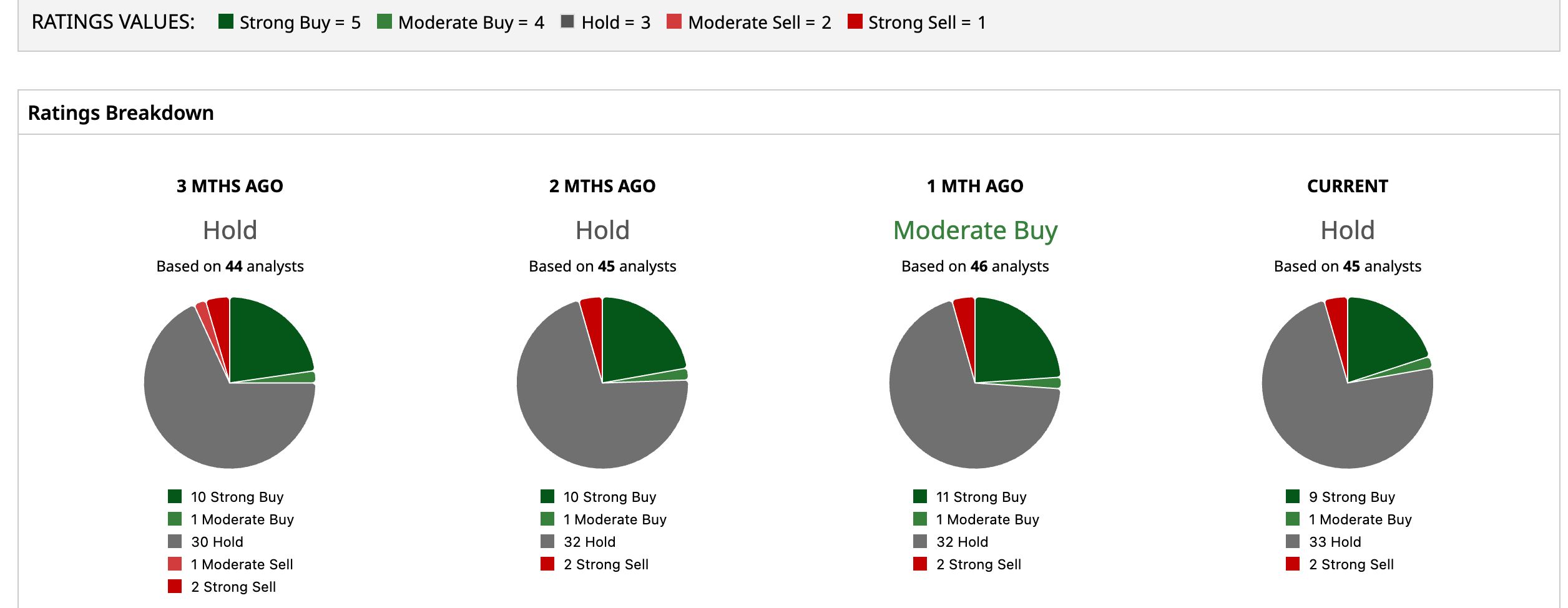
Additionally, the firm expects Intel’s EMIB customer base to expand beyond Alphabet's (GOOG) (GOOGL) Google to include Amazon.com (AMZN) Amazon Web Services (AWS) and others, with EMIB revenue projected at $1.1 billion in 2027 and as much as $7 billion in 2028. Still, Wall Street isn’t fully sold on Intel’s turnaround just yet. The stock carries a consensus “Hold” rating, with 33 of 45 analysts taking a wait-and-see approach.
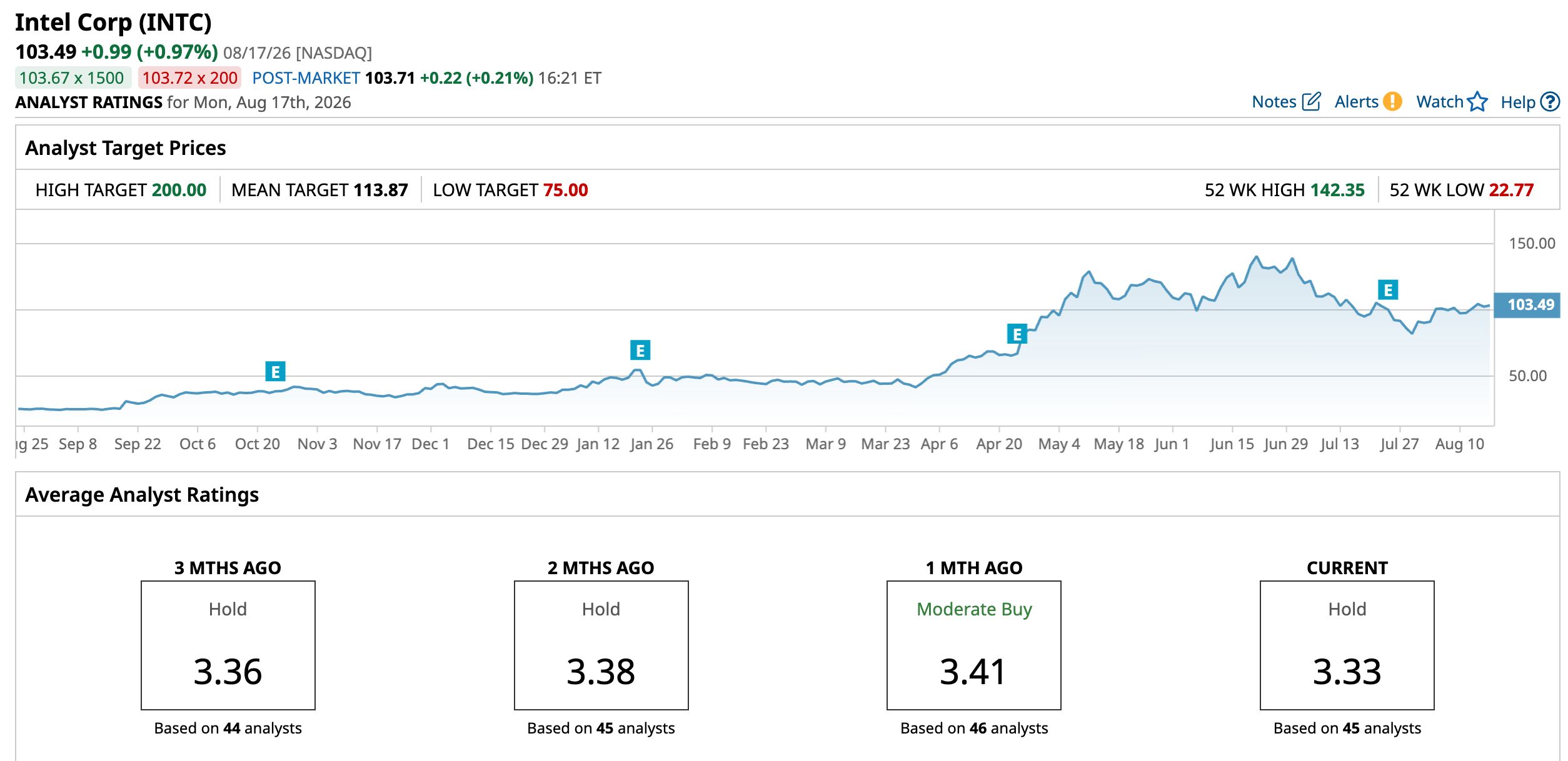
Nine analysts rate INTC a “Strong Buy,” one has a “Moderate Buy,” while just two recommend a “Strong Sell.” That cautious stance, however, leaves plenty of room for upside if Intel delivers on its comeback plans. The $113.87 average price target implies 10% upside, while the $200 Street-high target suggests a potential 93.3% gain from current levels.
 www.barchart.com
  www.barchart.com
 On the date of publication, Anushka Mukherji did not have (either directly or indirectly) positions in any of the securities mentioned in this article. All information and data in this article is solely for informational purposes. For more information please view the Barchart Disclosure Policy here.
More news from Barchart
Intel’s $23 Billion Capital Raise May Have a Silver Lining for INTC Stock VIST Stock Jumps as Peter Thiel Reveals Stake in Vista Energy Why Investors Should Consider Buying Apple Stock Ahead of Its September iPhone Event RTX Stock Alert: What to Know as Raytheon Nabs $23 Billion Navy Contract