

Stanley Druckenmiller has never been shy about moving fast when his conviction changes. His firm, Duquesne Family Office, follows a similar strategy. A recent regulatory filing shows the billionaire investor walked away from a stock that has been riding one of the market's hottest rallies this year: Intel (INTC).
The move stands out because the company is posting numbers most Wall Street analysts would call impressive.
More Top Stocks Daily: Go behind Wall Street’s hottest headlines with Barchart’s Active Investor newsletter.
 www.barchart.com
 Duquesne's Big Portfolio Shake Up
Duquesne Family Office, the New York-based investment firm founded by Druckenmiller, completely exited its position in Intel during the second quarter, according to its latest 13F filing with the Securities and Exchange Commission.
The firm also sold off its entire stake in Micron Technology (MU), the memory chip maker, as part of the same quarterly reshuffle, according to Seeking Alpha.
While Duquesne was cutting ties with those two chip names, it opened new positions elsewhere. The filing shows the firm initiated fresh stakes in Alphabet (GOOG) (GOOGL), Google's parent company, and Riot Platforms (RIOT), a Bitcoin (BTCUSD) mining company.
The 13F filing only shows what a fund owned at the end of the quarter. It does not reveal when Duquesne sold its Intel shares or at what price, so investors should not assume the timing lines up perfectly with any single headline or earnings report.
Intel Stock Is Riding the AI Tailwind
Investors have piled into Intel this year largely because of its growing role in artificial intelligence computing, even though the company is best known as a longtime maker of traditional PC and server chips.
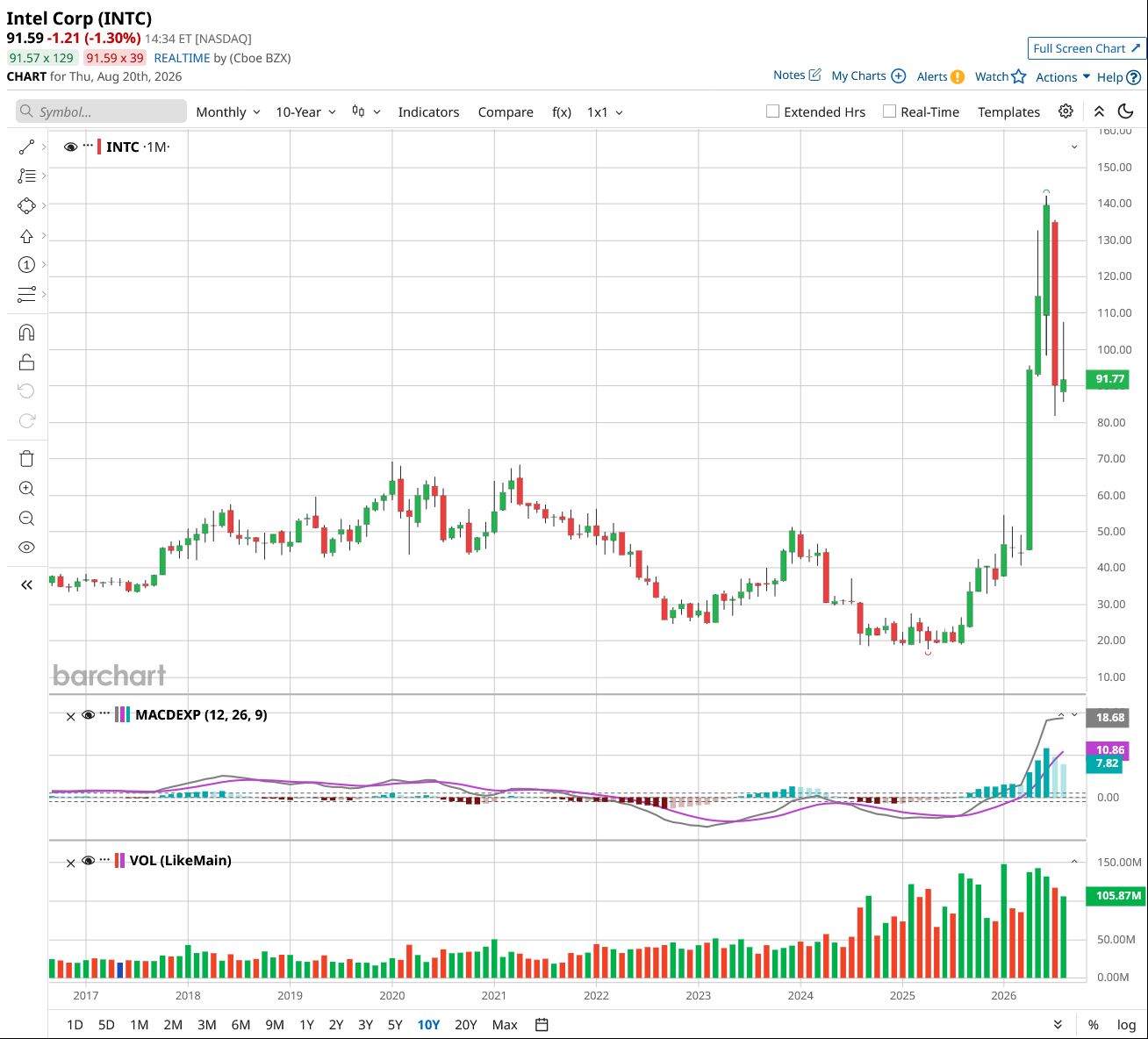
INTC stock is up close to 300% in the last 12 months and has more than doubled year-to-date (YTD). The timing of Duquesne's exit is notable because Intel posted a blowout second quarter.
Intel reported revenue of $16.1 billion in Q2, which was $1.8 billion above its own guidance. Intel said its AI-driven businesses, taken together, grew more than 70% year-over-year (YoY) and made up roughly 70% of total revenue in the quarter. The company's data center chip unit, which sells the processors that power cloud computing and AI workloads, saw revenue jump 59% YoY to $6.3 billion.Intel executives said demand from cloud providers and large businesses now outpaces what the company can produce. CEO Lip Bu Tan told analysts on the call that "the industry is facing one of the most severe supply constraints in its history across leading edge logic silicon wafers, memory, and substrates," adding that these shortages will persist for the foreseeable future.
AI Chip Supply Crunch Benefits Intel
The supply crunch is good news for Intel's near-term pricing power, but it also means the company must spend heavily to keep up with rising demand.
Intel raised its 2026 capital spending outlook to more than $20 billion, up sharply from what it expected at the start of the year, and said 2027 spending will climb even higher. Analysts forecast the chipmaker will spend around $125 billion on capital expenditures through 2030. Most of that money is going toward its U.S. factory network as it races to build out advanced manufacturing capacity.
Intel's foundry business, which manufactures chips for itself and outside customers, reported revenue of $5.8 billion for the quarter. The business is still losing money and posted an operating loss of $2.1 billion, narrower than the prior quarter loss of over $2.4 billion, as yields and factory efficiency improved.
CFO David Zinsner told analysts the company expects third quarter revenue between $15.8 billion and $16.8 billion, with gross margin around 42% on a non-GAAP basis.
What the Duquesne Exit Means for INTC Stock Investors
Hedge funds trim or exit positions for multiple reasons that could have nothing to do with a company's fundamentals, including portfolio rebalancing, tax planning, or rotating into a different theme.
In this case, Duquesne's shift toward Alphabet and Riot Platforms suggests the firm may be leaning further into artificial intelligence software and infrastructure plays, along with Bitcoin mining exposure, rather than the chip manufacturing side of the AI trade.
Retail investors watching Intel will want to watch the company's October update, when executives are expected to share more detail on its next-generation manufacturing process and 2027 spending plans.
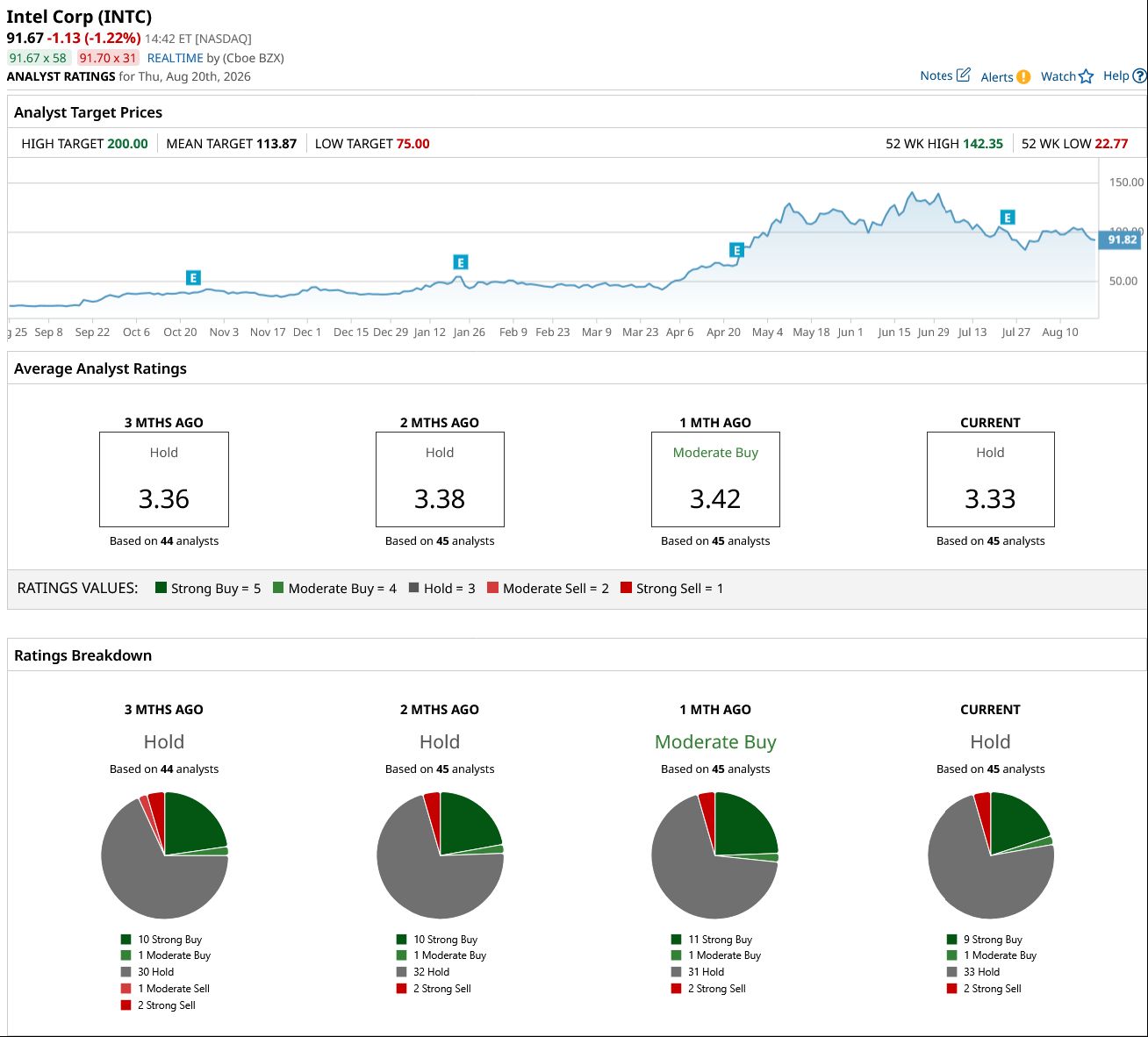
Out of the 45 analysts covering INTC stock, nine recommend “Strong Buy,” one recommends “Moderate Buy,” 33 recommend “Hold,” and two recommend “Strong Sell.” The average INTC price target is $113.87, above the current price of about $92.
 www.barchart.com
 On the date of publication, Aditya Raghunath did not have (either directly or indirectly) positions in any of the securities mentioned in this article. All information and data in this article is solely for informational purposes. For more information please view the Barchart Disclosure Policy here.
More news from Barchart
Duquesne Management Just Dumped Its Entire Stake in This Surging AI Stock The Biggest Players in a $500 Billion Market Are Exiting. Here’s Why Costco Just Entered. Paul Tudor Jones Just Liquidated His Entire Stake in Applied Materials Stock. I Don’t Think He’s 100% Bearish on AI Though… Yet Up almost 20%, Here’s Why Microsoft Stock Could Rise Even Further