


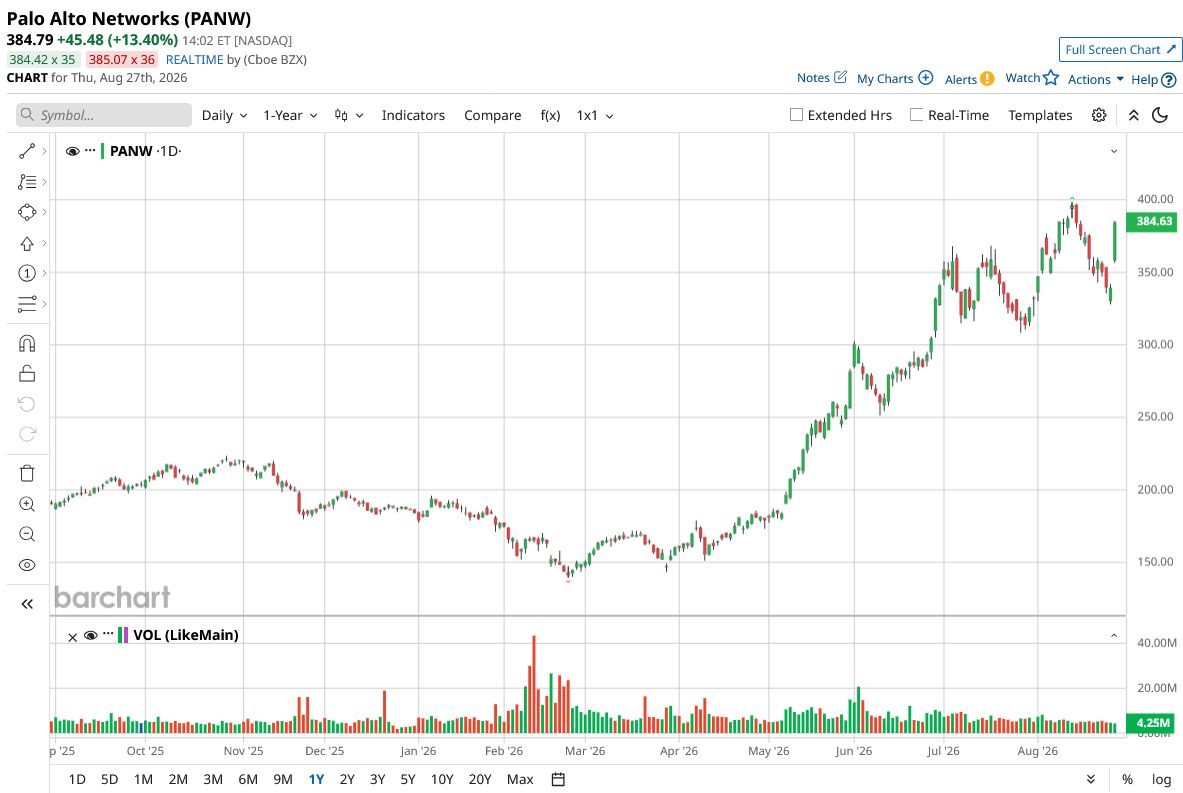
Palo Alto Networks (PANW) will release its fiscal fourth-quarter 2026 results on Sept. 1. Despite PANW stock’s sharp rally of more than 159% over the past six months, the company’s underlying growth drivers remain constructive. Its platformization strategy, which brings multiple cybersecurity capabilities together under a unified platform, is strengthening customer relationships and expanding its addressable revenue opportunity.
The broader spending environment is also supportive. As enterprises increase cybersecurity budgets and seek to reduce the cost of maintaining multiple standalone tools, spending is increasingly shifting toward established vendors that offer integrated security platforms. Palo Alto Networks is well positioned to benefit from this consolidation trend.
More Top Stocks Daily: Go behind Wall Street’s hottest headlines with Barchart’s Active Investor newsletter.
 www.barchart.com
 Platformization Is Becoming a Key Growth Driver
Palo Alto Networks is increasingly using its platform strategy to deepen customer relationships and capture a larger share of enterprise security spending. Instead of selling standalone products, the company is encouraging customers to consolidate multiple security functions onto its integrated platform. This approach can strengthen retention, increase contract values, and create more opportunities to cross-sell additional products.
The strategy is gaining traction. Palo Alto added 110 platformized customers in the third quarter, bringing the total to roughly 2,280, with further growth expected in the fourth quarter. More importantly, 80% of the company’s net new customers this year adopted multiple products, indicating that platform adoption is becoming an increasingly important part of its customer acquisition strategy.
The expanding platformized customer base matters because it can improve growth economics over time. Customers using multiple products are generally more embedded in the platform, which can support higher recurring revenue and reduce reliance on acquiring entirely new customers.
Management expects the number of platformized customers to exceed 4,000 by fiscal 2030 and is targeting $20 billion in annual recurring revenue from its Next-Generation Security (NGS) business. Achieving these targets would make platformization a key driver of Palo Alto Networks’ long-term revenue expansion.
PANW’s Top-Line Growth Will Likely Accelerate
Palo Alto Networks is positioned for faster revenue growth in Q4 FY26, supported by stronger organic bookings, contributions from recent acquisitions, momentum in its platformization strategy, and rising demand for cybersecurity as enterprises move AI deployments from experimentation to production.
Management expects Q4 revenue of $3.345 billion–$3.355 billion, implying approximately 32% year-over-year (YoY) growth, modestly above the 31% growth recorded in Q3. NGS ARR is projected at $8.9 billion–$8.95 billion, representing 59%–60% growth, while remaining performance obligations (RPO) are expected to reach $20.9 billion–$21 billion, up 32%–33%.
Network Security remains the core growth engine. The segment represented about 70% of Q3 revenue and should benefit from sustained investment in hardware, software firewalls, and SASE. SASE ARR increased 40% year over year to $1.6 billion in Q3, while net new ARR grew nearly 50%, reflecting customer additions and competitive displacement.
Hardware is also becoming strategically important. Despite contributing only about 10% of revenue in Q3, the business delivered solid growth, with firewall bookings rising nearly 40%. AI data center deployments are supporting demand, creating solid long-term opportunity as AI infrastructure expands.
AI security represents the more significant structural growth opportunity. Software firewall ARR increased 25% in Q3 as enterprises face growing volumes of traffic across cloud environments and AI workloads. Prisma AIRS, meanwhile, remains PANW's fastest-growing offering, indicating rising demand for protection across AI applications and infrastructure.
As companies transition from AI pilots to production-scale deployments and autonomous agents, security requirements are becoming more complex. This could expand cybersecurity spending beyond traditional endpoint and network protection.
PANW’s near-term margin outlook faces pressure from higher component costs, but management still expects adjusted EPS of $0.96–$0.98. Strong revenue growth and pricing actions should provide some offset, leaving PANW to deliver profitable growth.
The Key Takeaway
Palo Alto Networks Q4 will reflect a favorable growth setup, supported by accelerating platform adoption, strong NGS demand, and expanding cybersecurity spending tied to AI and cloud workloads. While cost pressure and the stock’s substantial rally warrant caution, the company’s ability to consolidate customer spending on its unified platform strengthens the bull case.
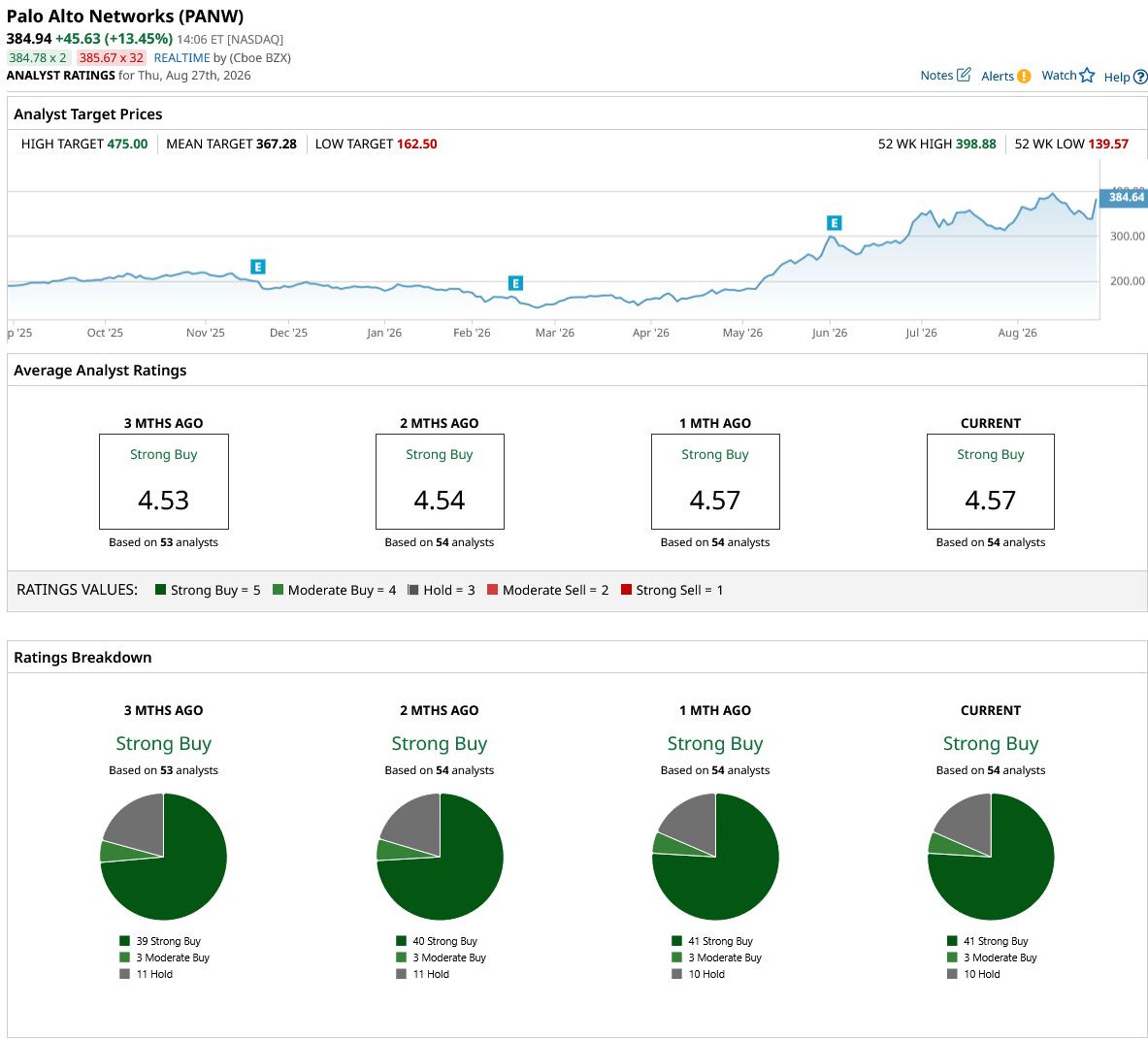
Wall Street maintains a “Strong Buy” consensus rating on PANW stock ahead of the Q4 earnings release.
 www.barchart.com
 On the date of publication, Amit Singh did not have (either directly or indirectly) positions in any of the securities mentioned in this article. All information and data in this article is solely for informational purposes. For more information please view the Barchart Disclosure Policy here.
More news from Barchart
George Soros Is Betting Big on Utility Stocks as AI Power Demand Surges Why Legendary Investor Michael Burry Says Nvidia Stock Is ‘Wildly Undervalued’… and Why He’s Still Cautious on Shares Okta Stock Just Hit a New 3-Year High on Earnings Rally. How You Should Play the Surge. Palo Alto Networks’ Platform Strategy Supports a Bullish Q4 Outlook