

Oracle (ORCL) is in the limelight again, slashing jobs with one hand while it borrows billions of dollars with the other hand. The company has started another round of layoffs, with affected employees receiving termination notices beginning Sept. 14 as the company pushes ahead with a broader restructuring plan. Meanwhile, it faces an $89 billion debt problem that investors cannot overlook.
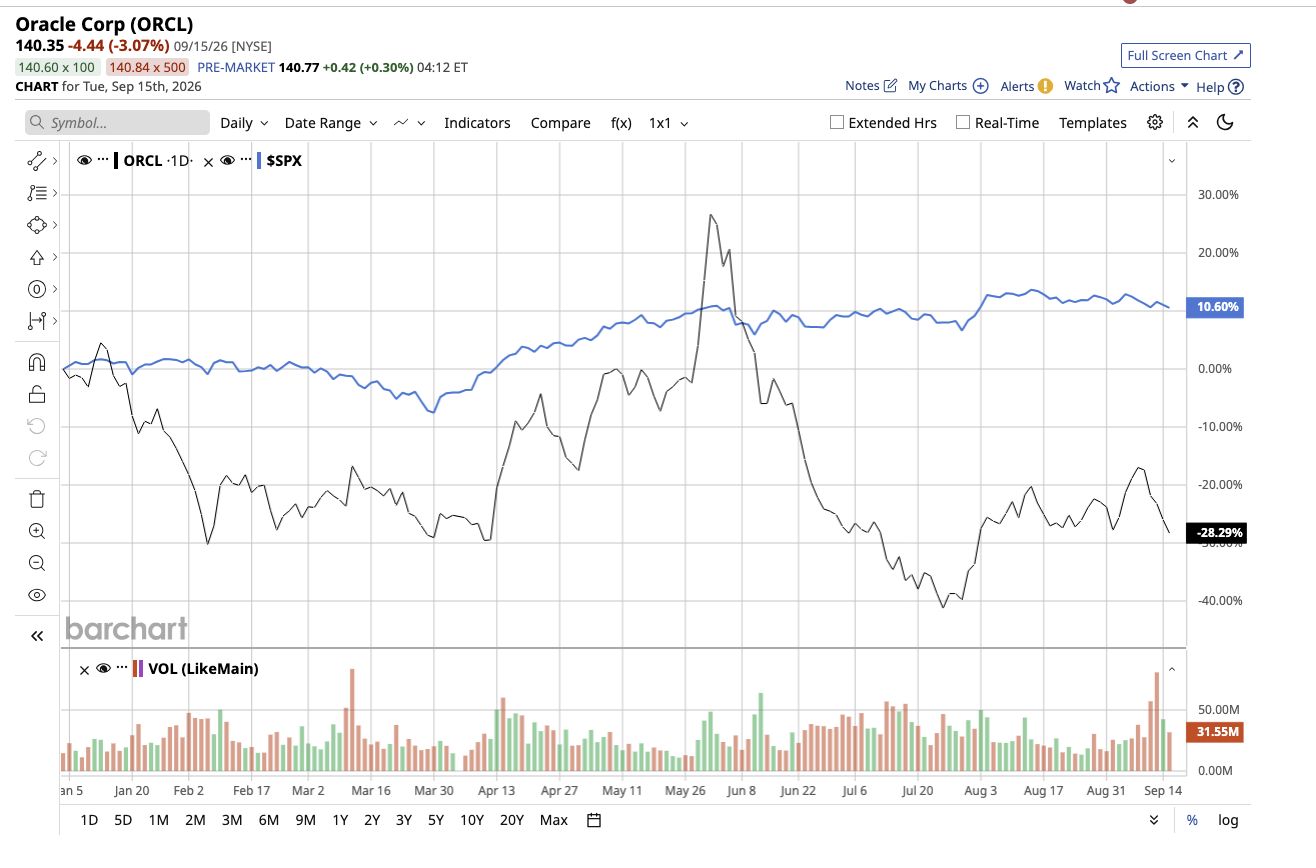
While this may appear counterintuitive, there is a clear bet behind it. Oracle is shrinking some costs so it can redirect more resources towards its AI cloud infrastructure business that is growing at extraordinary speed. Oracle stock is down 28% so far this year, underperforming the broader market. For Oracle investors, the question today is whether this gamble will pay off and whether Oracle is still worth investing in.
More Top Stocks Daily: Go behind Wall Street’s hottest headlines with Barchart’s Active Investor newsletter.
 www.barchart.com
 The Layoffs Can Improve Efficiency — But There Is A Catch
Oracle has started another round of layoffs this week. The new layoffs come after Oracle's workforce had already fallen by roughly 21,000 employees, or 13%, during fiscal 2026, leaving the company with about 141,000 employees as of May 31. The timing is notable, as Oracle announced recently that it expects fiscal 2027 capital expenditures to increase to around $90 billion to $95 billion. Capex reached $28.5 billion in the first quarter of fiscal 2027, compared to $8.5 billion in the same quarter a year earlier.
Cutting payroll doesn’t magically make AI infrastructure cheaper. However, it reduces operating expenses, giving Oracle more flexibility to absorb the enormous costs associated with expanding OCI. However, restructuring itself creates near-term costs. According to Reuters, Oracle's restructuring program is expected to cost roughly $2.8 billion after the company increased its projected restructuring expense by another $700 million.
The Profits Are Growing, But So Is the Cost of Chasing AI
For the time being, it appears Oracle’s restructuring efforts are paying off. Profitability is moving in the right direction. In the first quarter of fiscal 2027, adjusted operating income climbed 31% to $8.2 billion, while adjusted earnings per share (EPS) rose 30% to $1.92. However, gross margin declined as the company is ramping up data centers and rapidly increasing the contribution from infrastructure, which is more capital-intensive than its traditional software business. Management said the lower operating expenses due to workforce reduction helped somewhat to mitigate the margin pressure.
The Debt Problem Is the Part Investors Cannot Ignore
Oracle's AI expansion could not have been possible without an enormous amount of capital. At the end of August, Oracle had roughly $125.3 billion of current and non-current notes payable and other borrowings. Against that, it held roughly $36.4 billion in cash and cash equivalents. That leaves a net debt of about $89 billion excluding other balance sheet items.
What’s more, to fund its extraordinary spending commitment for fiscal 2027, Oracle has raised $20 billion through an equity issuance during Q1, while its broader fiscal 2027 funding plan calls for roughly $40 billion of debt and equity financing. Yet, Oracle keeps spending aggressively. Furthermore, because its capital expenditures were so large, they weighed on free cash flow, which came in at a negative $5.4 billion.
Investors need to watch whether the infrastructure being built today will generate enough revenue and cash flow tomorrow to justify this financing burden. Oracle seems confident that its current investments will pay off. The company raised its fiscal 2027 revenue outlook to $90 billion and increased its adjusted EPS target to $8.10. For the second quarter, Oracle expects revenue growth of 30% to 34% and cloud revenue growth of 65% to 71%. For fiscal 2028, analysts further expect revenue to increase by 45% to $132 billion and earnings to climb by 35% to $10.09.
So, Is Oracle Stock A Buy Now?
Oracle’s fiscal Q2 print showed that the company now has a much stronger growth profile, with an enormous AI-related backlog of $664 billion. However, in the coming quarters, investors need to watch the relationship between RPO growth, revenue growth, capital expenditures, and free cash flow rather than just the backlog number.
For investors considering Oracle, note that the layoffs may help keep operating expenses under control for the short-term. However, the bigger factor to consider before buying Oracle stock now is whether its growth can eventually generate enough operating profit and free cash flow to justify the debt, equity issuance, and the massive capital spending required to achieve it.
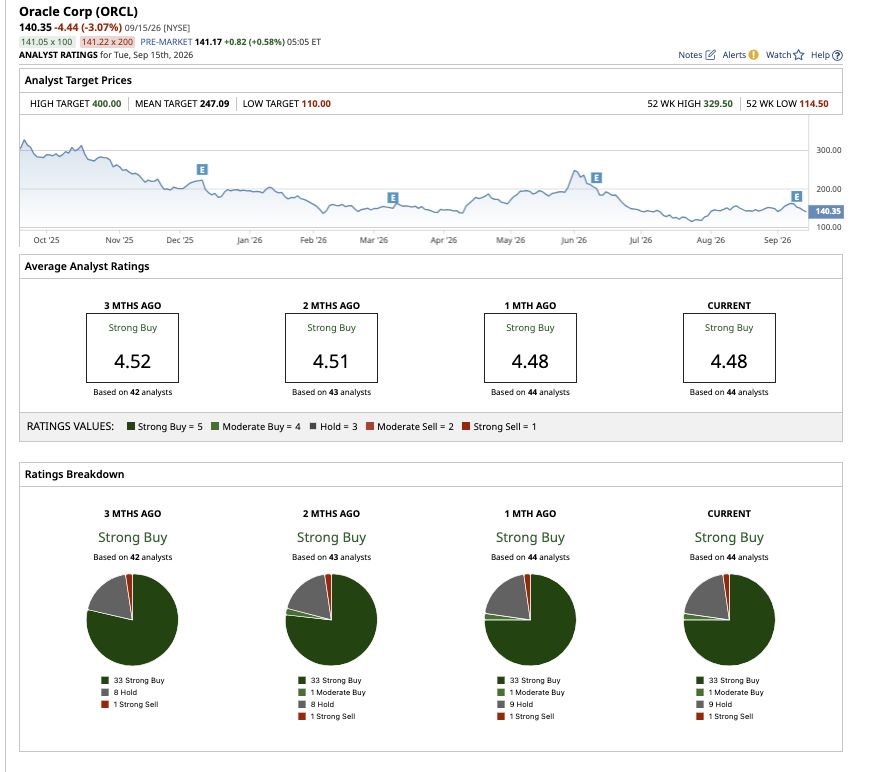
On Wall Street, of the 44 analysts covering the stock, 33 rate it a “Strong Buy,” one says it is a “Moderate Buy,” nine rate it a “Hold,” and one says it is a “Strong Sell.” The average target price for Oracle stock is $247.09, representing a potential upside of 76% from its current levels. Many analysts have given the stock a high price estimate of $400, which suggests it has an upside potential of 185% over the next year.
 www.barchart.com
 On the date of publication, Sushree Mohanty did not have (either directly or indirectly) positions in any of the securities mentioned in this article. All information and data in this article is solely for informational purposes. For more information please view the Barchart Disclosure Policy here.
More news from Barchart
Dear Future Electra Therapeutics Stock Fans, Mark Your Calendars for Sept. 18 Dear Future Orion180 Insurance Stock Investors, Mark Your Calendars for Sept. 18 Oracle Is Slashing Payroll While Borrowing Billions for AI. What It Means for ORCL Stock. Iren Stock Has Dropped 12% in a Week. Why, and How to Play It Here.