

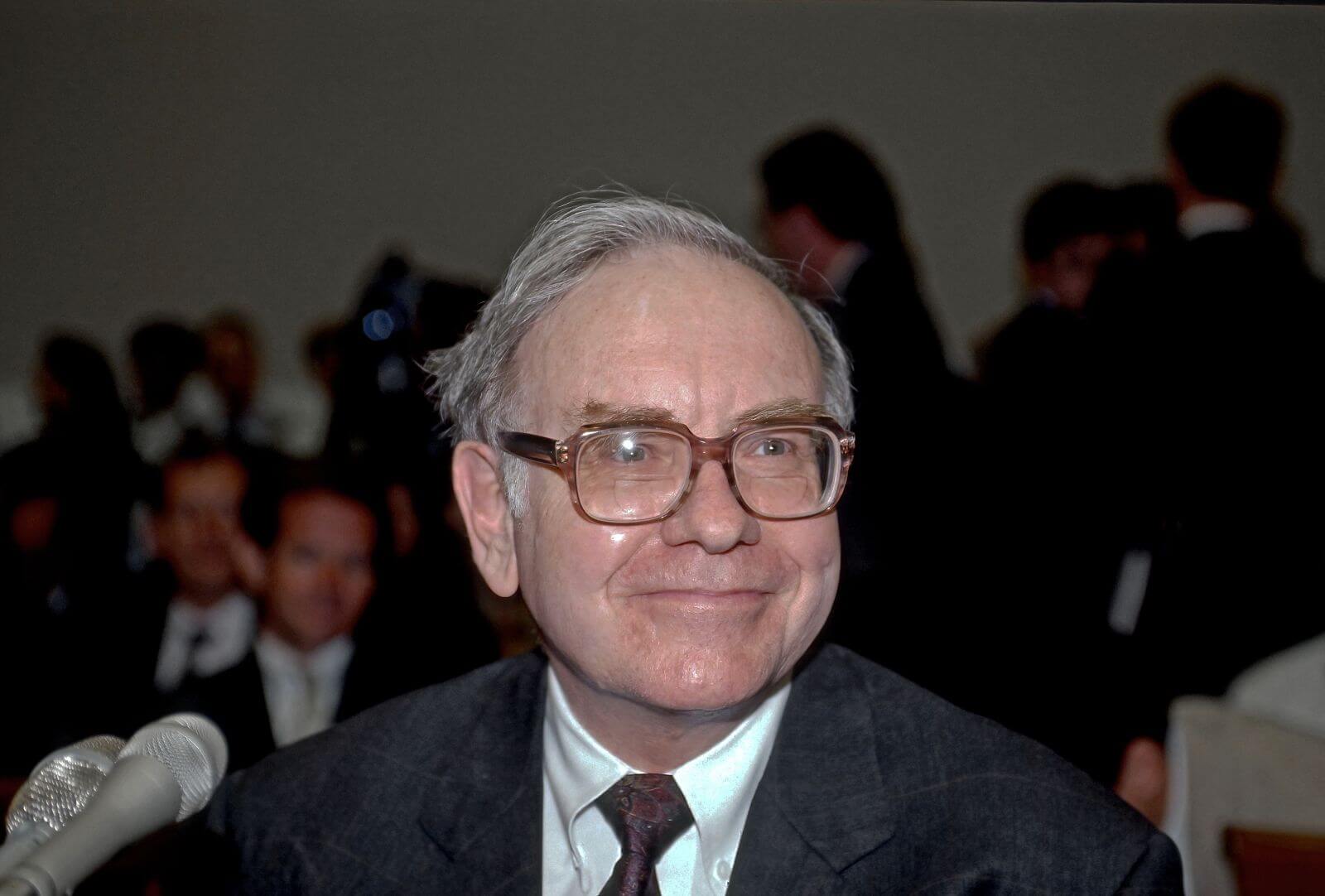
Management transitions are routine on Wall Street. Yet, some are seismic and have implications that remain milestones. When Warren Buffett's stint at Berkshire Hathaway (BRK.A) (BRK.B) as CEO came to an end, the investing world was taken by surprise. Even though the Oracle was 94, and murmurs about his retirement had intensified over the years.
Now, the legendary investor is giving up his role as chairman of the board as well. The 96-year-old billionaire, who turned a faltering textile business into one of the largest conglomerates in the world, has been at the helm of Berkshire's board for 56 years. Buffett's eldest son, Howard, will replace him. Howard Buffett has been a member of the board for 33 years.
More Top Stocks Daily: Go behind Wall Street’s hottest headlines with Barchart’s Active Investor newsletter.
In a statement to shareholders, Warren Buffett sounded philosophical and said, “Father Time always wins. He has, however, been generous with me. He has given me the opportunity to see Berkshire reach a point where I am more confident than ever about what lies ahead.” Sounding upbeat about the future of the company and expressing confidence in the current management, Buffett continued, “My expectations for him were sky high from the start, and he has exceeded them. He has taken hold of the chief executive officer job in every respect. He has been making the decisions that matter for some time now, and I have not had to think twice about any of them.”
Buffett will take up the role of Chairman Emeritus and will remain a part of the board.
 www.barchart.com
 Unmatched Legacy
Over the years, Warren Buffett has grown Berkshire into the only non-tech company in the U.S. with a market cap exceeding $1 trillion. For a man who shunned tech stocks until making Apple (AAPL) one of his biggest holdings (a company going through its own leadership transition with new CEO John Ternus), that is quite a feat. In fact, Buffett's holdings have largely been in the so-called non-glamorous part of the market, including insurance, railroads, retail, and energy, among others. Yet, these businesses have had solid management, with moats that were not easily shakeable and intrinsic value higher than their prevailing market prices—all basic tenets of Buffett's philosophy of investing.
In terms of sheer wealth creation, Buffett's consistency of outperforming the major indices is iconic. As per Berkshire's own annual report for 2025, the company's stock compounded at 19.7%, compared to the S&P 500's ($SPX) 10.5%. In absolute terms, Berkshire's stock was up 6,099,294%, dwarfing the S&P 500's rise of 46,061% in the same period. The Dow had a CAGR of 10.3% between 1965 and 2025.
To understand the scale of outperformance, if an individual had invested $100 in Berkshire and the S&P 500 in 1965, it would have grown to $6.1 million and $46,161, respectively.
However, with the dawn of the Greg Abel era, Berkshire's investing style seems to be changing, with technology stocks expected to dominate. As per its latest 10Q filing, Berkshire's largest holding is now Alphabet (GOOG) (GOOGL), the search giant that is also one of the foremost companies operating in the AI space. In fact, Berkshire parted with $10 billion to participate in the company's $80 billion private placement. Still, among its five largest holdings, Berkshire's portfolio is tilted towards non-tech stocks, such as American Express (AXP), Bank of America (BAC), and Coca-Cola (KO). Together with Apple (AAPL), these five holdings make up 66% of the aggregate fair value of its equity holdings.
Moreover, Abel's first annual meeting as CEO gave us a hint as to how his stewardship of the conglomerate looks and the way he is seeking to deploy the enormous $380.2 billion cash pile of Berkshire. And it seems to be that it will be more of the same, with some tweaks.
Able emphasises that Berkshire's investment actions will be in line with what Buffett has built over the years; that includes owning businesses whose economic activities the company understands, having a holding period that is long and even “forever,” while staying true to having a minimum cash balance of $30 billion.
Yet, Abel will not put to work Berkshire's record cash reserves just for the sake of it, as was evident when he said, “We're not anxious to deploy capital into subpar opportunities.” He also said market dislocations would eventually create opportunities for Berkshire to deploy significant amounts of capital, suggesting that while the company may evolve under Abel, its fundamental capital-allocation discipline is likely to remain intact.
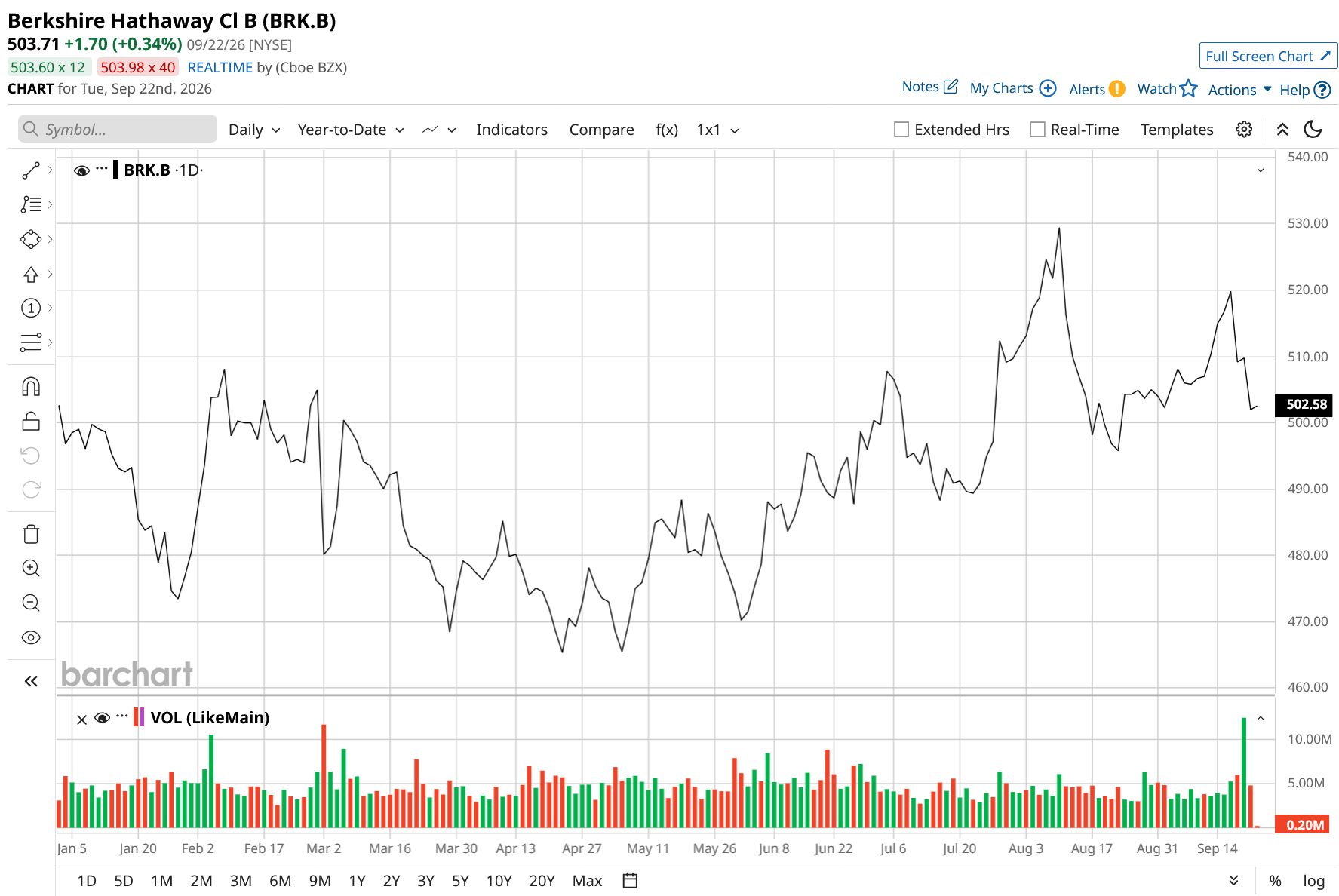
Overall, BRK.B stock is up 0.18% on a year-to-date (YTD) basis and just 2% in the past year.
Analyst Opinion on BRK.B
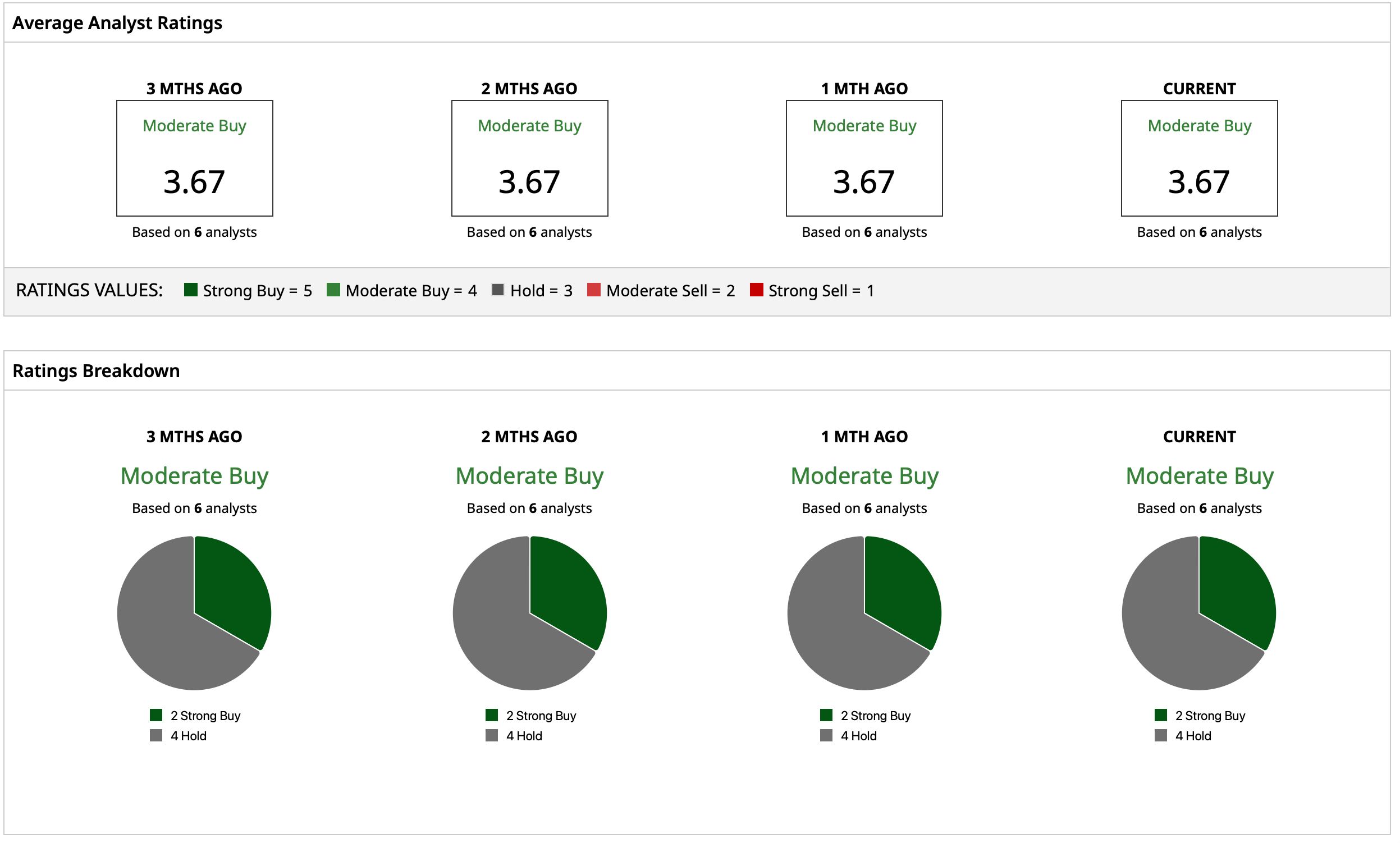
Considering this, analysts are cautiously optimistic about Berkshire's stock now, assigning it a consensus rating of “Moderate Buy.” The mean target price of $543.60 denotes a potential upside of 6.6% from current levels. Out of six analysts covering BRK.B stock, two have a “Strong Buy” rating, and four have a “Hold” rating.
 www.barchart.com
 On the date of publication, Pathikrit Bose did not have (either directly or indirectly) positions in any of the securities mentioned in this article. All information and data in this article is solely for informational purposes. For more information please view the Barchart Disclosure Policy here.
More news from Barchart
RBC Is Bullish on Kraft Heinz Stock and Expects Growth to Return in 2027 Huawei Is Ramping Up to New Chips in 2027. What That Means for Nvidia Stock Now. Meta’s Muse Is Dominating the App Store. What This Means for META Stock. This Blue-Chip ‘Loser’ Just Might Offer Contrarians a Pleasant Surprise