

After months of investor unease over Meta Platforms (META) soaring artificial intelligence (AI) spending and growing questions about whether those enormous investments can translate into meaningful returns, the company is taking steps that could change the conversation.
Meta launched Muse this month, an autonomous personal AI assistant built to help users handle online tasks such as scheduling, searching for products, and automating activities across the web. Yet the rapid rise of AI agents is creating complications for the websites they interact with.
More Top Stocks Daily: Go behind Wall Street’s hottest headlines with Barchart’s Active Investor newsletter.
Amazon.com (AMZN), for instance, blocked Muse from accessing its shopping platform, citing privacy and security concerns. According to the company, the agent bypasses personalization features and might capture customer credentials and scrape account data.
Still, Amazon access is hardly the only factor shaping Meta’s AI strategy. Muse has led app store charts for nearly two weeks, surpassing Claude and Grok. Additionally, Shopify (SHOP) partnered with Meta to enable agentic checkout across its merchant network, giving Muse an alternative e-commerce route.
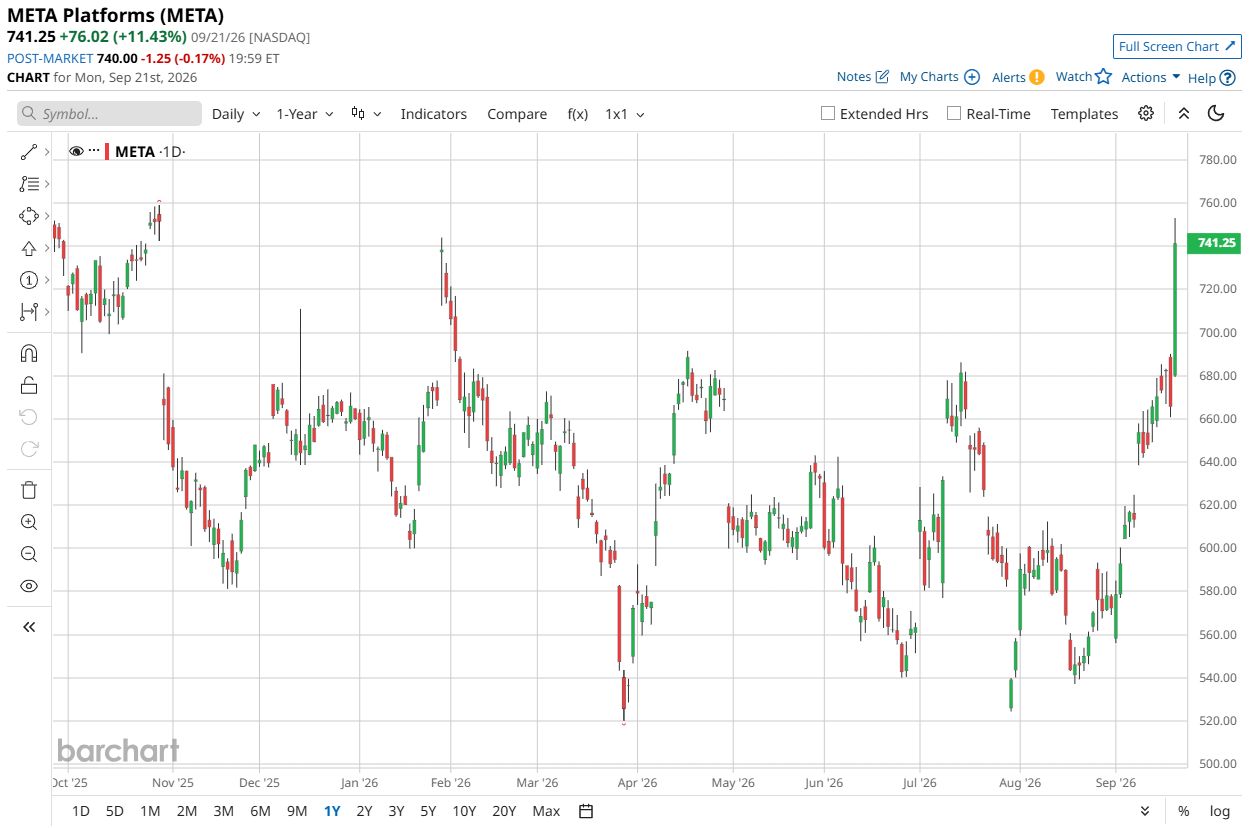
Moreover, expectations around Meta’s upcoming Connect event on Wednesday, Sept. 23, and continued AI infrastructure investments have boosted positive sentiment, driving the share price up 11.3% on Monday, Sept. 21, amid strong analyst optimism about Muse and the company’s broader AI strategy.
About Meta Stock
Headquartered in Menlo Park, California, Meta Platforms operates across social media, messaging, AI, virtual and augmented reality, and smart glasses. Its Family of Apps comprises Facebook, Instagram, Messenger, WhatsApp, Threads, and Meta AI. Through Reality Labs, the company is also expanding its footprint in Meta Quest devices, AI-powered glasses, wearables, and immersive digital experiences.
With a market cap of about $1.7 trillion, Meta is one of the largest companies in the technology sector. Yet its size has not insulated the stock from investor concerns. Over the past year, Wall Street has grown more cautious about the scale of Meta’s AI spending and how much those investments can ultimately translate into stronger financial returns.
Against that backdrop, META stock fell 4.8% over the past 52 weeks. The recent trend, however, has been considerably stronger. Meta’s shares are up 24.9% in the past six months and have advanced 34.8% in the last month.
 www.barchart.com
 Meta’s stronger share performance has also come with a valuation that commands a premium relative to the industry. The stock currently trades at 21.34 times forward adjusted earnings and 6.67 times sales, with both multiples above their respective industry averages.
Shareholders also receive a dividend. Meta distributes $2.10 per share annually, resulting in a yield of 0.32%. The company’s next payment of $0.53 per share is scheduled for Monday, Sept. 28 for shareholders of record on Sept. 21.
A Closer Look at Meta’s Q2 Earnings
Meta disclosed its Q2 FY2026 results on July 29, which highlighted the growing tension between strong top-line growth and the rising cost of building out its AI ambitions. Revenue reached $60.8 billion, up 28% year over year (YOY) and ahead of the $60.2 billion analysts expected.
Advertising remained the primary growth engine, with Family of Apps advertising revenue rising 27% YOY to $59.4 billion. That increase was driven by a 14% rise in ad impressions and a 12% increase in the average price per ad, pointing to continued strength across both advertising volume and pricing.
However, the revenue growth did not flow through to earnings. EPS fell 13.4% to $6.18, missing the roughly $7.22 analysts had projected. Meta recorded $2.40 billion in charges related to legal proceedings and $1.18 billion in severance expenses tied to the May headcount reduction, both of which weighed on the quarter’s profitability.
Moreover, total costs and expenses surged 55.2% YOY to $42 billion. The strain also showed up in cash generation. Cash flow from operating activities totaled $31.9 billion, but free cash flow fell sharply to $784 million from $8.5 billion a year earlier. CapEx reached $31.1 billion for the quarter as Meta ramped up spending on AI infrastructure.
Against this backdrop, Meta’s near-term outlook remains closely tied to both revenue growth and investment levels. For Q3 FY2026, the company expects revenue of $61 billion to $64 billion.
Meta has also raised its 2026 capital-spending outlook to $130 billion to $145 billion from the previous $125 billion to $145 billion range. The company also raised the lower end of its full-year expense outlook to $165 billion to $169 billion to reflect the legal charge, while maintaining that 2026 operating income will exceed the previous year.
In this context, analysts forecast Q3 FY2026 EPS to decrease 11.9% YOY to $6.39, with full-year FY2026 EPS expected to drop 5.9% from a year ago to $27.93. Nonetheless, FY2027 is expected to recover, with EPS rising 23% YOY to $34.36.
What Do Analysts Expect for Meta Stock?
Analyst sentiment toward Meta remains notably positive, particularly around the company’s ability to translate its AI investments into stronger advertising growth and new monetization opportunities.
On that note, Ken Gawrelski of Wells Fargo maintains a “Buy” rating on META stock while raising his price target from $640 to $796. Mark Mahaney of Evercore ISI also reiterated a “Buy” rating, with an $860 target, citing confidence in Meta’s AI-driven advertising growth and monetization potential.
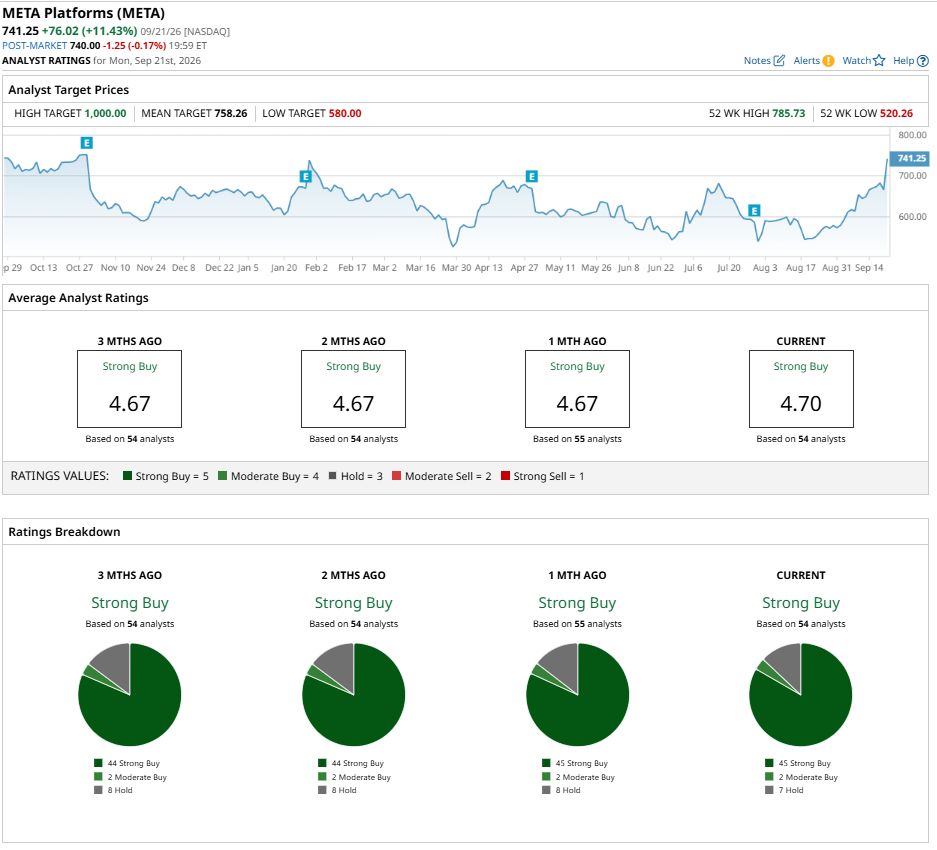
That constructive view is reflected in Wall Street’s overall rating of “Strong Buy.” Among 54 analysts covering Meta, 45 rate the stock a “Strong Buy,” two assign a “Moderate Buy,” and seven recommend “Hold.”
The price targets reinforce the market’s expectations for further appreciation. The average price target stands at $758.26, representing potential upside of 2.3%, while the Street-high target of $1,000 implies a 34.9% gain from current levels.
 www.barchart.com
 On the date of publication, Aanchal Sugandh did not have (either directly or indirectly) positions in any of the securities mentioned in this article. All information and data in this article is solely for informational purposes. For more information please view the Barchart Disclosure Policy here.
More news from Barchart
Nvidia and AMD Get the Headlines. The Real AI Winners Might Be Applied Materials and Lam Research. Costco Earnings Bull Put Spread has a High Probability of Success As Amazon Strikes a Blow Against the New Muse Bot, Here’s How You Should Play META Stock How to Play MicroStrategy Stock as Bitcoin Prices Surge Higher Again