


Nokia's (NOK) chief executive says the AI boom still has plenty of room to run, and his company's numbers help explain why.
Nokia built its name selling telecom equipment. But a fast-growing segment of the company is tied to massive data centers that power artificial intelligence.
More Top Stocks Daily: Go behind Wall Street’s hottest headlines with Barchart’s Active Investor newsletter.
This ongoing shift has put Nokia right in the midst of a global megatrend. But is AI in a bubble, and are companies overinvesting in AI-related infrastructure?
Nokia's boss has a blunt answer.
 www.barchart.com
 Why NOK Is an AI Stock
Nokia is one of the world's biggest telecommunications equipment makers. It has pivoted to become a key player in AI infrastructure.
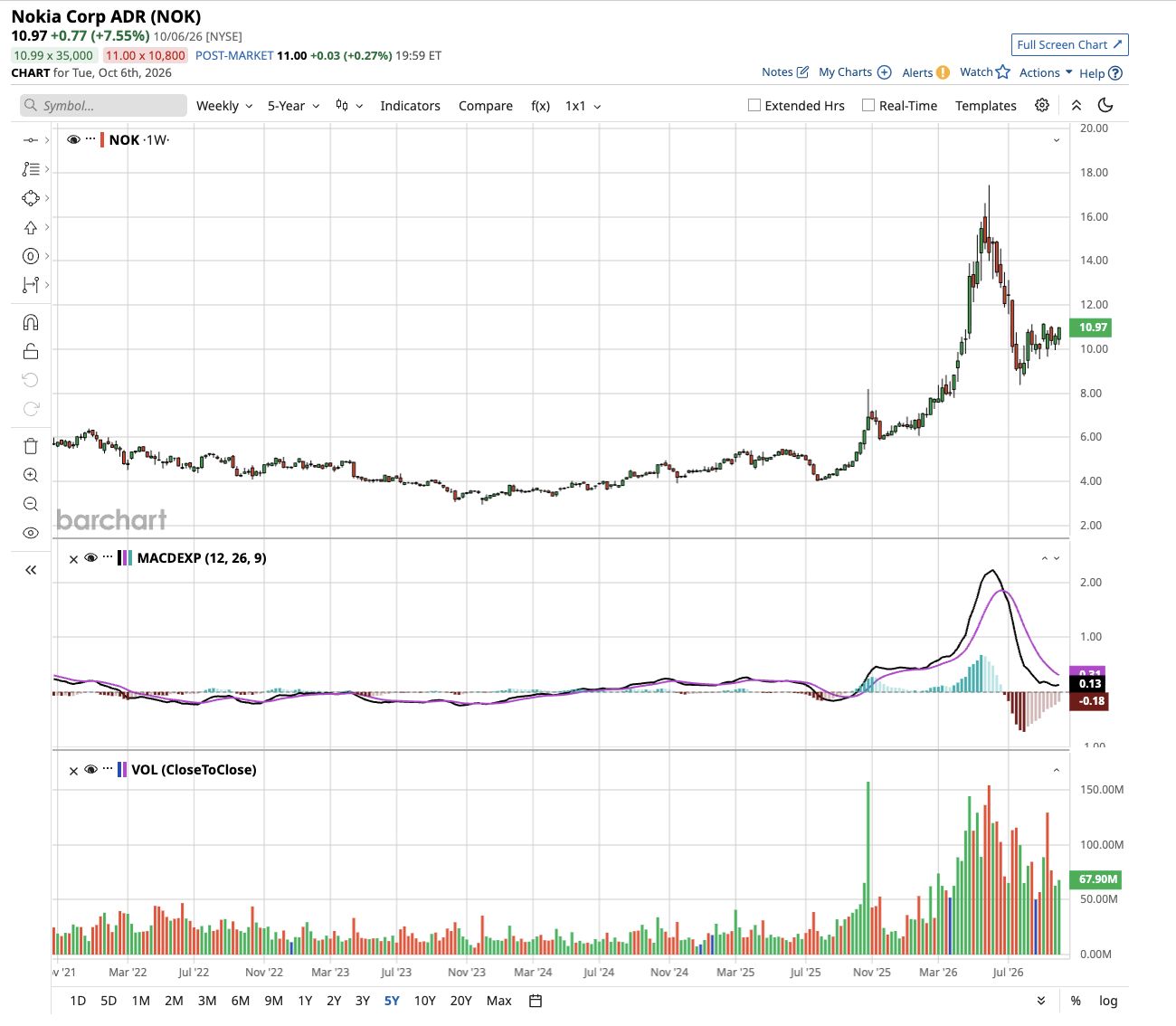
The ongoing transition has more than doubled the telecom stock over the last 12 months, valuing it at a market cap of $60.5 billion.
Nokia could be considered a “picks and shovels” play, given the company does not build AI models. Instead, it sells the technology that connects racks of chips inside data centers. It also sells the gear that links data centers in different locations.
According to a CNBC report, AI investments, including data centers and chips, will total $10.3 trillion through 2032, accounting for 3.63% of U.S. GDP each year. Most of this expenditure is funded with debt and complex deals. Basically, stakeholders expect AI demand to hold up over the next decade.
Nokia CEO: AI Boom Still Early
Nokia CEO Justin Hotard remains optimistic amid massive AI-related capital expenditures.
“I don't think you can say in any manner we're overbuilding today because reality is that if we could build 2x faster, our customers could build 2x faster, they probably would,” Hotard told CNBC's “The Tech Download” podcast.
He emphasized that the bottleneck is supply, where shortages of key memory chips and energy are holding the industry back.
“So that gives me confidence that we're still in the early days” of the AI buildout, he said.
He added that demand doesn't hinge on labs like Anthropic and OpenAI releasing new models.
“Even if we didn't have another frontier model released in the next three years, we could probably make tremendous progress just deploying the technology that's there today,” he said.
AI Orders Hit €2.8 Billion
During the company's second quarter 2026 earnings call, Hotard said sales to AI and cloud customers more than doubled from a year earlier to €446 million ($501 million). Orders from those customers jumped to €2.8 billion ($3.15 billion).
Here's an easy way to read that. Orders are promises of future sales. In the quarter, Nokia booked more than six times as much in AI orders as it recorded in AI sales.
Total net sales grew 9%. Gross margin rose 0.7 percentage points to 46%. Optical network sales grew 20%, while IP networks grew 16%. Nokia ended the quarter with €2.8 billion ($3.15 billion) in net cash.Hotard didn't oversell the AI tailwind, given that roughly half of those orders should turn into revenue within 12 months. Several customers placed large, long-term orders to lock in scarce supply.
“Order patterns in this market can be lumpy, and we should not expect this level of intake every quarter,” he said.
Supply Shortages Cap Nokia Growth
The shortages Hotard described to CNBC show up in Nokia's own business.
Asked by a Danske Bank analyst whether Nokia's optical unit was supply constrained, Hotard answered:
“In general, I would think of us as being constrained. If there was more supply, I think we'd probably generate more revenue.”
Nokia is spending to ease the squeeze. Its new indium phosphide chip fab in San Jose is on track for volume production by year-end. It is also buying a manufacturing site in Arizona from NXP (NXPI).
Risks NOK Stock Investors Should Watch
Investing in NOK stock carries certain risks.
A Bernstein analyst asked whether customers might be “double ordering” to grab scarce supply, which could overstate demand. Hotard argued that these sophisticated buyers have little reason to do so, and Nokia also expects firm commitments in return.
Nokia reported a negative free cash flow of $822 million in Q2. CFO Marco Wiren said the second quarter is typically the weakest for cash because it pays annual employee incentives during this period.
For the third quarter, Nokia expects sales to rise 3% to 7% from the second quarter. It still sees full-year operating profit landing somewhat above the midpoint of its guidance. Analysts expect free cash flow to narrow by 10% year-over-year (YoY) to $1.31 billion. However, FCF is projected to expand to $3.77 billion in 2030.
Hotard's bet is clear. As long as customers would build faster if they could, he believes the AI buildout still has a long runway.
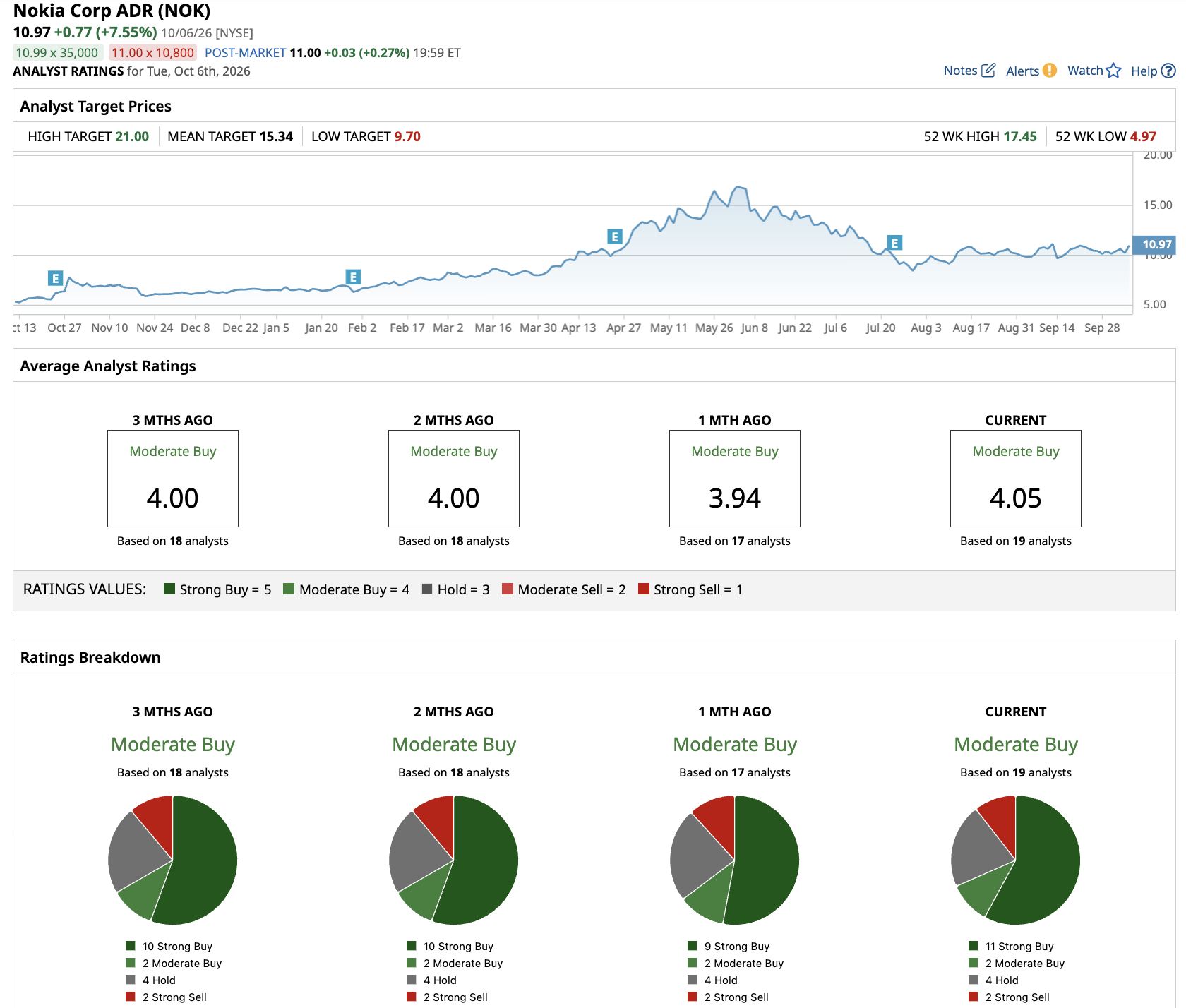
Out of the 19 analysts covering NOK stock, 11 recommend “Strong Buy,” two recommend “Moderate Buy,” four recommend “Hold,” and two recommend “Strong Sell.” The average NOK price target is $15.34, above the current price of about $11.
 www.barchart.com
 On the date of publication, Aditya Raghunath did not have (either directly or indirectly) positions in any of the securities mentioned in this article. All information and data in this article is solely for informational purposes. For more information please view the Barchart Disclosure Policy here.