

The companies building the future of artificial intelligence (AI) are discovering that computing power is only half the equation. They also need electricity, and plenty of it. Nvidia (NVDA) CEO Jensen Huang recently described the infrastructure opportunity in “tens of trillions” rather than billions, highlighting the scale of the investment taking shape around AI.
That ambition comes with a growing power bill. One August industry commentary cited International Energy Agency (IEA) projections showing global data-center electricity consumption climbing from 485 terawatt-hours in 2025 to roughly 950 TWh by 2030. Nearly doubling demand in five years puts electricity suppliers squarely in the spotlight.
Don’t Miss a Day: From crude oil to coffee, sign up free for Barchart’s best-in-class commodity analysis.
That helps explain the attention surrounding Constellation Energy (CEG). Talk of a nuclear power deal worth more than $1 billion with Alphabet's (GOOGL) Google has given investors another reason to buy shares.
But excitement over a technology giant’s commitment is one thing; translating it into shareholder returns is another. Is this the catalyst that strengthens Constellation’s earnings outlook, or is CEG stock getting ahead of the economics? Let’s take a closer look.
Constellation Secures Long-Term Power Buyers
Constellation Energy is a Baltimore, Maryland-based electricity producer and supplier with a market capitalization of $106 billion. Its nuclear, natural gas, and renewable facilities generate power for homes, businesses, and wholesale customers across the United States, supporting everyday consumption and industrial demand.
Constellation’s Google agreement gives substance to the excitement surrounding a potential $1 billion-plus nuclear deal. On Oct. 6, Constellation announced commitments covering 3,590 megawatts of electricity supply.
The company will invest more than $4.3 billion to increase nuclear capacity by 890 MW under a 20-year power purchase agreement with Google. Upgrades will span 11 reactor units at six sites in Illinois, Pennsylvania, and New Jersey, with the first additional capacity expected by 2028.
This means expanding output from existing facilities rather than constructing new reactors. A separate 15-year agreement supplies Google with another 2,700 MW of electricity in PJM. Constellation also secured a five-year technology collaboration involving Google Cloud and Gemini Enterprise to modernize operations.
The Google announcement follows Constellation's 20-year agreement to supply Amazon (AMZN) with 690 MW from its Calvert Cliffs nuclear plant in Maryland. That includes 190 MW of additional capacity scheduled between 2030 and 2032.
The Amazon commitment enables more than $3 billion of investment across the 1,790 MW facility and supports pursuing another 20 years of operating licenses. Constellation will also supply Amazon’s operations through a separate retail agreement across PJM’s 13-state market.
Constellation is broadening its generation portfolio alongside those nuclear expansions. On Sept. 10, the company agreed to acquire 100% of RISEC Holdings from Shell Energy North America for $715 million. The deal adds a 609 MW gas-fired facility in Johnston, Rhode Island, which serves ISO New England.
Together, these agreements give Constellation a clearer path to expanding generation and securing long-term customers. The investment case now hinges on turning those commitments into earnings and cash flow that justify the spending and CEG stock’s premium.
Constellation Energy’s Premium Earnings
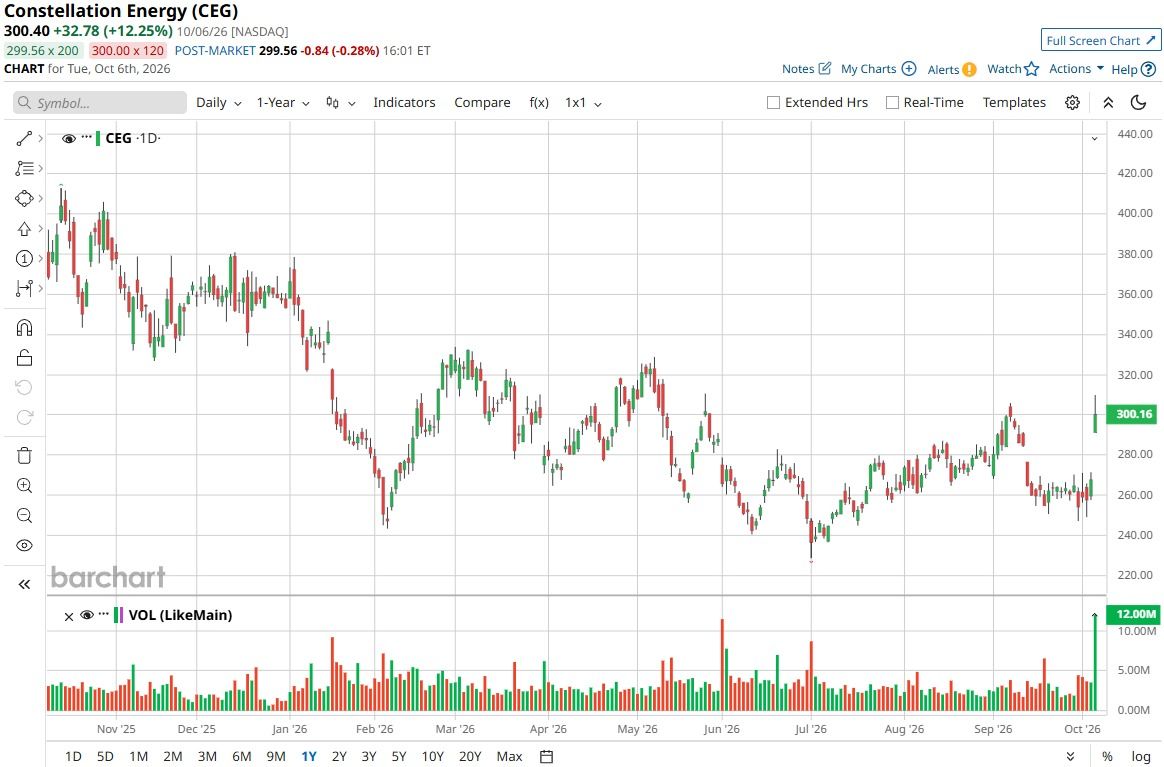
CEG stock closed at $285.07 per share on Oct. 8, down 19% year-to-date (YTD) and down 23% over the past 52 weeks. Despite those declines, both its trailing price-to-earnings (P/E) ratio and forward P/E ratio of 28.2 times and 24.6 times exceed the respective sector medians.
 www.barchart.com
 Constellation Energy reported second-quarter revenue of $7.5 billion, up 23% year-over-year (YOY) from $6.1 billion. The result missed the consensus estimate, but adjusted EPS increased almost 34% YOY to $2.55 from $1.91 per share, beating the $2.29 estimate.
Adjusted operating earnings reached $920 million, compared with $599 million a year earlier. This improvement contrasted with GAAP earnings attributable to common shareholders, which fell to $513 million from $839 million, or $1.42 per share from $2.67 per share.
On the Q2 earnings call, Constellation raised its full-year adjusted EPS guidance to $11.50 to $12.50 from $11 to $12, strengthening its earnings outlook before any assessment of Google-related upside.
The operating picture was less encouraging, as nuclear generation declined to 44,160 gigawatt-hours from 45,170 GWh. Meanwhile, capacity factor fell to 93% from 94.8%.
Non-refueling outage days improved to 20 from 22. These interruptions involve repairs or other operational issues outside scheduled refueling, although fewer such days did not prevent overall generation from declining.
Constellation's first-half operating cash flow remained broadly unchanged at $1.55 billion compared with $1.58 billion a year earlier. The company ended June with $697 million in cash against $5.6 billion in short-term debt. That gap makes available credit and refinancing capacity important to the investment case.
Wall Street’s Bullish Backing
The next earnings release is anticipated to be on Nov. 6. Analysts expect EPS of $3.99 for the quarter ended September 2026, compared with $3.04 a year earlier. That represents estimated YOY growth of 31%.
Earnings expectations align with Wall Street’s bullish stance. JPMorgan analyst Jeremy Tonet maintained a “Buy” rating on July 31 while lowering his price target from $386 to $385 per share. The analyst's revised target implies potential upside of 35%.
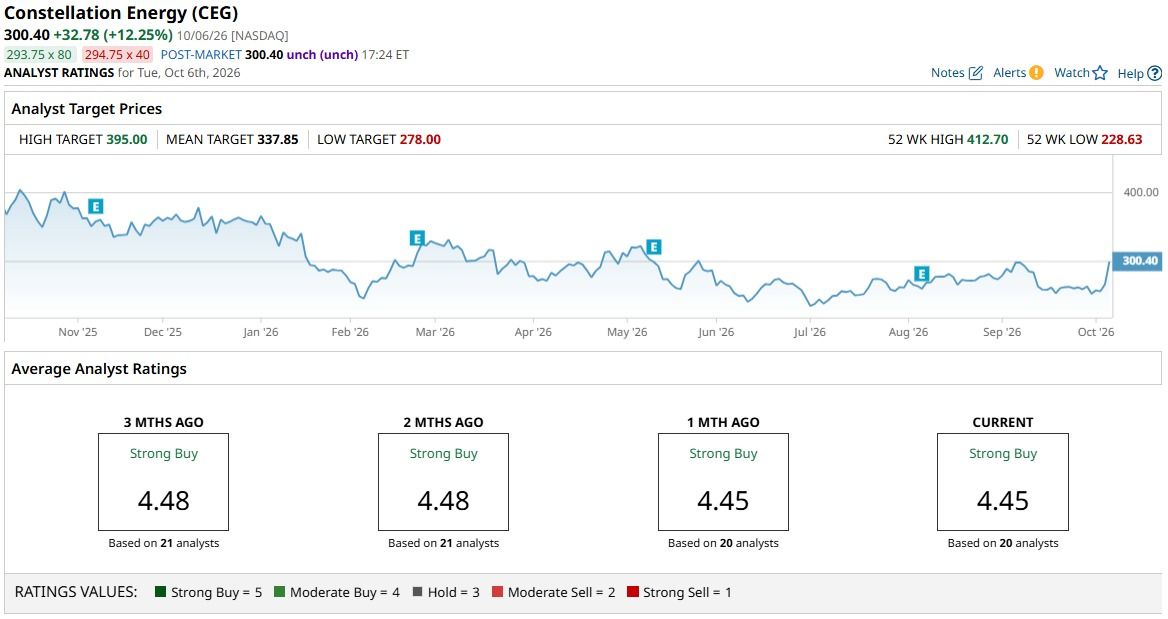
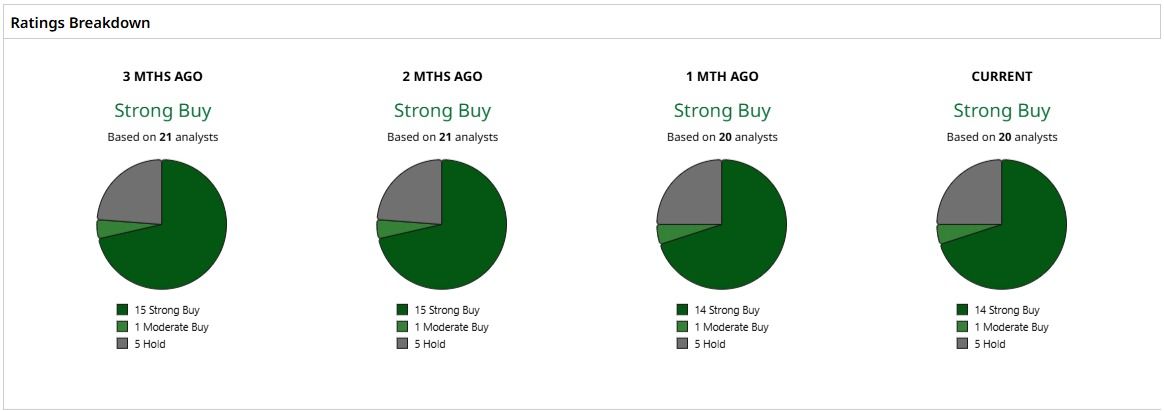
Other analysts see room for gains, although less than what Tonet predicts. Overall, CEG stock holds a consensus “Strong Buy” rating among 20 analysts with coverage. The average price target of $337.85 implies a potential gain of 19% from current levels.
 www.barchart.com
  www.barchart.com
 Conclusion
Constellation’s Google agreement is real, so this is more than another headline. What remains unclear is how much profit the deal will generate, since pricing and expected earnings contributions remain undisclosed. The most likely outcome is a gradual earnings boost as additional capacity comes online rather than an immediate jump. That strengthens Constellation’s growth case, but its premium leaves little room for disappointing returns. The deal gives shareholders a reason to stay interested, not a reason to ignore the price.
On the date of publication, Ebube Jones did not have (either directly or indirectly) positions in any of the securities mentioned in this article. All information and data in this article is solely for informational purposes. For more information please view the Barchart Disclosure Policy here.
More news from Barchart
Big Tech Needs Power. Constellation Just Found a $1 Billion Buyer in Google. How High Can Heating Oil and Distillate Prices Rise? What Did We See in the Commodities Complex During Hump Day? Constellation Lands a 3,590 MW Power Deal With Google. AI’s Quietest Winner May Not Stay Quiet for Long.