

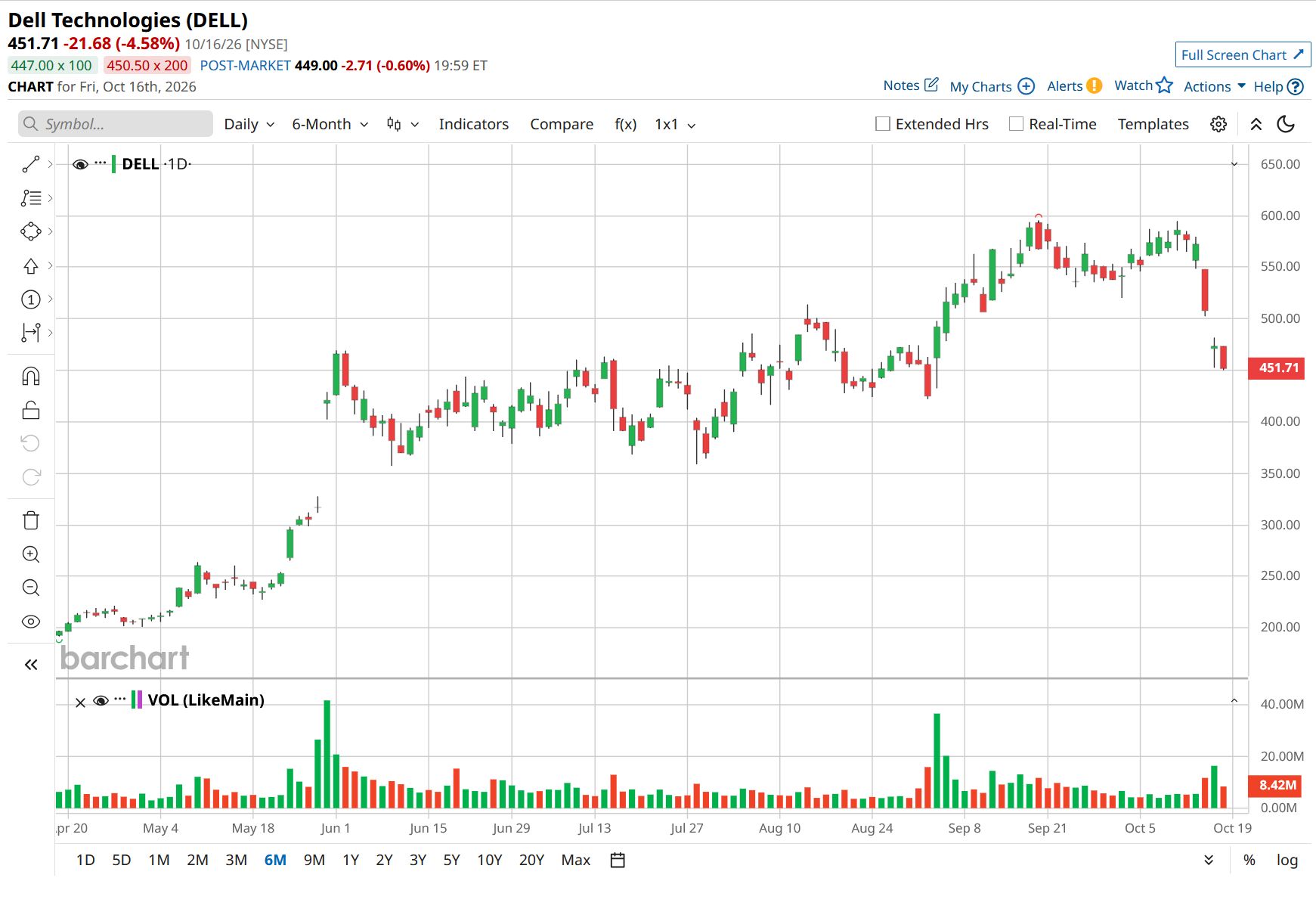
Dell Technologies (DELL) stock has had a rough week. Shares of DELL fell more than 11% on Oct. 14 and another 7% the next day. The drop came primarily after Barclays downgraded DELL stock to “Equal Weight” and cut its price target from $603 to $574. The firm also downgraded Dell's rival, Hewlett Packard Enterprise (HPE), causing HPE shares to dip sharply as well.
Barclays’ main argument is that businesses haven’t meaningfully stepped up their artificial intelligence (AI) spending yet. Analysts also believe that part of Dell’s revenue growth is coming from a global memory shortage pushing component prices higher rather than from new demand.
More Top Stocks Daily: Go behind Wall Street’s hottest headlines with Barchart’s Active Investor newsletter.
What Dell’s Own Filing Shows
Since memory prices have soared this year, I’d say the concern from Barclays is fair. But Dell’s latest quarterly filing paints a different picture.
Dell said AI server revenue doubled to $16.4 billion mainly because it sold more units, with higher selling prices playing a smaller role. Demand also appears strong looking ahead. The firm booked a record $60.9 billion in AI server orders in the second quarter and ended the period with a $95 billion backlog. As I have covered previously, Dell is far more than a low-margin hardware assembler, and this quarter’s numbers back that up.
There may be a bigger risk many investors are overlooking, however. Neoclouds and smaller cloud providers like CoreWeave (CRWV) have long been a big part of Dell's AI server sales, and management said that customer mix hasn't changed much. But CoreWeave’s bonds recently came under heavy pressure over worries about its debt. If buyers struggle to raise money, some of Dell’s backlog could take longer to turn into sales.
About Dell Stock
Dell is a global technology company that develops and sells laptops, personal computers, networking equipment, servers, data storage systems, and related software and services. The company operates through its Client Solutions Group (CSG) and Infrastructure Solutions Group (ISG) segments. Dell also offers technical support, consulting, equipment installation, and more. Founded in 1984, the company is headquartered in Round Rock, Texas.
DELL stock has surged about 212% over the past year versus the S&P 500’s ($SPX) gain of roughly 15%, driven by growing AI server demand, a record backlog, and sharply raised guidance. However, the stock has also fallen about 23% from its peak on the Barclays downgrade, valuation worries, and a broader AI selloff.
 ww.barchart.com
DELL stock trades well above its historical norms. The forward price-to-earnings (P/E) ratio of 17.9 times is higher than its five-year average, while the forward price-to-sales (P/S) ratio of 2.5 times is also significantly higher.
Part of that premium is earned. Analysts expect EPS to jump about 172% this fiscal year as AI servers take off. After that, though, growth is expected to slow to around 16% in fiscal 2028, which is solid but much slower.
Dell carries about $23 billion in net debt, which is manageable for a $290 billion company. Overall, a lot depends on whether its backlog converts, since DELL stock only looks fairly priced if it does.
Dell’s AI Backlog Signals Growth, But Supply Constraints Remain
Dell Technologies reported Q2 fiscal 2027 earnings on Sept. 1. The quarter reflected broad strength across its infrastructure and PC businesses, but the clearest driver was AI. Infrastructure Solutions Group revenue climbed 89% year-over-year (YOY) to $31.8 billion, while traditional server and networking revenue rose 122% (YOY) to $10.5 billion. Non-GAAP diluted EPS came in at $7.04, comfortably beating the Wall Street consensus estimate of $4.87 per share. Dell is benefiting from a wave of data-center modernization as customers refresh older systems, add more memory and storage, and build infrastructure for AI workloads. Operating income for the quarter came in at $5.9 billion, up 160% YOY.
Looking forward, Dell guided Q3 revenue of $49 billion and non-GAAP EPS of $6.50. Management also noted that AI server revenue should reach about $19 billion in Q3. For full-year fiscal 2027, the company raised its revenue outlook by $25 billion to $192 billion at the midpoint. The company also forecast adjusted EPS of $25.50 at the midpoint, pointing to about 150% YOY growth. Management expects continued supply constraints in DRAM, NAND, and other components.
What Do Analysts Expect for Dell Stock?
On Oct. 14, Barclays downgraded DELL stock to “Equal Weight” from “Overweight” and lowered its price target to $574 from $603. The firm has become more cautious about IT hardware stocks, and believes valuations have risen significantly while higher component prices have helped boost revenue. In contrast to Barclays, Bernstein has a “Buy” rating with a price target of $650 per share.
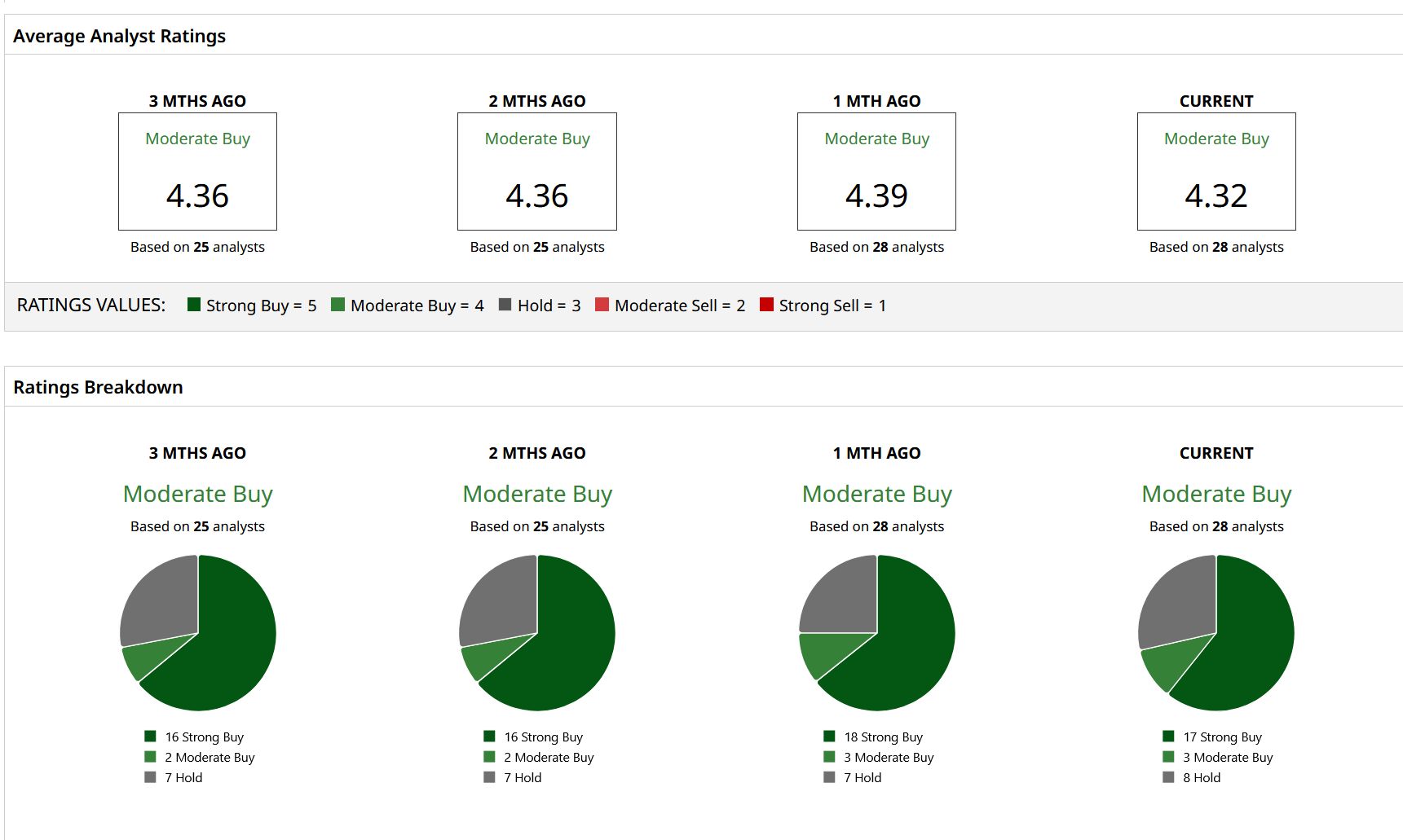
Based on 28 Wall Street analysts with coverage, Dell has a consensus “Moderate Buy” rating overall. Out of those analysts, 17 have a “Strong Buy” rating, three have a “Moderate Buy” rating, and eight analysts have a “Hold” rating. The mean price target of $599.65 reflects 30% potential upside from current levels, while the high price target of $735 implies a possible 59% climb from here.
 www.barchart.com
On the date of publication, Jabran Kundi did not have (either directly or indirectly) positions in any of the securities mentioned in this article. All information and data in this article is solely for informational purposes. For more information please view the Barchart Disclosure Policy here.
More news from Barchart
Dell Stock Got Hit by a Downgrade. CoreWeave’s Debt Problem Could Matter More Than You Think. Strategy Increased Its Preferred Stock Buyback to $3 Billion and Shares Moved Higher. What This Means for MSTR Elon Musk Pledged a SpaceX Share to Every Kid in America Next Year. Don’t Fret the Dilution Risk. ‘Stop Paying The Mortgage Payment Right Now’: Suze Orman Gives Shocking Advice to a Laid-Off Teacher Who Owed $400,000 on a $200,000 House