


I asked why ICE Arabica coffee futures were back in bullish mode in a July 14, 2026, Barchart article, and I concluded with the following:
Coffee is back in bullish mode in July 2026, which will likely increase trading activity and could lead to wide price swings. Any risk position in ICE Arabica coffee requires a risk-reward plan with stops and profit horizons to protect capital and establish reasonable odds of success.
Don’t Miss a Day: From crude oil to coffee, sign up free for Barchart’s best-in-class commodity analysis.
Nearby ICE coffee futures traded at $3.2820 per pound on July 13, but the price ran out of upward momentum in late August at $3.45, then trended lower until late September, when it may have bottomed.
The short-term trend remains bearish
Arabica coffee futures on the Intercontinental Exchange have made a series of lower highs in 2026.
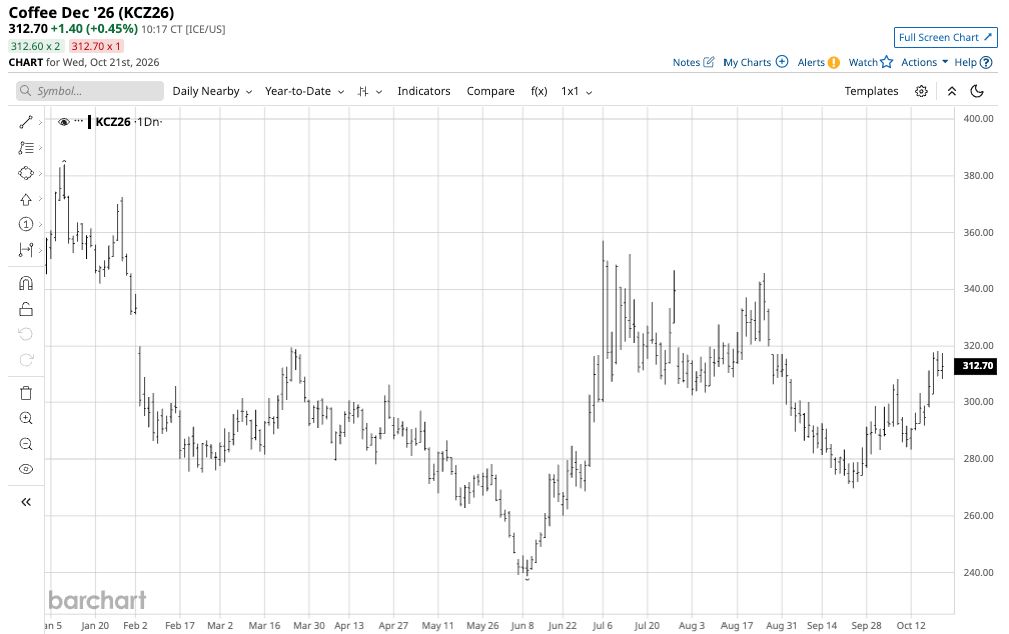
The year-to-date continuous futures chart shows that the coffee futures reached a 2026 high of $3.8385 per pound on January 8. After declining 37.8% to a low of $2.3885 on June 9 (the 2026 low), coffee recovered to a lower high of $3.57 on July 6 and has made lower highs in August, September, and so far in October.
The longer-term trend is bullish
The long-term chart shows that Arabica coffee futures remain in a long-term bullish trend.
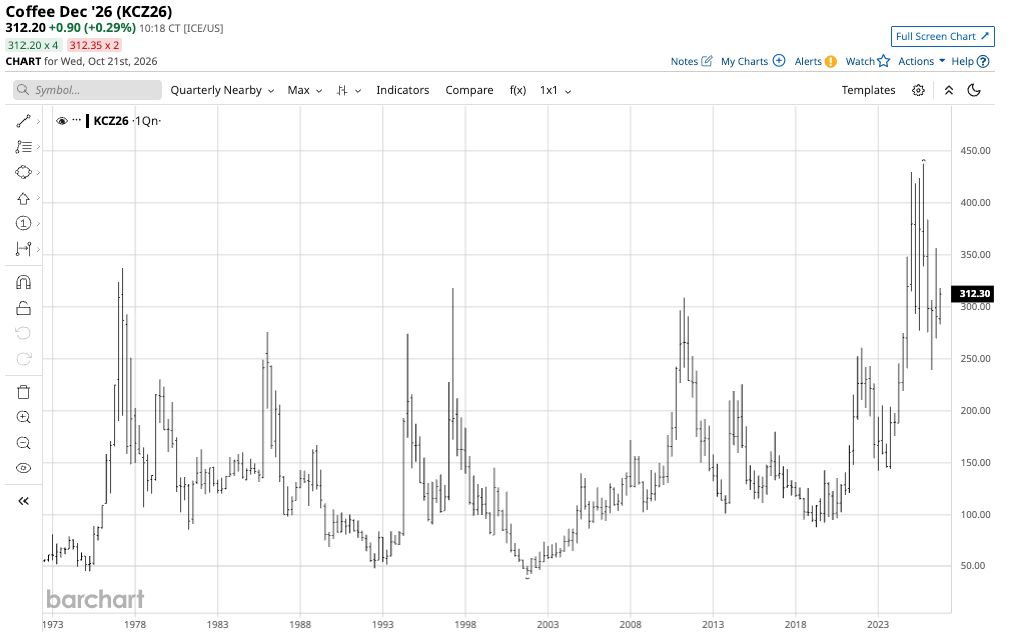
The continuous contract quarterly chart shows that the coffee bean futures have made higher lows since Q4 2001, when they reached a record low of 41.50 cents per pound. Futures rallied to a record high of $4.3795 per pound in late 2025 and remain in a long-term bullish trend, despite bearish price action in 2026.
A super El Niño in 2027 could have a dramatic effect on coffee prices
A super El Niño is a very strong climate anomaly that occurs when the average sea-surface temperatures in the central and eastern tropical Pacific Ocean rise by 3.6 degrees Fahrenheit or more above the normal baseline. This intense warming acts like a massive boulder dropped into the global climate system, shifting atmospheric jet streams and triggering severe, widespread weather conditions across the Earth. Average sea-surface temperatures in the region have been well above the normal baseline in 2026, suggesting severe weather conditions are on the horizon over the coming months and into 2027.
Weather is the most critical factor in agricultural production; a super El Niño over the coming year could affect crop yields, and coffee beans are no exception. Brazil is the world’s leading Arabica coffee bean producer and exporter. Droughts, floods, wildfires, and other environmental events could affect the coffee bean crop. According to El Nino live.com:
Flowering, around September and October, sets the size of the following year's harvest. Cherry filling in the months after determines bean size and quality. Heat and moisture stress at either point reduces next season's crop, not this one.
That lag is the whole trading story. A dry, hot spring in Minas Gerais during an El Niño shows up as a physical shortfall roughly a year later — which is why coffee futures respond to a Brazilian El Niño long before anyone can count the missing bags. Our coffee price page tracks the mechanism in more detail, and Vietnam and Colombia carry the robusta and washed-arabica halves of the same picture.
Production uncertainty could drive extreme price volatility in the coffee futures market over the coming months and into 2027.
Levels to watch in the ICE Arabica coffee futures market
The 10-year monthly continuous contract ICE Arabica coffee futures chart highlights the critical technical support and resistance levels to watch over the coming weeks and months.
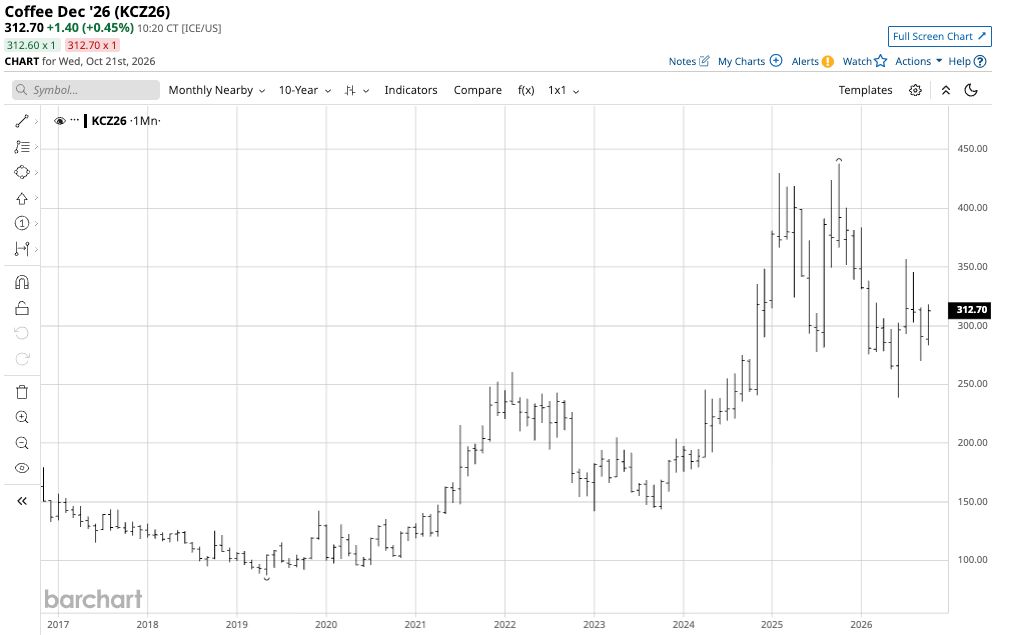
The chart shows current technical resistance at the July 2026 high of $3.57 and the October 2025 all-time high of $4.3795 per pound. Support is at the June 2026 low of $2.3885 per pound. The super El Niño, which can shift weather patterns, can support or suppress production, so price action may become highly volatile over the coming months.
Futures are the only route for exposure
Coffee is a highly volatile soft or tropical commodity. The only route to take a risk position in Arabica coffee prices is the ICE futures market; no ETFs directly track the futures. Agricultural ETFs such as DBA and others may include the Arabica futures, but only as a small part of a larger agricultural portfolio.
ICE coffee futures are leveraged and require specialized futures trading accounts. Each ICE Arabica coffee futures contract contains 37,500 pounds of coffee beans. At $3.13 per pound, the contract value is $117,375. The ICE’s original margin requirement is currently $16,651 per contract. A market participant can control $110,625 worth of coffee futures on the long or short side for a 14.2% down payment. If equity on a long or short position falls below $15,138, the exchange requires maintenance margin payments. Margin requirements can change as volatility changes. Rising price volatility increases margin levels, while falling price volatility lowers them.
A super El Niño could cause substantial price swings in the coffee futures market over the coming months and into 2027. Trade the trends until they bend, as coffee is a market for trading, not investing.
On the date of publication, Andrew Hecht did not have (either directly or indirectly) positions in any of the securities mentioned in this article. All information and data in this article is solely for informational purposes. For more information please view the Barchart Disclosure Policy here.
More news from Barchart
Where Are ICE Arabica Coffee Futures Heading in 2027? Which Sector Had the Most Energy Overnight? Buy Sugar Here Before Prices Rise Again on Global Deficits, Ethanol Production A Big Soybean Crop Is Being Harvested and Is Sending Prices Lower