

Shares of technology and consulting giant International Business Machines (IBM), better known as IBM, came under pressure on Thursday, even after the company delivered a stronger-than-expected third-quarter earnings report. Despite beating Wall Street’s revenue and adjusted earnings estimates, IBM shares slid as investors weighed the company’s unchanged full-year revenue outlook against a more cautious message from CEO Arvind Krishna on artificial intelligence (AI) spending.
Following IBM’s third-quarter 2026 results, reported on Oct. 21, Krishna offered a pointed assessment of how enterprise customers are approaching AI investments. As a provider of the software, mainframes, and consulting services businesses rely on to implement AI, IBM has a front-row seat to the evolving spending landscape. During the company’s earnings conference call, Krishna noted that enterprise customers are becoming “a lot more cognizant and a lot more aware of what is the true ROI of all of their AI spend.”
More Top Stocks Daily: Go behind Wall Street’s hottest headlines with Barchart’s Active Investor newsletter.
He also highlighted growing concerns among clients about “some of the AI spending completely out of control with no real return.” Yet Krishna sees this growing scrutiny as an opportunity for IBM rather than simply a headwind. As companies seek to redesign workflows, improve efficiency, and rein in AI token spending, IBM could benefit from helping them deploy AI more strategically. “That is the tailwind for us,” he said. He also urged businesses to “pick a few” AI initiatives and scale them meaningfully, cautioning against spreading resources across “100 little experiments” that never receive sufficient investment to deliver tangible results.
Still, Krishna’s remarks appear to have unsettled investors, with IBM shares declining despite the earnings beat. The reaction underscores growing market sensitivity to the sustainability of enterprise AI spending and the returns it can generate. With the company’s full-year outlook unchanged and questions mounting over the pace of AI investment, here’s a closer look at IBM stock.
About IBM Stock
Founded in 1911 as the Computing-Tabulating-Recording Company and renamed International Business Machines in 1924, IBM is a global technology company headquartered in Armonk, New York. With a business rooted in enterprise computing, IBM helps organizations navigate complex technology challenges through its portfolio of software, hybrid cloud solutions, AI platforms, mainframe computers, IT infrastructure, and consulting services.
Its offerings also span cybersecurity, data analytics, automation, and quantum computing, serving businesses seeking to modernize operations, manage critical workloads, and integrate emerging technologies into their operations. With a market capitalization of approximately $237.52 billion, IBM has struggled to keep pace with the broader market as enterprise technology spending shifts toward AI infrastructure.
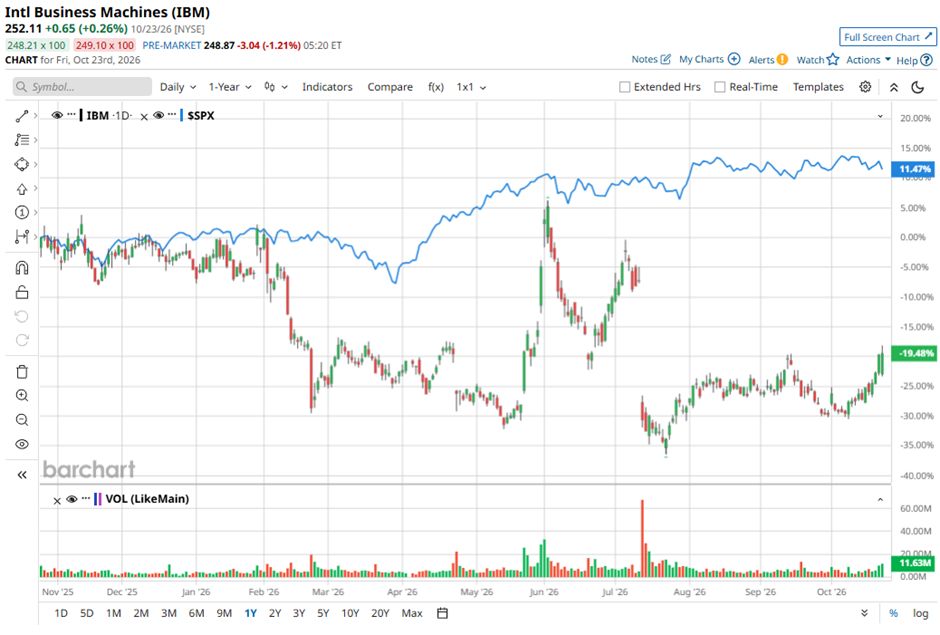
Corporate clients have been redirecting budgets from traditional enterprise software and high-margin mainframe computers toward costly AI infrastructure, memory storage, and graphics processing units (GPUs), creating headwinds for IBM’s stock performance. Over the past year, IBM shares have fallen 12.3%, extending their decline to approximately 14.9% in 2026. In contrast, the broader S&P 500 Index ($SPX) has climbed 14.4% over the past year and gained 12% so far in 2026, highlighting IBM’s widening performance gap with the broader market.
 www.barchart.com
Inside IBM’s Q3 Earnings Report
IBM delivered a stronger-than-expected performance in its fiscal 2026 third quarter, beating Wall Street’s estimates for both revenue and adjusted earnings as software and infrastructure growth supported its top line. Total revenue reached $17.1 billion, up 5% year over year and 6% at constant currency, comfortably surpassing analysts’ forecast of $16.8 billion. The results underscore IBM’s continued push toward higher-margin software, hybrid cloud solutions, and enterprise AI, even as businesses reassess their technology spending priorities.
Software emerged as the primary growth driver, with segment revenue climbing 8% year over year. Demand for enterprise software platforms, data solutions, and workflow automation remained resilient as businesses continued investing in digital transformation. IBM’s infrastructure segment also contributed to the stronger quarter, with revenue increasing 4%, reflecting continued demand for its technology infrastructure offerings.
However, growth was not uniform across the business. The Consulting segment remained relatively flat on a reported basis, although revenue increased 2% at constant currency. This performance reflects a more cautious corporate spending environment, particularly for discretionary technology services. Despite the uneven segment performance, IBM maintained healthy profitability, supported by a strong non-GAAP operating pre-tax income margin and substantial growth in its bottom line.
Earnings growth provided another bright spot. Net income increased 25.6% from the year-ago period, while adjusted earnings per share reached $2.95, beating Wall Street’s consensus estimate of $2.87. The improvement highlights IBM’s ability to translate revenue growth into stronger earnings, even as some parts of its business face a more challenging demand environment.
Cash generation also strengthened during the quarter. Net cash from operating activities reached $4 billion, an increase of $0.9 billion year over year, while free cash flow rose by $0.7 billion to $3 billion. IBM continued returning capital to investors, distributing $1.6 billion in dividends during the third quarter. On the balance sheet, IBM ended the quarter with $11.1 billion in cash, restricted cash, and marketable securities, down $3.4 billion from year-end 2025.
The decline came as the company invested $11.4 billion in acquisitions during the year, reflecting its continued focus on expanding its technology portfolio. Meanwhile, total debt, including $12.7 billion in IBM Financing debt, stood at $63.8 billion, up $2.6 billion year to date. These figures highlight the importance of monitoring IBM’s cash position and debt levels alongside its acquisition-driven growth strategy. Looking ahead, IBM maintained its full-year fiscal 2026 revenue outlook, continuing to expect constant-currency growth of 4% to 5%.
At current foreign exchange rates, currency is expected to have a neutral impact on full-year revenue growth. The company also raised its free cash flow expectations, now projecting an increase of more than $1 billion year over year. This improved cash flow outlook provides an encouraging signal for investors, although the unchanged revenue forecast suggests that management remains measured in its expectations for the remainder of the year.
What Do Analysts Think About IBM Stock?
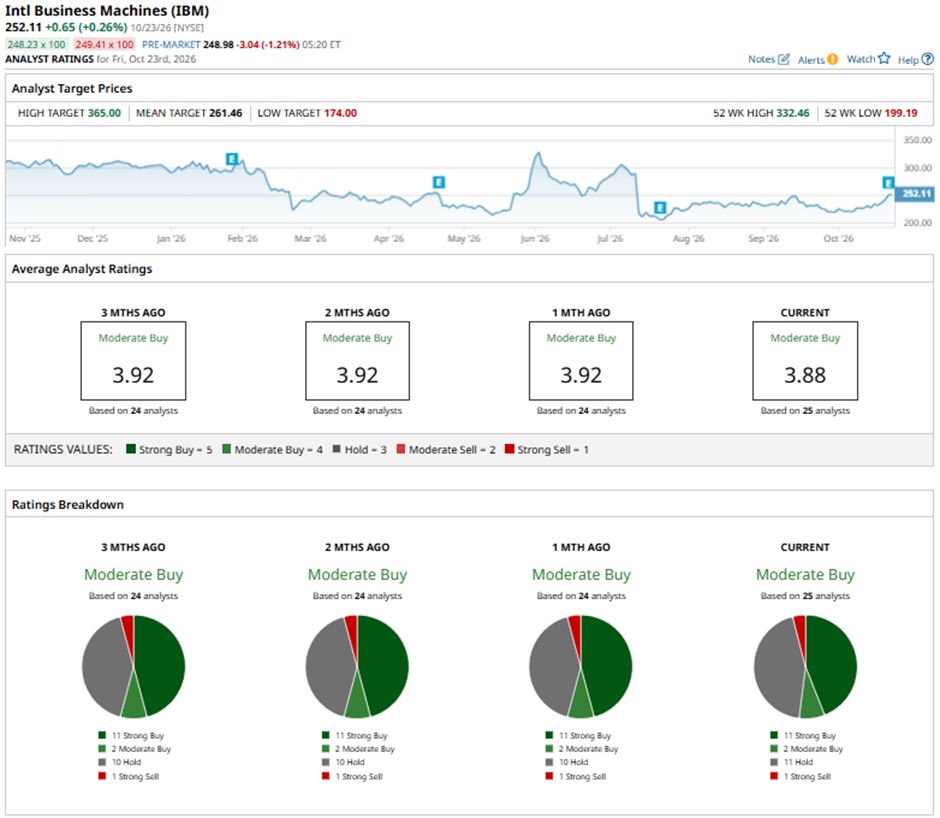
Despite its recent struggles, Wall Street remains cautiously optimistic about IBM, with analysts assigning the stock a consensus “Moderate Buy” rating. Of the 25 analysts covering the company, 11 recommend a “Strong Buy,” two issue a “Moderate Buy,” 11 rate it a “Hold,” and one gives a “Strong Sell.” The average price target of $261.46 points to a potential upside of approximately 3.7%, while the Street-high target of $365 implies a rally of as much as 45%, suggesting that some analysts see considerable recovery potential ahead.
 www.barchart.com
On the date of publication, Anushka Mukherji did not have (either directly or indirectly) positions in any of the securities mentioned in this article. All information and data in this article is solely for informational purposes. For more information please view the Barchart Disclosure Policy here.
More news from Barchart
Micron’s Taiwan Unit Reached a Deal With the Taichung Union. Here’s What to Know. IBM’s CEO Just Issued a Warning Message on AI Spending. He Ended Up Hurting His Own Stock. What the New Class C Share Structure Actually Means for Meta Platforms Stock Investors Lockheed Vs. RTX: The Cheaper Defense Giant Is The Clear Value Win