

The space race is entering a new phase. Launching rockets is no longer the ultimate prize. The bigger opportunity may be owning the satellite networks that provide communications, internet access, and other services to customers on Earth. Companies are spending billions of dollars acquiring the technology and infrastructure needed to compete, and investors are beginning to recognize the stakes.
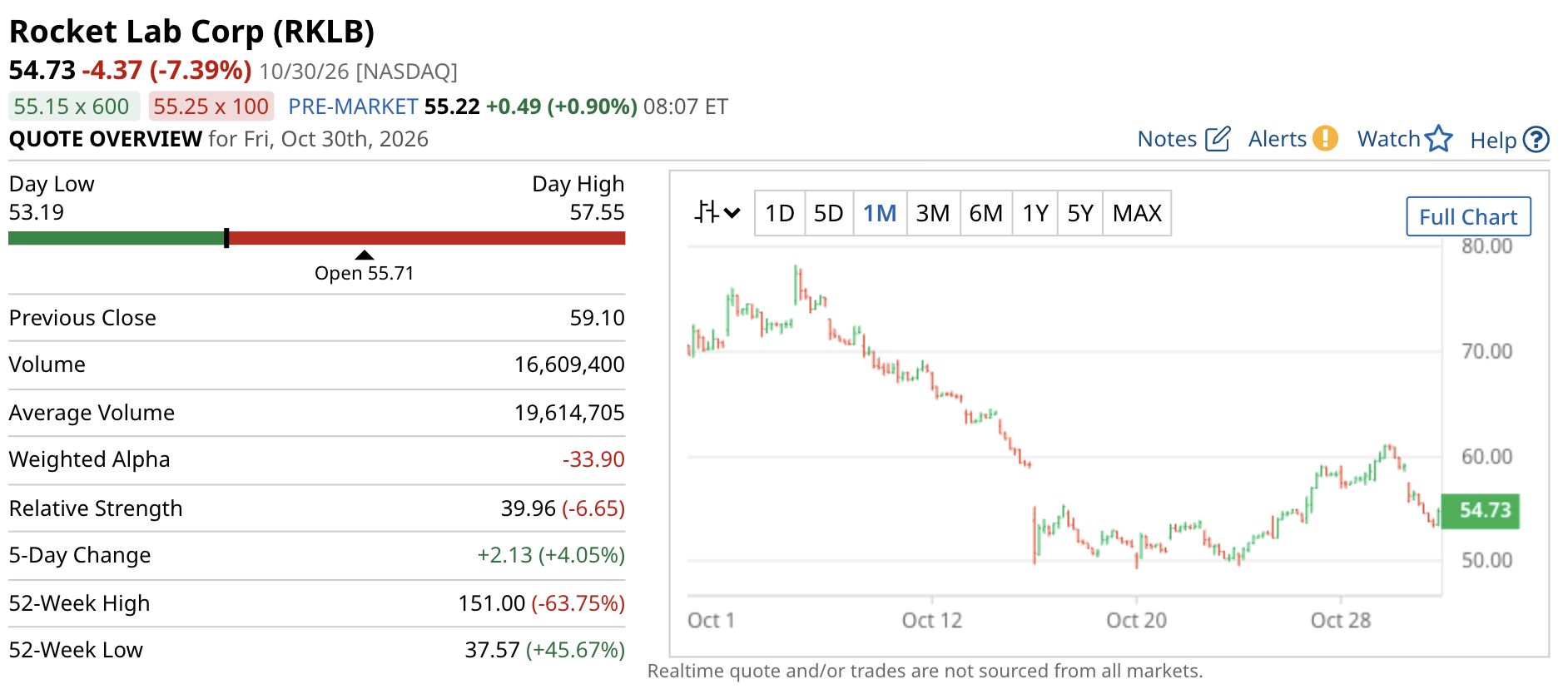
That makes Friday's 7.4% plunge in Rocket Lab (RKLB) stock to $54.73 particularly interesting. Amid a broader technology selloff, concerns about Amazon's (AMZN) growing satellite ambitions added another reason for investors to worry.
More Top Stocks Daily: Go behind Wall Street’s hottest headlines with Barchart’s Active Investor newsletter.
Yet Amazon's expansion could ultimately strengthen Rocket Lab's investment case.
 www.barchart.com
Amazon Is Coming for Rocket Lab's Future Business
During its Oct. 29 earnings conference call, Amazon confirmed its Leo satellite broadband service remains on track to begin commercial operations before year-end.
On its own, that isn't much of a threat to Rocket Lab. Amazon operates a satellite network, while Rocket Lab builds and launches spacecraft. But there's another development that changes the picture.
Amazon agreed in April to acquire satellite communications provider Globalstar (GSAT) for $11.5 billion. The Federal Communications Commission approved the transaction on Oct. 27. That puts Amazon on a collision course with Rocket Lab's ambitions.
In June, Rocket Lab announced its own $8 billion acquisition of Iridium Communications (IRDM), a move designed to transform the company from a rocket manufacturer into a satellite communications powerhouse.
Both acquisitions target businesses that own valuable satellite spectrum and provide connectivity services. Their markets aren't identical, but they increasingly overlap in direct-to-device communications, data services, and global connectivity.
Amazon is a legitimate competitor. But the combined $19.5 billion the companies are committing to these acquisitions also demonstrates the value they see in satellite communications. And that's where the investment opportunity gets interesting.
Rocket Lab Has More Than Rockets Going for It
Rocket Lab's Iridium acquisition could transform its financial outlook. The communications company brings an established satellite network, more than 2.5 million subscribers, and recurring communications revenue. Rocket Lab would gain something its launch business currently lacks: an existing customer base paying for ongoing services.
Meanwhile, the underlying business is growing. Rocket Lab's second-quarter earnings release reported revenue of $234 million, up 62% year-over-year (YoY). Its backlog surged 137% to $2.36 billion, with approximately 60% coming from space systems rather than launch services.
That means Rocket Lab's future isn't entirely dependent on its delayed Neutron rocket. The company's expanding space systems business already supplies satellites and components to commercial and government customers.
Ironically, Amazon's satellite expansion could create additional launch demand across the industry, although Rocket Lab isn't currently an announced Leo launch provider.
Neutron Is Still the Missing Piece
Granted, Rocket Lab has plenty to prove. Its reusable Neutron rocket has slipped into 2027 following manufacturing problems. That's important because Neutron would allow Rocket Lab to compete for larger satellite deployments currently dominated by established launch providers. The repeated delays have raised legitimate questions about development costs and execution.
Rocket Lab also remains unprofitable, and at roughly 40 times sales, its stock isn't a traditional bargain. The Iridium acquisition introduces financing, dilution, and integration risks, while Amazon brings deeper pockets to the competitive fight.
Still, with approximately $2.4 billion in cash and investments at June's end, Rocket Lab has resources to pursue its plans.
Management expects third-quarter revenue of $250 million to $265 million. Its Nov. 9 earnings report should provide a clearer picture of progress.
 www.barchart.com
What Wall Street Thinks of RKLB Stock
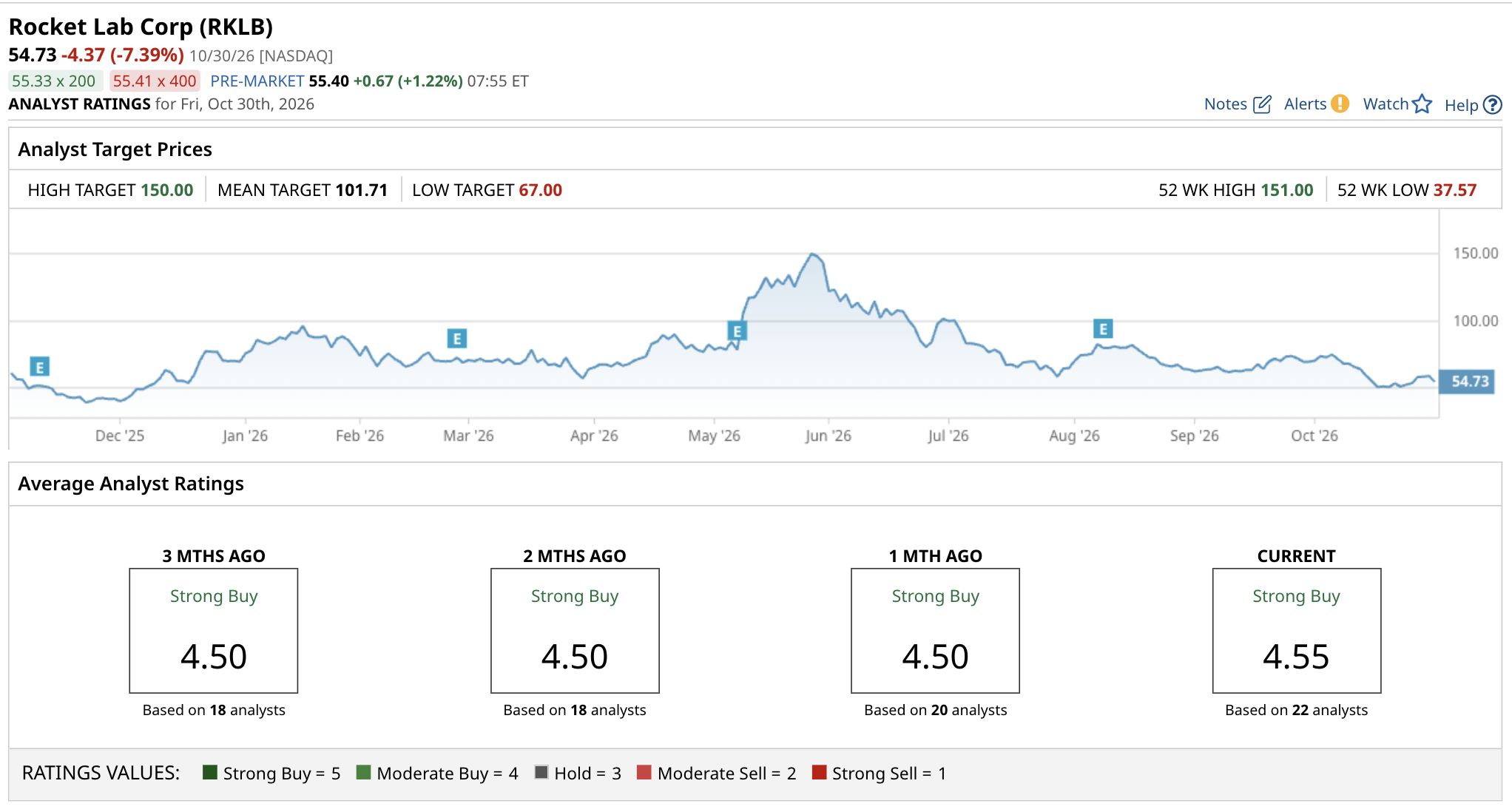
Despite concerns about Neutron delays and Amazon competition, 16 of the 22 analysts covering RKLB stock gave it a “Strong Buy” rating, two have a “Moderate Buy” rating, and four recommend a “Hold.” Notably, none say sell.
Analysts at Goldman Sachs, TD Cowen, and Keybanc did trim their price targets, as did Citizens, which cut its target to $90. However, Cantor Fitzgerald reiterated its “Overweight” rating and $122 target. Taken together, analysts give RKLB stock a consensus price target of $101.71, implying 85.6% potential upside. Even the Street-low price of $67 implies a 22.4% upside.
Key Takeaway
In short, Amazon's expansion creates real competition, but it also validates Rocket Lab's strategy of moving beyond rockets into satellite communications.
If Rocket Lab completes its Iridium acquisition, gets Neutron flying in 2027, and converts its growing backlog into revenue and profits, Friday's selloff could prove an attractive entry point for patient investors.
RKLB stock remains speculative. But Amazon's ambitions may be less a reason to abandon Rocket Lab than a reason to take its long-term potential seriously.
On the date of publication, Rich Duprey did not directly have a position in any of the securities mentioned in this article. All information and data in this article is solely for informational purposes. For more information please view the Barchart Disclosure Policy here.
More news from Barchart
Intel Stock Had Its Worst Day Since 1974 Despite 8th Straight Guidance Beat. Here’s What Investors Missed. OpenAI Wants to Buy Google AI Chips. What That Means for GOOGL Stock Here. A $1 Trillion Reason to Buy Amazon Stock Today Rocket Lab Plunged 7% Amid Amazon Fears — but That Could Be the Best Reason to Buy