


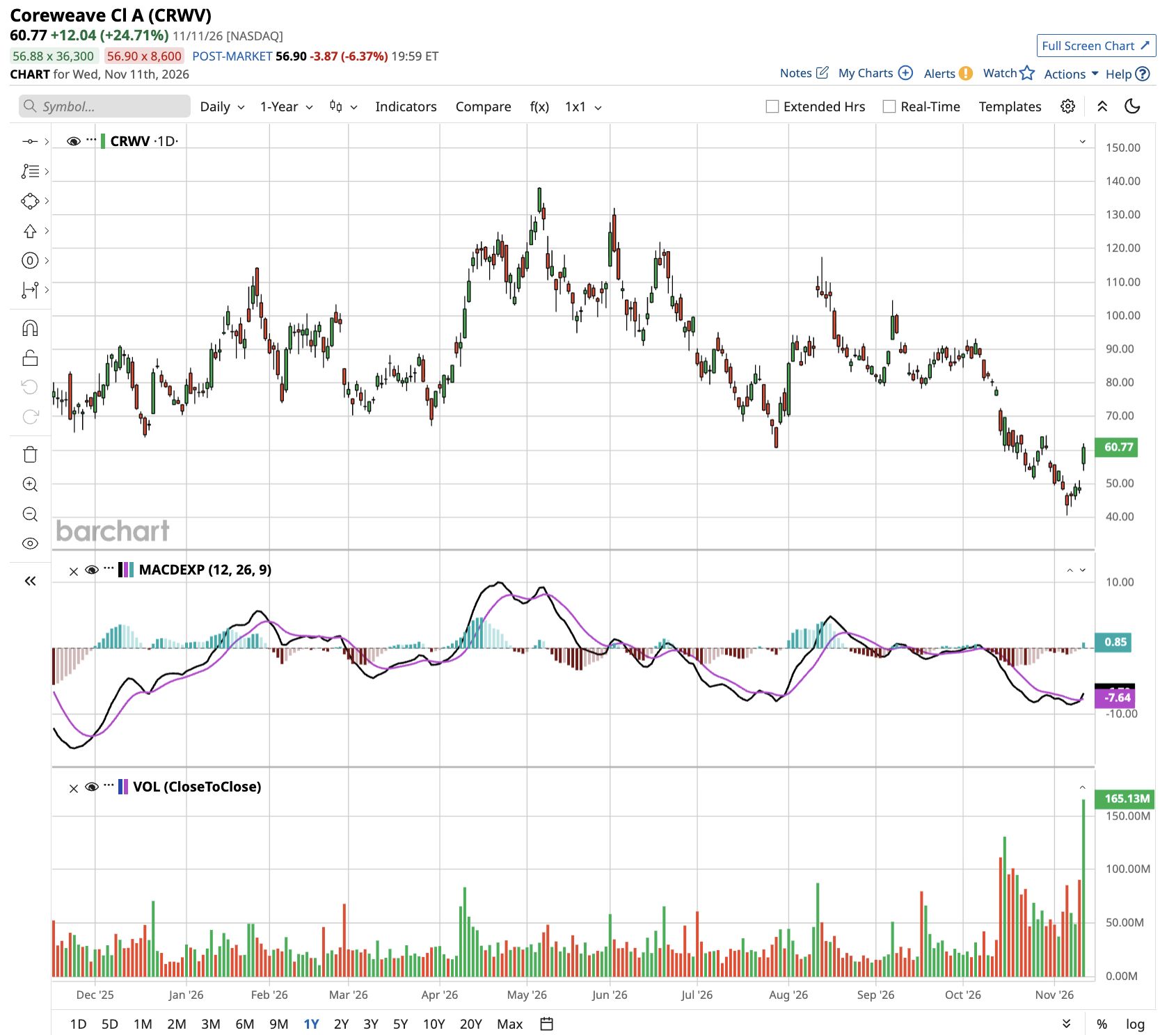
CoreWeave (CRWV) looked like a company in trouble last month. On Oct. 15, CNBC reported that credit default swap (CDS) spreads on CoreWeave’s debt had widened past 11%. That worried investors.
A CDS is essentially insurance on a company’s debt. If a lender holds $10 million of CoreWeave bonds and is worried about repayment, it can pay a third party a regular fee, and the third party covers the loss if CoreWeave defaults. Traders who don’t own the bonds can also buy a CDS to bet that the company is in trouble. The spread is the price of that insurance, quoted as a percentage per year. A spread of 11% means protecting $10 million of CoreWeave debt costs about $1.1 million a year.
More Top Stocks Daily: Go behind Wall Street’s hottest headlines with Barchart’s Active Investor newsletter.
Insurance costs more when the risk is higher. So, when the spread widens, the market projects a higher default rate. As noted by CNBC, spreads past 11% are “generally viewed as a distress level.” Healthy companies usually have far lower CDS costs. At 11%, investors are treating CoreWeave as a high default risk.
CoreWeave borrows heavily to build data centers, and its interest expense more than doubled year-over-year (YOY) to $846 million in the third quarter of 2026. The CDS spike suggests the market is unsure whether the company can keep raising debt to fund its expansion plans.
 www.barchart.com
CoreWeave Reports Q3 Earnings
CoreWeave is a neocloud that rents artificial intelligence (AI) computing power to customers and builds the data centers to deliver it. CoreWeave's business model is capital-intensive, as the company reported capital expenditures of $14.5 billion in Q3 alone. Due to higher interest expense, net loss widened to $709 million in Q3, up from $110 million last year.
On the Q3 earnings call, management cited a 7.9% weighted average cost of debt, a new investment-grade loan expected to price at 7% to 7.5%, and about $9 billion of customer prepayments.
Revenue grew 168% year-over-year (YOY) to $3.7 billion in Q3, topping the high end of management's guidance. CoreWeave also reported adjusted operating income of $379 million, well above guidance of $230 million at the midpoint. Adjusted operating margin rose to 10% in Q3, up from 1% in Q1 and 5% in Q2.
The company ended the period with a backlog of about $133 billion, up 138% YOY. CoreWeave raised its 2026 outlook and now projects revenue of $13 billion to $13.3 billion. Adjusted operating income is forecast to come in between $1.275 billion and $1.375 billion.
CRWV stock surged almost 25% on Nov. 11 following these positive developments. Still, despite the recent rally, CoreWeave stock is down 62% from its 52-week high.
How CoreWeave Is Calming Debt Fears
CEO Michael Intrator said CoreWeave's weighted average cost of debt was 7.9% at the end of the quarter, down 2.5 percentage points from a year ago. CoreWeave also said it will stop selling unsecured bonds, which are typically loans with no collateral backing them but a high interest rate. Instead, the company will borrow against specific customer contracts, which lenders see as safer and cheaper.
After the earnings release, Intrator told CNBC that a new loan would launch in the next week or two, and that it had already been rated high investment grade. It is expected to price at 7% to 7.5%.
CoreWeave also expects about $9 billion in customer prepayments and deposits over the next three months. Notably, it has paid down more than $4 billion of debt.
Intrator noted that the company has 10 times more demand than it has capacity left to sell for 2027. Meanwhile, for 2028, requests already outnumber available capacity.
On the earnings call, management noted that the company raised prices about 25% in July, then another 10% later in the quarter. Short-term capacity now sells for more than $40 million per megawatt a year, “while pricing for new infrastructure on four and five-year contracts is moving to $20 million-$25 million per megawatt.”
More than 130,000 GPUs will also come off contract in 2027. At current prices, renewing them could add nearly $4 billion in annual revenue with no new capital spending, according to CoreWeave. That sits outside the company's backlog, while CoreWeave's customer base is widening, too.
Risks CoreWeave Investors Should Weigh
CoreWeave remains a loss-making company. CFO Nitin Agrawal expects adjusted net income to turn positive in the first half of 2028. The company also plans to invest around $38 billion toward capital spending this year.
Analysts forecast free cash outflow to total more than $100 billion cumulatively through 2030. Meanwhile, CoreWeave ended Q3 with $4.12 billion in cash, meaning it will have to raise significant capital to fuel expansion.
Finally, on the Q3 earnings call, Goldman Sachs analyst Gabriela Borges asked about what happens if new industry supply outruns demand. Intrator said that demand for computing power is growing faster than capacity.
Is CoreWeave Stock a Buy Now?
In the roughly four weeks since mid-October, CoreWeave's story went from distress to what Intrator called an “inflection point.”
The bull case is clear. Revenue is surging, margins are rising, and funding looks cheaper. But the bear case is just as easy to see. Losses and interest costs remain large, and adjusted profit is not expected until 2028.
The next test is that new loan. If it prices as expected, it would support management's claim that financing fears are fading.
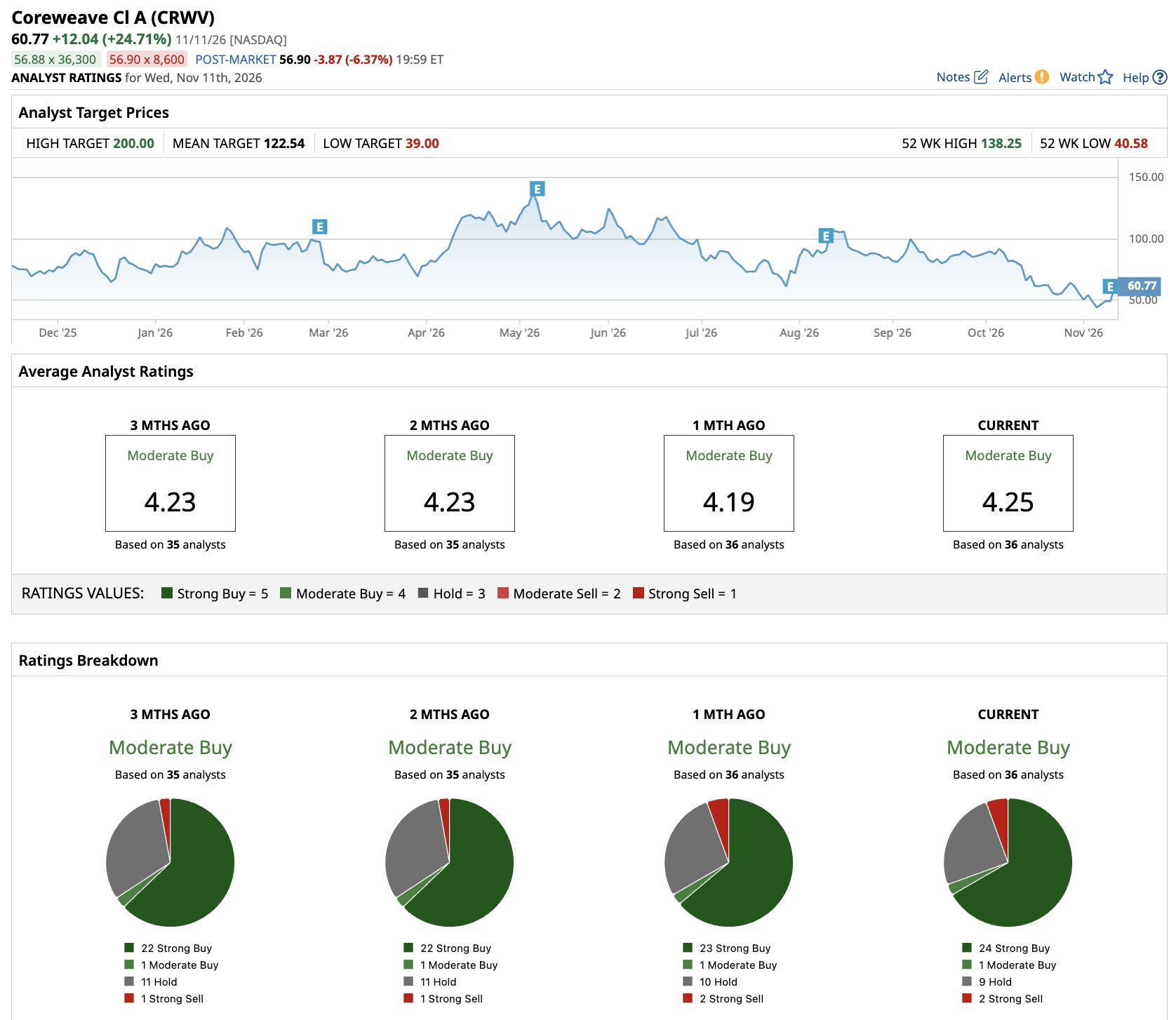
Overall, CoreWeave has a consensus “Moderate Buy” rating on Wall Street. Out of the 36 analysts covering CRWV stock, 24 recommend a “Strong Buy” rating, one recommends a “Moderate Buy," nine recommend a “Hold” rating, and two recommend a “Strong Sell." The average price target of $108.06 suggests potential upside of 103% from current levels.
 www.barchart.com
On the date of publication, Aditya Raghunath did not directly have a position in any of the securities mentioned in this article. All information and data in this article is solely for informational purposes. For more information please view the Barchart Disclosure Policy here.
More news from Barchart
Cisco Systems Had a Stellar Quarter, But CSCO Tumbled - Is It Too Cheap Here? Down 62% From All-Time Highs, Here’s How to Play CRWV Stock as CoreWeave Smashes Q3 Estimates Demand for the Anthropic IPO Far Outpaces Available Shares. Be Careful in an Early Scramble for Stock. Option Volatility and Earnings Report For Nov 16-20