


Cummins (CMI) hit a new 52-week low of $431.30 on Monday. The manufacturer of diesel engines, electric vehicle components, and power generation products has had a mixed bag in 2026.
Between Jan. 1 and June 18, CMI stock gained nearly 45%, hitting an all-time high of $737.76. In the five months since, it has lost all of those gains, and a little more.
More Top Stocks Daily: Go behind Wall Street’s hottest headlines with Barchart’s Active Investor newsletter.
This explains why Cummins stock has hit 40 new 52-week highs in the past 12 months and only 3 new 52-week lows. However, the Barchart Technical Opinion suggests that the imbalance will shrink in the near term as CMI loses more of its value.
In February, I recommended Protective Collars for three stocks: Caterpillar (CAT), Wayfair (W), and Southwest Airlines (LUV). At the time, I considered two others: Vale (VALE) and Cummins. In hindsight, I should have included Cummins.
Now, at the lowest point since October 2025, I’m tempted to recommend that investors buy CMI at the new low despite what the momentum says.
Here’s why.
Why the 42% Swoon for CMI Stock Since June?
Without having spent a minute on Cummins in recent weeks, my guess would be valuation concerns. But before I confirm that, I’ll consider a few other reasons.
The most recent concern was the company’s Q3 2026 results released on Nov. 5 before the markets opened. They weren’t ideal, and investors knocked the stock down 4.9% in a single day. Over the next four days, they rallied, only to fall 4.6% in yesterday’s trading before closing off its 52-week low. As I write this in early Tuesday trading, it’s up 1%.
Although the company reported third-quarter top-line revenue and earnings higher year over year, both missed analyst estimates.
On the top line, it reported $9.44 billion in revenue, up 13.5% from $8.32 billion a year earlier, but 4.6% below the Zacks consensus estimate. On the bottom line, earnings per share were $7.71, excluding $0.54 in tax-related items. That’s 37.9% higher than its adjusted EPS of $5.59 from a year ago, but 67 cents shy of the estimate.
Analysts expected more; however, of the 19 that cover CMI, 11 rate it a Buy (4.11 out of 5), with a $602.31 target price, 37% above its current share price.
So, Wall Street is still onside. The MarketWatch EPS estimate for 2026 is $28.81. Its shares trade at 15.2 times that estimate. On the surface, that seems very reasonable. However, analyst estimates could be revised downward more than they already have.
More relevant to the share price’s fall was the company’s lower guidance.
It now expects revenues to increase by 10% in 2026, down from previous guidance of 11.5% at the midpoint. That’s a $1.34 billion revision lower from 2025’s $33.67 billion in sales.
The Wall Street revision that really sticks out is yesterday’s target price change from Morgan Stanley. Although it maintained its Overweight rating, it lowered the target price by 23% from $761 to $588.
That explains yesterday’s price drop.
The question is whether this is a blip in Cummins’ business or a cyclical decline that warrants a lower rerating.
Cummins’ Strengths Aren’t Insignificant
Cummins has five reportable segments: Distribution (35% of external sales), Components (25%), Engine (25%), Power Systems (13%), and Accelera (2%). Right there, you have to like that it has four segments with over $1 billion in external sales.
One thing you’ll notice is that the company had $2.25 billion in inter-segment sales in the third quarter, more than 19% of its total sales of $11.69 billion. That’s a strength, not a weakness, as the vertical integration has led to higher margins.
In the third quarter, its gross margin on external sales was 27.7%, up 210 basis points from a year ago. As a result, its gross margin in the 12 months ended Sept. 30 was higher than it’s ever been.
Further down the income statement, S&P Global Market Intelligence estimates its EBITDA (earnings before interest, taxes, depreciation and amortization) margin for 2026 will be 18.04%, double what it was two decades ago, and 264 basis points higher than in 2025.
I don’t want to get into the nitty-gritty of its financials. I live around the corner from Willow Park, a part of Canadian Forces Base Halifax, the largest in Canada by personnel. It has a massive Cummins generator outside one of its main buildings to keep the base running. AI or not, the need for these products isn’t going away.
Lastly, it allocates capital well, especially when it comes to returning capital to shareholders through dividends and share repurchases.
On the former, it has increased its annual dividend payments for 17 consecutive years, raising the quarterly amount by 10% to $2.20 with the September 2026 payment. The annual rate of $8.80 yields 2.0%.
On the latter, it approved a $2 billion share repurchase program in December 2019. It completed that program by buying back $218 million of its stock in Q1 2026.
At the same time, it started an additional $2 billion share repurchase program in December 2021, which began after completing the 2019 plan at the end of March.
In the first nine months of 2026, it has repurchased $615 million of its stock, leaving $1.39 billion left on the 2021 plan. Those repurchases were a reasonable 33% of its $2.47 billion in free cash flow, while dividends were 35%.
The average price paid for the 1.4 million shares repurchased in 2026 was $586.33, well below the June all-time high of $737.76.
That’s commendable restraint.
Historical Valuation Suggests CMI Isn't Expensive
The 10-year chart shown below shows CMI’s current enterprise value is 13.43 times its EBIT (earnings before interest and taxes), well above the 10-year low of 6.11x in March 2020 and slightly above the 10-year average of 12.65x.
Overvalued? Not compared to its June prices. For most of the decade, its EV/EBIT multiple has always been double digits. I suppose you could wait until the multiple falls below 10.0x. That would be around $385, about 11% from its current share price.
If you’re in that camp, you might be better off buying a half position and waiting to see what happens between now and early 2027.
Long-term, I like the anti-AI play with Cummins.
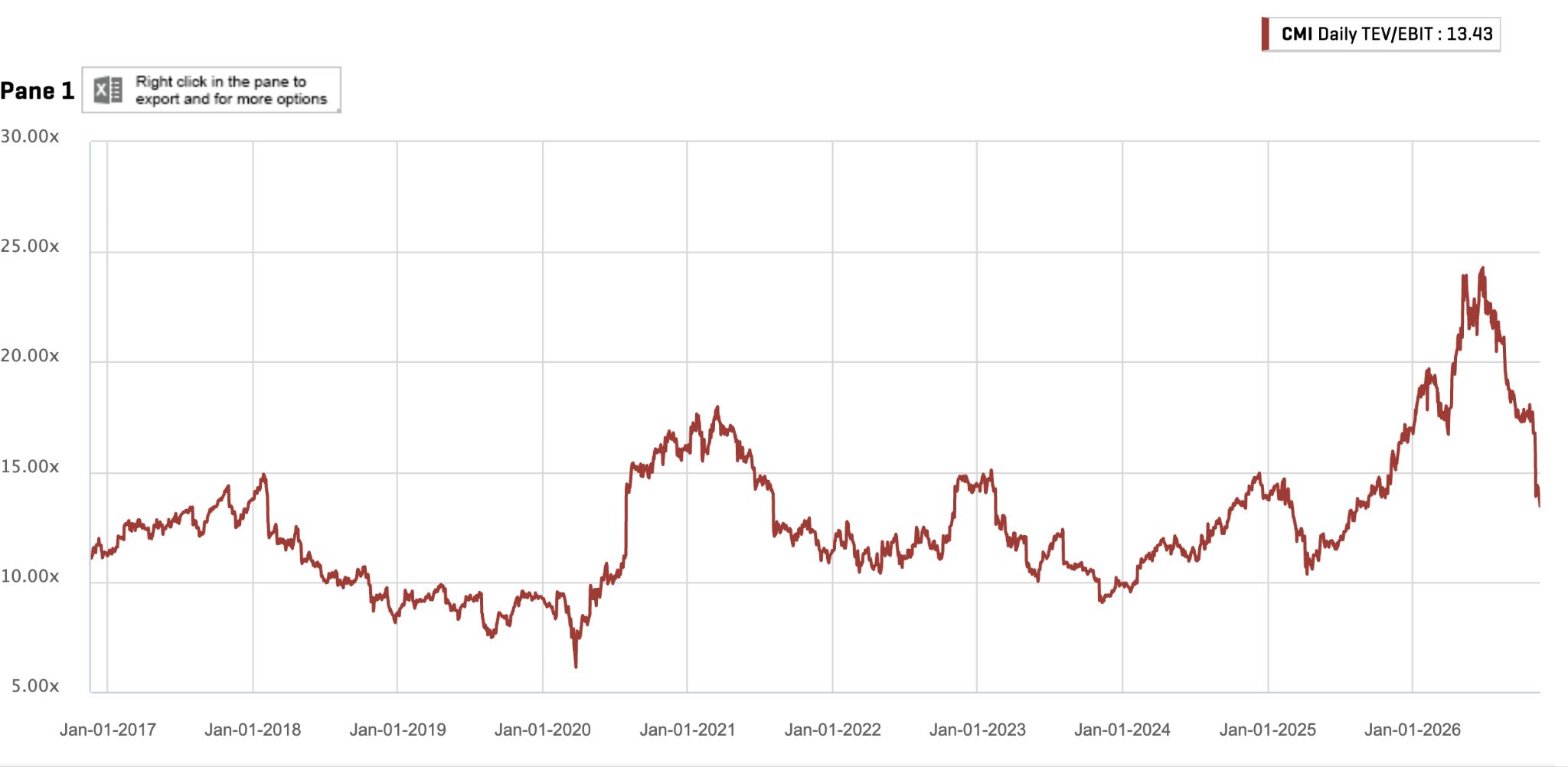
Source: S&P Global Market Intelligence
On the date of publication, Will Ashworth did not directly have a position in any of the securities mentioned in this article. All information and data in this article is solely for informational purposes. For more information please view the Barchart Disclosure Policy here.