

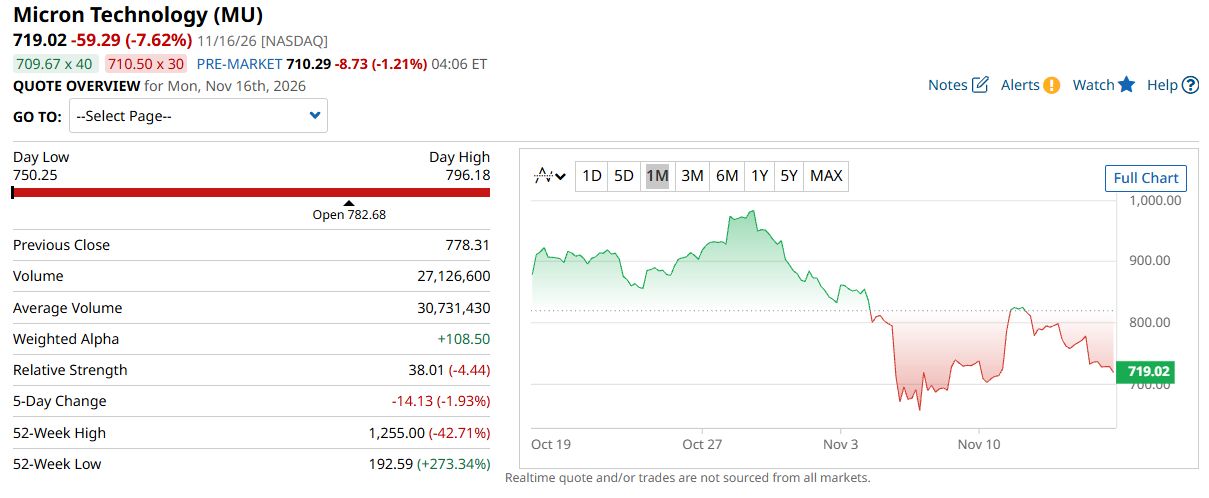
Micron Technology (MU) just closed out the most profitable year in its history, and if management's guidance holds, the current quarter should be even stronger. But we might not know that from looking at the stock, which closed at around $719 on Nov. 16, 2026, or about 41% below its June high. In fact, judging by how the shares have traded this month, it seems like the market has already made up its mind that the memory boom is over.
Personally, I see it a bit differently, mostly because the numbers Micron has already locked in tell a much calmer story than the share price does. Plus, a record $35 billion buyback is cleared to start on Dec. 9, which I think is going to matter a lot for shareholders at these prices. Of course, that doesn't mean owning the stock at $719 is risk-free. In fact, there's one risk in particular that I think every shareholder should understand before buying. More on that later, but first, let's rewind to what turned out to be a pretty rough start to November.
More Top Stocks Daily: Go behind Wall Street’s hottest headlines with Barchart’s Active Investor newsletter.
Why Micron's 17.5% Drop Left Its Guidance Untouched
It all started on Nov. 5, just two days after Democrats swept the U.S. midterm elections. Investors started to worry that a new wave of lawmakers and governors could slow down the construction of data centers, and that fear was enough to send AI stocks tumbling across the board.
Micron got hit especially hard, falling 17.5% to $656.39 in its worst day in at least a year. On top of that, the company reportedly had all but stopped building Fab 11E that same day, which is a planned $3 billion to $4.5 billion plant in Taoyuan, Taiwan. The plant was supposed to start making high-bandwidth memory in 2028.
 Screenshot courtesy of: www.barchart.com
From there, the headlines just kept rolling in. On Nov. 14, a federal judge allowed a class action lawsuit to move forward, which accuses Micron, Samsung and SK Hynix (SKHY) of holding back the supply of regular memory chips to push prices up.
Two days later, the Commerce Department rolled out a new rule aimed at keeping advanced AI chips out of China, and Micron slid another 7.6%. In other words, companies operating in places like Singapore and Malaysia now have to screen their buyers and get licenses to sell to them. All of that could slow down AI server sales in those markets.
If that's not all, the leadership shakeup at Nvidia (NVDA), one of Micron's key HBM customers, has kept everyone on edge the whole time. I'll admit that all of this looks like a pile of bad news when stacked together, but once I looked at each headline on its own, the picture's a lot less scary.
The midterms and export concerns, for example, are all about future AI spending, and neither one changes what customers have already signed up to buy. As for the Taiwan pause, it actually comes from a labor dispute over pay and profit sharing, and Micron says its current factories in Taiwan are running “business as usual.”
Personally, I think a delayed factory might even help a little, since it means less new supply coming into a market that Micron already calls tight. The lawsuit doesn't worry me much either, mainly because a court threw out a similar case a few years ago, so I'm treating it as noise for now.
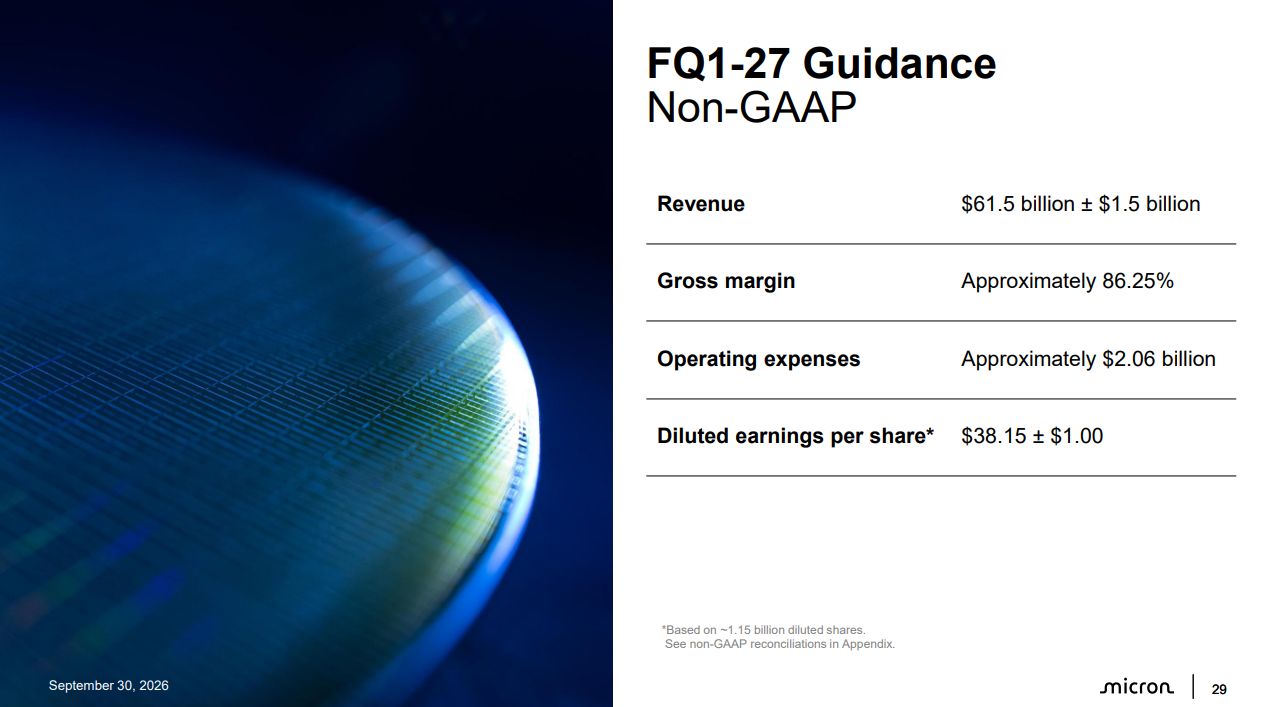
Better yet, the two numbers that really drive Micron's next 12 months haven't budged. Management still expects revenue of $61.5 billion, give or take $1.5 billion, for the first quarter of fiscal 2027, and the company says more than 75% of its fiscal 2027 output is already spoken for.
That's a pretty solid order book for a stock that's down 41%, and as the next section shows, it makes the valuation hard to ignore.
Micron Now Trades at Only 4.7x Its Own Guided Earnings
Start with the guidance itself. Micron expects to earn about $38 a share this quarter, and if that pace simply held for a full year, the stock would trade at only about 4.7x those earnings. That's a multiple I'd normally expect to see on a business in trouble, not one that just posted record profits.
 Screenshot courtesy of: www.micron.com
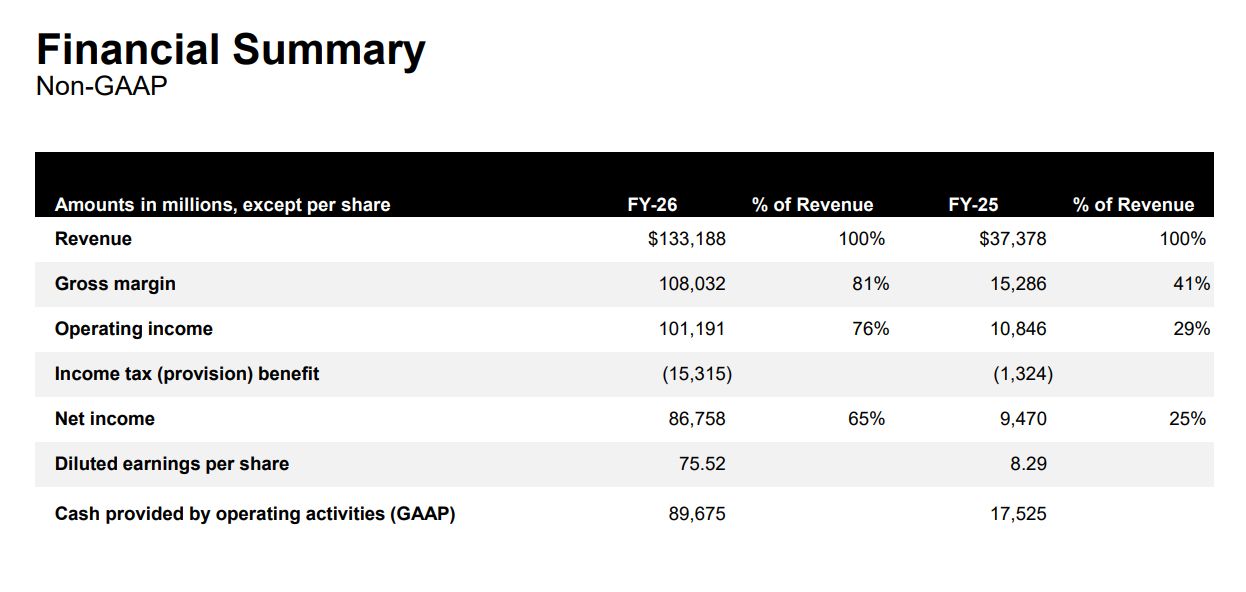
However, the comparison I find most telling is with last year. Micron earned about $75.50 in adjusted EPS for all of fiscal 2026, and the current quarter alone is expected to bring roughly half of that, yet the stock trades at only around 9.5x last year's earnings. Those two metrics don't make sense.
Honestly, I think the market is pricing Micron as if fiscal 2027 never shows up and profits slide right back to where they were a year ago, which is exactly why this setup caught my attention.
 Screenshot courtesy of: www.micron.com
For long-term investors, it all boils down to how long Micron can keep earning like this and what the company plans to do with all that cash in the meantime. As it turns out, that second part already has a date circled on the calendar.
How the Selloff Gives Micron's $35 Billion Buyback More Punch
That date is Dec. 9, which is when Micron can finally start using the $35 billion buyback plan its board approved on Oct. 8, the largest in company history. Why the wait? Well, it goes back to the CHIPS Act, the federal law that gave Micron grants to build new factories in Idaho and New York.
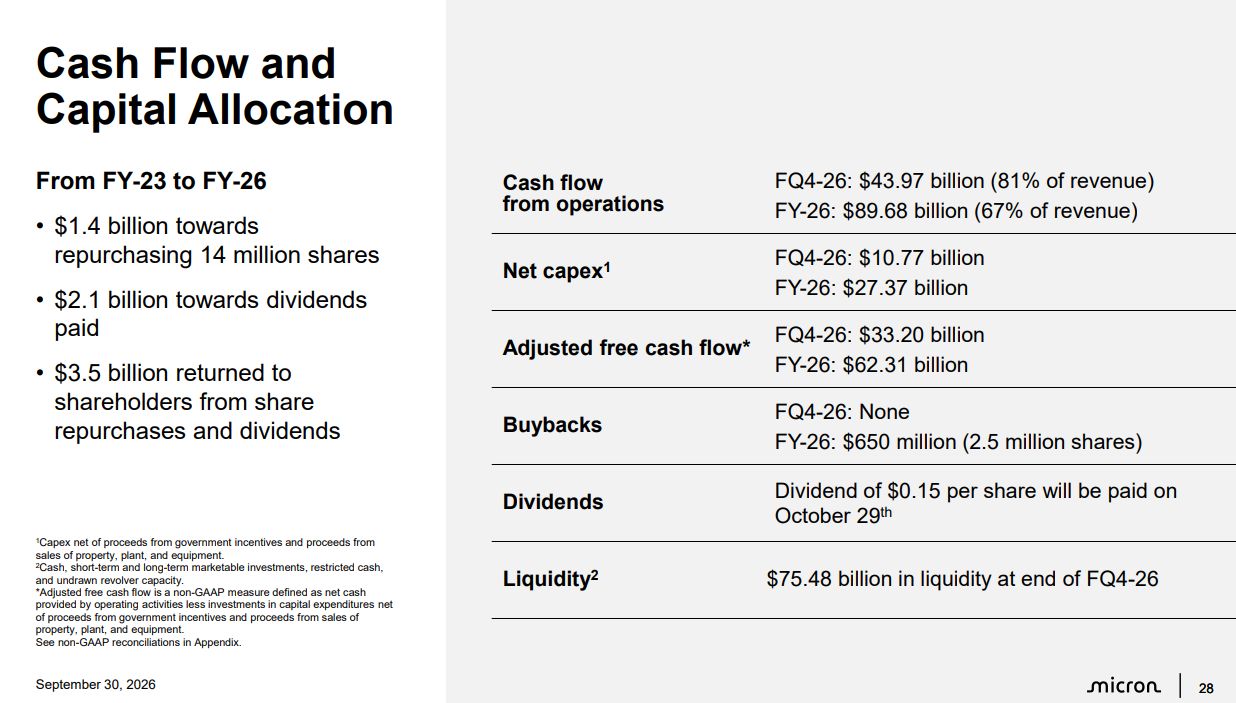
As part of that deal, Micron agreed to hold off on large buybacks for two years after the December 2024 award, which is why the company bought back only about $650 million of its own stock in fiscal 2026.
Paying for the plan won't be a problem, either. Micron generated about $33 billion of adjusted free cash flow in the fiscal fourth quarter alone, and in everyday terms, free cash flow is the money left over after paying for new factories and equipment. The current quarter should be even better, too.
If I take the guided EPS of about $38, apply last quarter's cash conversion, and subtract the roughly $11.5 billion Micron plans to spend on new capacity, I get close to $38 billion of free cash flow for the first quarter of fiscal 2027.
 Screenshot courtesy of: www.micron.com
Put simply, Micron could cover the entire $35 billion buyback with about three months of cash and still leave its $68 billion net cash pile untouched.
Now, the part I think most investors are overlooking is the timing. Had Micron been allowed to buy back stock at the June high of roughly $1,214, $35 billion would have retired about 29 million shares. At today's $719, the same money buys about 49 million shares, or roughly 4.3% of the company, which is around 70% more stock for the same dollars.
In other words, the selloff hurting shareholders is also giving Micron a steep discount on its own stock right before it's allowed to start buying, and that alone could lift EPS by about 4.5%.
I also like what this does with all that idle cash. Most of Micron's $68 billion sits in cash and investments earning interest, while the stock trades at about 4.7x its guided earnings, which works out to an earnings yield of roughly 21%! Personally, I can't think of a better use for that money than buying a business that earns about 21 cents a year on every dollar spent, especially when that business is Micron itself.
Better yet, buybacks are one of the few benefits of this boom that stick around after it ends. Memory prices can fall, and margins can shrink, but a share that's been retired stays retired. If Micron printed four quarters of free cash flow like this one at its own stock at current prices, I think it could retire close to one in every five shares within a year and lift EPS by more than 20% without selling a single extra chip.
Even at half that pace, long-term holders would head into the next downturn owning a noticeably bigger slice of the company. But Micron is also pouring a record amount of money into new factories, and that's the one part of this story that makes me a little uneasy.
Micron's $25 Billion Capacity Push Is the Risk to Watch
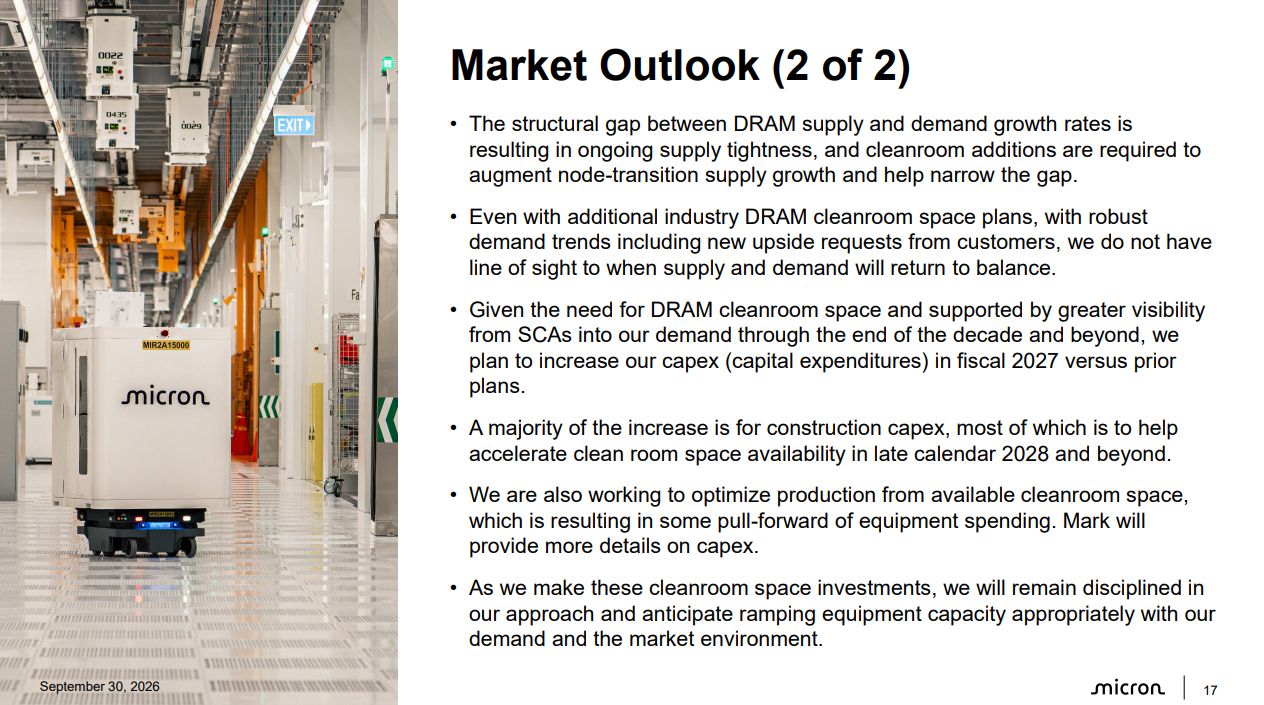
Micron is building faster than ever right now, with management expecting to spend about $25 billion on new capacity in just the first half of fiscal 2027. That's already more than 90% of the roughly $27 billion it spent in all of fiscal 2026, and the company says spending will climb even higher in the second half.
SK Hynix and Samsung are expanding as well, and China's ChangXin Memory Technologies has more than doubled its share of global DRAM sales in about a year. If all of that new supply hits the market around the same time, memory prices could fall off a cliff, just like they have in past cycles.
Management, for its part, expects supply to get even tighter in fiscal 2027 and 2028, mostly because the bulk of its new cleanroom space won't come online until 2028. Cleanrooms are the ultra-clean buildings where chips actually get made. I think that buys Micron two strong years, though it also makes 2028 the year I'd circle on the calendar.
 Screenshot courtesy of: www.micron.com
Micron's long-term contracts certainly help, just not as much as the headlines might suggest. The company has signed 26 strategic customer agreements, multiyear deals in which customers commit to set volumes ahead of time, often with price floors and ceilings.
These deals should make up only a bit more than 35% of revenue through 2030, though, which leaves close to 65% of sales riding on wherever memory prices happen to land.
 Screenshot courtesy of: www.micron.com
That's a lot of exposure, and a simple what-if shows why. Say revenue and operating costs stay right at guidance and only the gross margin moves, which is the share of each sales dollar Micron keeps after paying the cost of making the chips.
If gross margin slipped back to the roughly 46% Micron earned in the fiscal fourth quarter of 2025, this quarter's guided EPS of about $38 would shrink to around $19.50, and that cheap-looking 4.7x multiple would nearly double overnight.
Micron would still be profitable in that case, but the last downturn got much uglier. Revenue roughly halved from a record of nearly $31 billion in fiscal 2022 to about $15.5 billion a year later, and the company swung to an adjusted loss of $4.45 per share.
Since memory stocks tend to fall well before profits do, I think today's 41% slide could turn out to be either a great buying window or the market's early warning about 2028. So, with the bull case and the risks both on the table, here's where I land.
Why I Rate Micron a Buy Despite the Cycle Risk
I prefer to think long term, so the idea of Micron swinging another 20% on the next headline doesn't keep me up at night. Memory stocks have always been a bit of a rollercoaster, and personally, I prefer buying when the market is this nervous.
The way I see it, Micron has a couple of strong years ahead and far more control over how this cycle ends than it had in past ones. I won't pretend the next downturn can't sting, but at today's price, I think investors are being paid well to sit through it.
With the guidance intact and the buyback clock about to start on Dec. 9, I'm happy to stay firmly in Micron's corner.
On the date of publication, Rick Orford did not directly have a position in any of the securities mentioned in this article. All information and data in this article is solely for informational purposes. For more information please view the Barchart Disclosure Policy here.
More news from Barchart
A $3 Billion Reason Why Disney Stock Is in Focus Today A $5 Billion Reason Why Nike Stock Is in Focus Today What It Will Take for Cerebras Stock to Stage a Real Revival After Q3 Earnings Rally Micron Stock Is Down 41%, but the $35 Billion Buyback Could Change the Game. Here's How.