

The United States personal savings rate dropped to 4.1% in August 2026, its lowest level since November 2022, according to the Bureau of Economic Analysis.
That decline now raises a pointed question: can Bitcoin serve as a hedge against shrinking household buffers?
What Does the Falling US Savings Rate Reveal About Household Finances?
The personal savings rate measures the share of disposable income households set aside rather than spend. A falling rate signals families are draining reserves to maintain consumption levels.
August's reading fell 0.5% from July. It has dropped 1.6 points since January 2025, based on Bureau of Economic Analysis data.
Excluding the 2022 inflation shock, this marks the lowest level since 2008. The five-year average now sits at 5.4%, the weakest in 14 years. That compares with roughly 6% before the pandemic. Persistent inflation in housing, food, and energy continues to squeeze household budgets nationwide.
Follow us on X to get the latest news as it happens
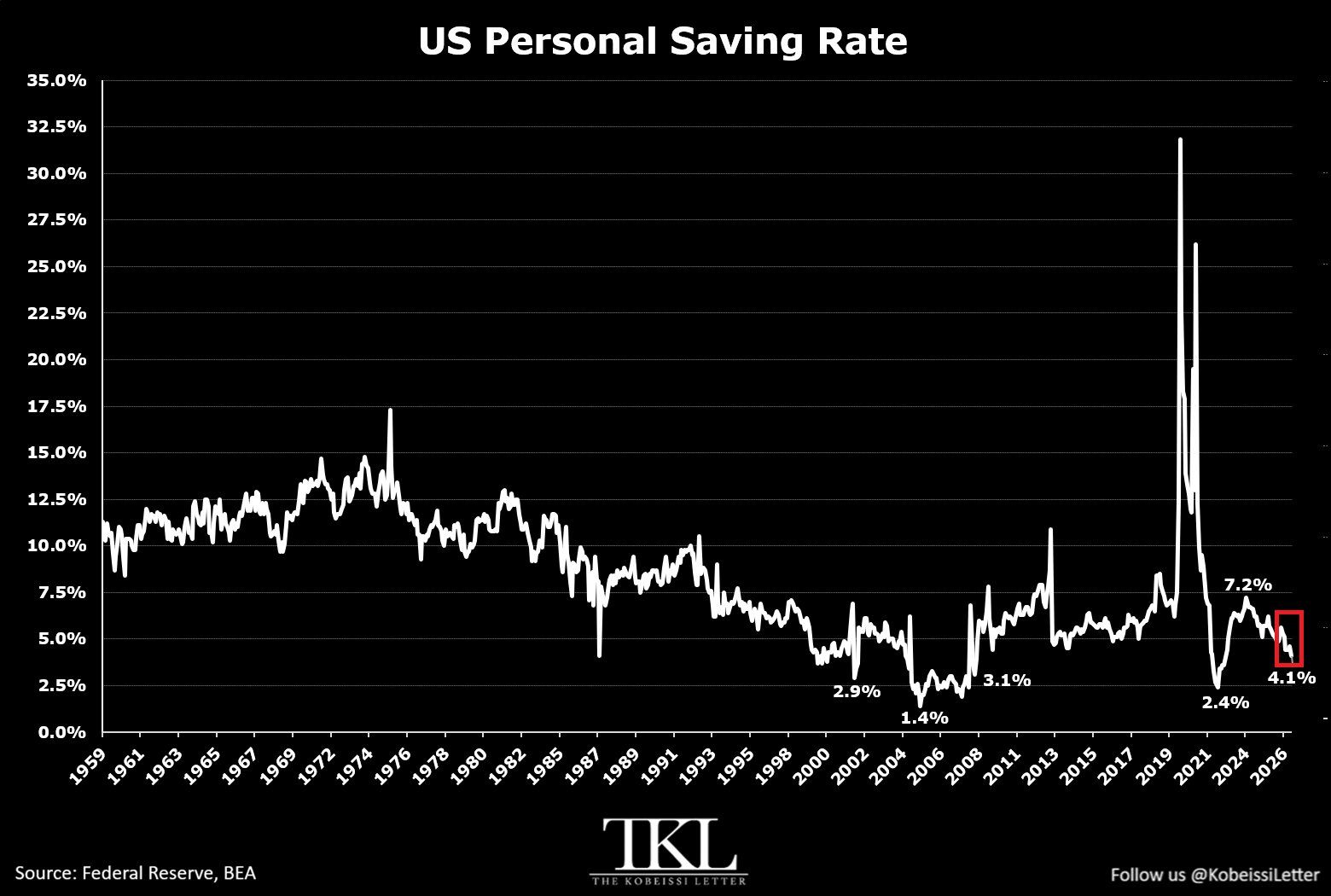 US Household Savings Fall to Their Lowest Level Since 2021. Source: X/@KobeissiLetter
 Spending remains relatively resilient for now, but that strength comes at a cost. Families increasingly rely on savings as their main cushion shrinks month after month.
For most Americans, this level means less room to absorb a job loss, a medical bill, or any other emergency expense. It leaves fewer households prepared for financial shocks heading into next year.
Could Bitcoin Work as a Hedge Against This Pressure?
Bitcoin just posted its first fully green third quarter on record. It gained 42.71% as July, August, and September all closed positive individually. Even so, BTC still trades roughly 4% below its $87,498 starting price for 2026. It also remains about 34% below its record near $126,000.
That mixed picture complicates the hedge narrative. Fidelity's Jurrien Timmer recently highlighted Bitcoin as a key portfolio diversifier beyond traditional stocks and bonds, alongside gold and commodities, as correlations between equities and bonds turn unusually positive.
Beyond the 60 (global equities) and the 20 (bonds) the main diversifiers (against both asset classes) are commodities, gold, Bitcoin, cash, alts (equity L/S, managed futures, absolute return) and leveraged loans. Note how the equity bucket is to the right of center and the bond… pic.twitter.com/XmZj55MJ4f
— Jurrien Timmer (@TimmerFidelity) October 2, 2026
Bitcoin remains volatile and often tracks technology stocks during risk-off periods. When households cut back on savings, demand for speculative assets can weaken too, at least in the short term. Regulatory and access barriers still limit its use as a true inflation hedge.
This savings decline signals broader financial fragility across much of the population. Bitcoin is not an automatic solution for struggling households, though it may fit within a diversified strategy for long-term investors.
Subscribe to our YouTube channel to watch leaders and journalists provide expert insights
https://www.youtube.com/watch?v=TL9qy39hvwcRead the Original story US Savings Rate Hits a 2022 Low: Could Bitcoin Be a Hedge? by Luis Blanco at beincrypto.com