


Prudent pricing, increasing climate-related risks and rapid digital transformation are likely to influence the insurance industry’s outlook in 2026. Although insurers remain exposed to catastrophe losses, driven by climate change, stronger pricing continues to support profitability. Global commercial insurance rates are expected to have moderated, largely due to abundant capacity and heightened competition among insurers.
The Fed has kept interest rates unchanged so far in 2026 and has hinted at the possibility of a cut later this year. Despite this environment, industry giants Berkshire Hathaway Inc. BRK.B and Arch Capital Group ACGL are expected to remain resilient.
At the same time, increasing adoption of digital technologies is likely to drive a rise in merger and acquisition (M&A) activity, particularly in tech-focused deals, as highlighted by Willis Towers Watson’s Quarterly Deal Performance Monitor. Against this backdrop, which of these stocks presents a more compelling opportunity for long-term investors focused on the insurance sector? Let’s take a closer look at their fundamentals.
Factors to Consider for BRK.B
Berkshire Hathaway is a highly diversified conglomerate with more than 90 operating businesses across insurance, energy, railroads, manufacturing, retail and consumer products. Its broad business mix reduces reliance on any single industry, providing earnings stability and enhancing resilience across varying economic and market conditions.
Insurance remains Berkshire's largest business, contributing roughly one-fourth of total revenues. The segment benefits from disciplined underwriting, steady premium growth and favorable pricing trends. A major competitive advantage is its substantial insurance float—premiums collected before claims are paid—which provides a low-cost source of capital to fund investments and acquisitions. This unique funding model has been a key driver of Berkshire's long-term value creation and capital allocation flexibility.
Beyond insurance, Berkshire continues to optimize its investment portfolio to improve income stability and diversify geographic exposure. The company has increased investments in Japanese trading houses, reduced stakes in select payment companies and expanded its airline-related investments. Its planned $6.8 billion acquisition of Taylor Morrison Home Corp. further underscores confidence in the long-term growth potential of the U.S. housing market.
Berkshire's financial strength remains unmatched. Backed by more than $370 billion in cash and U.S. Treasury holdings, conservative leverage and a fortress balance sheet, the company is well positioned to pursue strategic investments, capitalize on acquisition opportunities and navigate periods of economic uncertainty.
Berkshire’s return on equity of 6.6% lags the industry average of 7.4%, but the company has improved its returns over time. BRK.B shares have gained 3.2% year to date, outperforming the industry.
Factors to Consider for ACGL
Arch Capital Group is a leading global specialty insurer with a diversified business model that continues to support strong operating performance. The company remains well-positioned to benefit from favorable property and casualty insurance market conditions, where disciplined underwriting, firm pricing and sustained demand for specialty insurance products continue to support premium growth.
Arch Capital has consistently expanded its business, delivering a seven-year (2018-2025) net premiums written CAGR of 17.4%. Premiums should continue to benefit from favorable pricing, new business opportunities, higher retention, product innovation, geographic expansion, disciplined underwriting and strategic investments.
The Mortgage segment provides valuable diversification by generating a stable stream of earnings, reducing reliance on traditional insurance operations. Alongside organic growth, ACGL continues to strengthen its competitive position through strategic acquisitions and investments that broaden its capabilities and enhance its presence across insurance and reinsurance markets.
Investment income remains another growth driver, supported by a larger fixed-income portfolio and improved returns from non-fixed-income investments. Its emphasis on high-quality fixed-income securities provides predictable cash flows to support claims while contributing meaningfully to earnings growth.
Arch Capital maintains a strong capital position, providing ample financial flexibility for shareholder returns and growth initiatives. The company declared its first-ever special dividend of $5 per share in December 2024, and as of May 1, 2026, had approximately $3 billion remaining under its share repurchase authorization.
Its return on equity of 17.6% is better than the industry average. ACGL shares have gained 2.7% year to date, underperforming the industry.
Estimates for BRK.B and ACGL
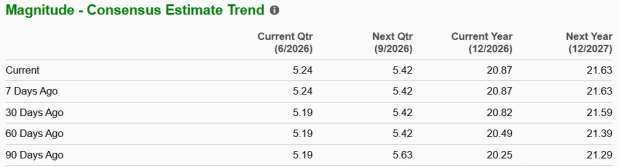
The Zacks Consensus Estimate for BRK.B’s 2026 revenues implies a year-over-year increase of 3.8%, while that for EPS implies a year-over-year decrease of 2.1%. EPS estimates have moved 5 cents north over the past 30 days.
Image Source: Zacks Investment Research
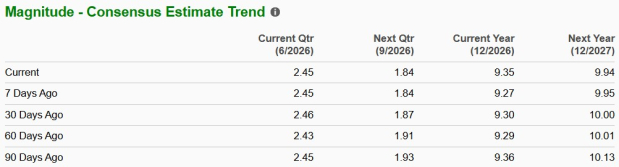
The Zacks Consensus Estimate for ACGL’s 2026 revenues implies a year-over-year decrease of 2.9%, while that for EPS implies a year-over-year decrease of 5%. EPS estimates have moved 5 cents north over the past 30 days.
Image Source: Zacks Investment Research
Are BRK.B and ACGL Shares Expensive?
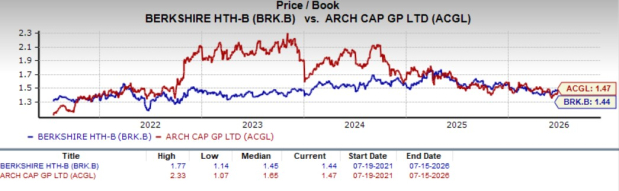
Berkshire is trading at a price-to-book multiple of 1.44, below its median of 1.45 over the last five years. ACGL’s price-to-book multiple sits at 1.47, lower than its median of 1.65 over the last five years.
Image Source: Zacks Investment Research
Conclusion
Holding shares of Berkshire Hathaway adds dynamism to shareholders’ portfolios. It gives the feel of investing in mutual funds while rewarding investors with higher returns. However, investors are still waiting to see how the conglomerate fares under the leadership of the new CEO.
Arch Capital is set to grow, driven by premium growth, strategic buyouts, and a robust capital and liquidity position, shielding it from market volatility and enabling it to retain its financial flexibility.
Price appreciation and growth projections clearly show that BRK.B has an edge over ACGL.
BRK.B carries a Zacks Rank #2 (Buy) while ACGL carries a Zacks Rank #3 (Hold). You can see the complete list of today’s Zacks #1 Rank (Strong Buy) stocks here.
Zacks' Research Chief Names "Stock Most Likely to Double"
Our team of experts has just released the 5 stocks with the greatest probability of gaining +100% or more in the coming months. Of those 5, Director of Research Sheraz Mian highlights the one stock set to climb highest.
This top pick is a little-known satellite-based communications firm. Space is projected to become a trillion dollar industry, and this company's customer base is growing fast. Analysts have forecasted a major revenue breakout in 2025. Of course, all our elite picks aren't winners but this one could far surpass earlier Zacks' Stocks Set to Double like Hims & Hers Health, which shot up +209%.
Free: See Our Top Stock And 4 Runners UpWant the latest recommendations from Zacks Investment Research? Today, you can download 7 Best Stocks for the Next 30 Days. Click to get this free report
Berkshire Hathaway Inc. (BRK.B): Free Stock Analysis Report
Arch Capital Group Ltd. (ACGL): Free Stock Analysis Report
This article originally published on Zacks Investment Research (zacks.com).