


Realty Income O is widening its growth playbook beyond buying properties with its balance sheet. The net-lease giant is building partnerships that bring in outside capital, open new sectors and spread risk. Recent agreements with Apollo, GIC and Cloud Capital point to a broader real estate platform rather than a landlord funded mainly through public debt and equity.
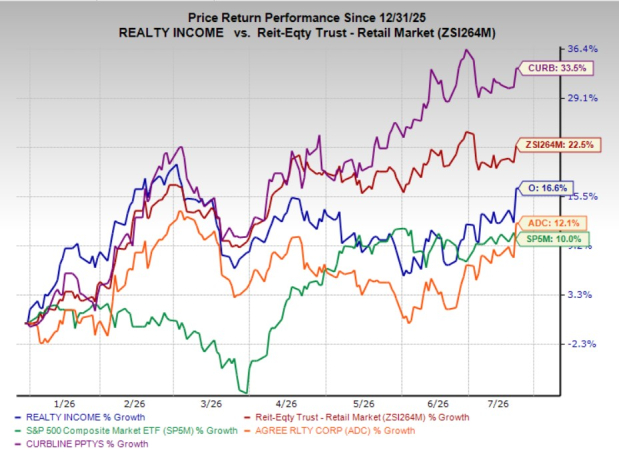
Investors have responded positively, driving Realty Income’s shares up 16.6% year to date. The stock has outperformed the S&P 500 as well as peers Agree Realty Corporation ADC and Curbline Properties Corp. CURB, though it remains behind the 22.5% gain of the Zacks REIT and Equity Trust - Retail. Trading near its 52-week high, the stock appears to reflect much of the favorable outlook. That price action makes valuation and execution more important from here.
The company offers the features income investors know well, such as monthly dividends, a diversified portfolio and high occupancy. The key question is whether partnerships can lift growth enough to justify the price while protecting its dependable income profile.
Year-to-Date Price Performance
Image Source: Zacks Investment Research
Partnerships Create a Wider Growth Lane for Realty Income
Realty Income’s latest venture with Cloud Capital targets hyperscale data centers. Realty Income expects to invest up to $1.4 billion for a 45% stake in a three-asset Northern Virginia portfolio valued at more than $6 billion, with leases running 15 to 20 years.
The March 2026 Apollo deal is central to Realty Income’s private-capital strategy. Apollo agreed to invest $1 billion for a 49% interest in a joint venture holding about 500 U.S. retail properties. Realty Income retains management responsibility and expects the structure to provide long-term equity at a lower, more stable cost. That can support acquisitions without placing the full funding burden on shareholders.
The GIC relationship adds another path. Its framework exceeds $1.5 billion and includes U.S. build-to-suit logistics projects, a $200 million commitment tied to a Mexican industrial portfolio and an investment in Realty Income’s U.S. Core Plus fund.
These arrangements give Realty Income access to logistics, data centers and private funding pools. The efforts also create management fees and allow the company to pursue deals that might be too large or concentrated to own alone. Moreover, the earlier $800 million preferred-equity investment in Blackstone’s CityCenter real estate shows that Realty Income can structure investments outside standard property purchases.
Strong Operations Support Realty Income’s Plan and Dividend Appeal
Alongside its partnership strategy, Realty Income’s base business remains healthy. First-quarter 2026 adjusted funds from operations (AFFO) per share rose 6.6% to $1.13, occupancy was 98.9%, and management lifted full-year AFFO guidance to $4.41-$4.44. Investment guidance also increased to $9.5 billion. Its focus on essential retail properties, such as convenience stores, drugstores and grocery stores, continues to generate reliable rental income.
Realty Income’s scale, credit ratings and global sourcing network give it an advantage over its peers when competing for large transactions. It owned 15,571 properties across 92 industries as of March 31, 2026, giving it broad diversification and helping reduce portfolio risk. Its track record of 115 consecutive quarterly dividend increases, along with its membership in the S&P 500 Dividend Aristocrats Index for having increased its dividend for more than 31 consecutive years, further supports its reputation as a dependable income stock.
Risks Could Slow the Payoff for Realty Income
However, partnership growth adds complexity. Joint ventures reduce direct ownership and can limit control over assets, timing and exit decisions. Data centers bring development, power-supply and tenant-concentration risks that differ from Realty Income’s traditional retail model. The company must also fund sizable commitments while interest rates remain important for REIT valuations.
Moreover, execution matters because the stock has already risen. If projects face delays or acquisition spreads narrow, growth may disappoint. Realty Income’s broader strategy may deliver more opportunity, but it also creates more moving parts.
O’s Estimate Revisions and Valuation
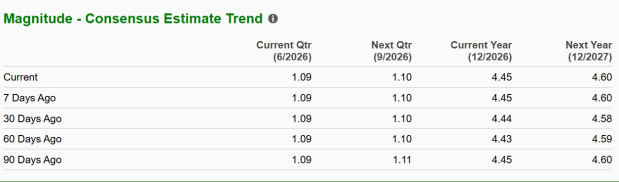
Estimate revisions reflect a positive trend. Over the past 30 days, the Zacks Consensus Estimate for 2026 and 2027 AFFO per share has inched up slightly, reflecting a balanced view of growth and reduced cost pressures.
Image Source: Zacks Investment Research
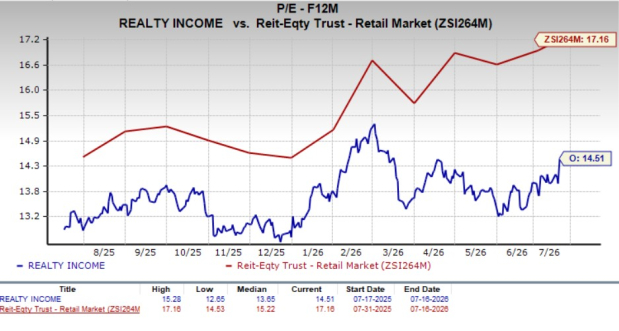
Valuation-wise, Realty Income stock is trading at a forward 12-month price-to-FFO of 14.51X, below the retail REIT industry average of 17.16X and its three-year median. O stock is also currently trading at a reasonable discount compared to its industry peers, Agree Realty and Curbline Properties. This valuation disparity might not be as favorable as it seems. Agree Realty is trading at a forward 12-month price-to-FFO of 17.09X, while CURB is trading at 24.01X.
However, its Value Score of D suggests that it may not be a bargain at current levels.
Image Source: Zacks Investment Research
Realty Income: A Sensible Hold for Income Seekers
Realty Income’s partnerships improve growth options, diversify funding and extend the business into logistics, data centers and private capital. Its record, high occupancy and dividend remain reasons to own shares.
Still, the stock’s advance has reduced the margin of safety, while joint ventures and newer asset types add execution risks. Also, the stock’s valuation and slower growth outlook limit its appeal as a strong buying opportunity at current levels.
As such for current shareholders it will be prudent to collect income while watching partnership returns develop. New investors may find entry points after a pullback. For now, Realty Income is a Hold.
At present, O carries a Zacks Rank #3 (Hold). You can see the complete list of today’s Zacks #1 Rank (Strong Buy) stocks here.
Note: Anything related to earnings presented in this write-up represents funds from operations (FFO) — a widely used metric to gauge the performance of REITs.
Realty Income and Apollo to Establish Strategic Partnership | Realty Income
Realty Income Establishes Strategic Partnership with GIC | Realty Income
7 Best Stocks for the Next 30 Days
Just released: Experts distill 7 elite stocks from the current list of 220 Zacks Rank #1 Strong Buys. They deem these tickers "Most Likely for Early Price Pops."
Since 1988, the full list has beaten the market more than 2X over with an average gain of +23.9% per year. So be sure to give these hand picked 7 your immediate attention.
See them now >>Want the latest recommendations from Zacks Investment Research? Today, you can download 7 Best Stocks for the Next 30 Days. Click to get this free report
Realty Income Corporation (O): Free Stock Analysis Report
Agree Realty Corporation (ADC): Free Stock Analysis Report
Curbline Properties Corp. (CURB): Free Stock Analysis Report
This article originally published on Zacks Investment Research (zacks.com).