

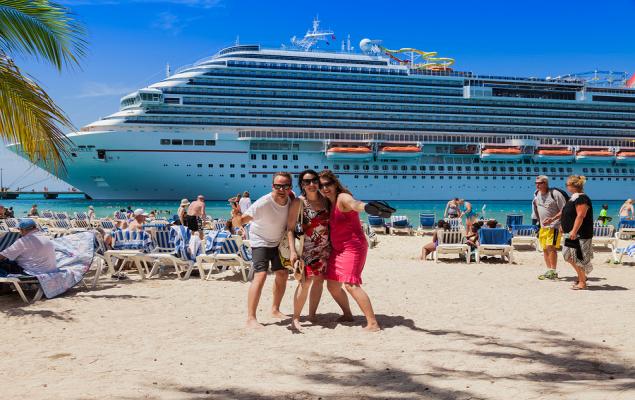
Carnival Corporation CCL is refining its growth strategy by combining measured capacity additions with greater investment in fleet modernization and destination-led differentiation. Second-quarter 2026 results underscored the progress of this strategy, as the company delivered record revenues, yields, EBITDA and customer deposits, while net income exceeded its March guidance by $100 million. Stronger commercial execution and cost discipline supported the outperformance despite geopolitical pressure on European demand.
Disciplined Growth Strategy Is Taking Shape
Rather than accelerating new ship deliveries, Carnival plans to maintain a measured cadence of one to two vessels annually. The company ordered three Princess Cruises ships for delivery in 2035, 2038 and 2039 while expanding modernization programs across AIDA and Holland America Line. These upgrades are designed to enhance guest experiences, create additional onboard revenue opportunities and improve operating efficiency.
Controlled destinations are also becoming a more important growth lever. Carnival completed infrastructure improvements at Celebration Key and RelaxAway, Half Moon Cay, increasing capacity and itinerary flexibility. The broader Paradise Collection is expected to receive more than 9 million guest visits next year. Approximately 85% of Carnival’s Caribbean itineraries are projected to include at least one exclusive destination, with nearly half including two or more.
Carnival’s financial flexibility continues to improve alongside these investments. The company has repurchased more than $450 million of shares and reduced its net debt-to-adjusted EBITDA ratio to 3.1 times. Although the Middle East conflict prompted an approximately one-percentage-point reduction in normalized yield-growth guidance, Carnival views the pressure as temporary. With 93% of 2026 already booked and booking volumes and pricing for 2027 and beyond running ahead of last year, the longer-term demand outlook remains constructive.
How Does Carnival Compare With Cruise Industry Rivals?
Carnival competes with Royal Caribbean Group RCL and Norwegian Cruise Line Holdings NCLH, which are also investing in ships, destinations and commercial capabilities.
Royal Caribbean is pursuing an ecosystem-led growth model centered on Icon-class ships, Royal Beach Clubs, Perfect Day destinations, technology and loyalty. RCL continues to expect double-digit revenue and earnings growth, supported by strong demand, record pricing and disciplined cost control.
Norwegian Cruise, meanwhile, is focused on an operational turnaround after entering 2026 behind its targeted booking curve. NCLH is improving revenue management, marketing effectiveness and organizational efficiency while targeting $125 million of annualized SG&A savings. However, internal execution challenges and softer European demand could make its revenue recovery more gradual.
Carnival’s strategy stands out through its emphasis on measured fleet growth, high-return modernization and exclusive destinations. The model does not abandon traditional capacity expansion, but it broadens the industry playbook by seeking to generate greater earnings from existing assets while preserving capital flexibility.
CCL’s Price Performance, Valuation & Estimates
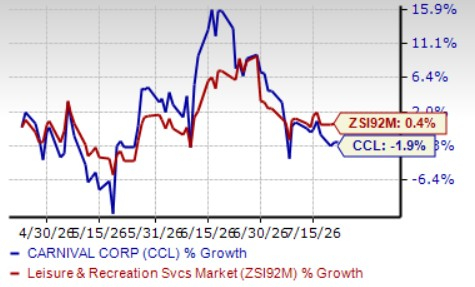
Shares of Carnival have dropped 1.9% in the past three months against the industry’s 0.4% growth.
CCL Stock’s Three-Month Price Performance
Image Source: Zacks Investment Research
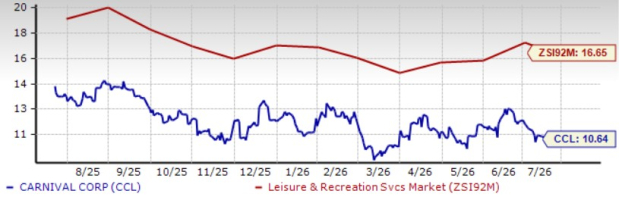
From a valuation standpoint, CCL trades at a forward price-to-earnings ratio of 10.64, significantly below the industry’s average of 16.65.
CCL’s P/E Ratio (Forward 12-Month) vs. Industry
Image Source: Zacks Investment Research
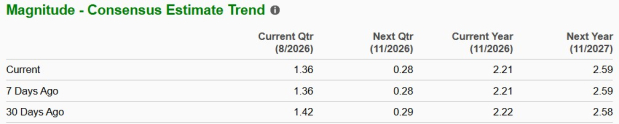
The Zacks Consensus Estimate for CCL’s fiscal 2026 earnings implies a year-over-year decline of 1.8%. The EPS estimates for fiscal 2026 have declined in the past 30 days.
EPS Trend of CCL Stock
Image Source: Zacks Investment Research
CCL stock currently has a Zacks Rank #3 (Hold). You can see the complete list of today’s Zacks #1 Rank (Strong Buy) stocks here.
Beyond Nvidia: AI's Second Wave Is Here
The AI revolution has already minted millionaires. But the stocks everyone knows about aren't likely to keep delivering the biggest profits. AI’s second wave is moving from infrastructure to implementation and these companies are at the forefront of this transition, positioned to become what Amazon and Google were to the internet era.
See Stocks Now >>Want the latest recommendations from Zacks Investment Research? Today, you can download 7 Best Stocks for the Next 30 Days. Click to get this free report
Carnival Corporation (CCL): Free Stock Analysis Report
Royal Caribbean Cruises Ltd. (RCL): Free Stock Analysis Report
Norwegian Cruise Line Holdings Ltd. (NCLH): Free Stock Analysis Report
This article originally published on Zacks Investment Research (zacks.com).