

Valero Energy Corporation VLO is set to report second-quarter 2026 results on July 30, before the market opens.
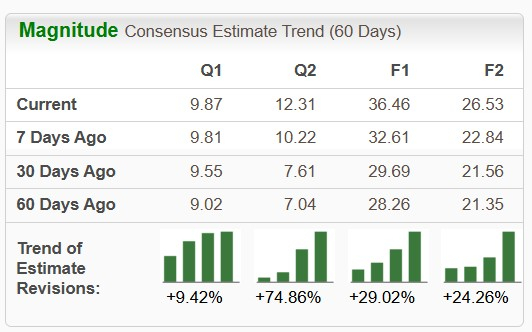
The Zacks Consensus Estimate for second-quarter earnings is pegged at $9.87 per share, implying an increase of 332.9% from the year-ago reported number. VLO has witnessed two upward and no downward earnings estimate revisions over the past seven days. The Zacks Consensus Estimate for second-quarter revenues is currently pinned at $35.95 billion, suggesting a 20.3% rise from the year-ago actuals.
VLO beat the consensus estimate for earnings in each of the trailing four quarters, delivering an average surprise of 27.99%. This is depicted in the graph below:
Valero’s Q2 Earnings Whispers
Our proven model does not conclusively predict an earnings beat for VLO this time around. The combination of a positive Earnings ESP and a Zacks Rank #1 (Strong Buy), 2 (Buy) or 3 (Hold) increases the chances of an earnings beat. That is not the case here, as you will see below.
The company has an Earnings ESP of -0.91% and a Zacks Rank #2. You can see the complete list of today’s Zacks #1 Rank stocks here.
You can uncover the best stocks to buy or sell before they’re reported with our Earnings ESP Filter.
Factors to Note for VLO
Valero Energy is expected to have sustained steady performance in the second quarter, driven by the resilient demand for refined products amid constrained global refining capacity, further amplified by the geopolitical situation in the Middle East.
Moreover, the current business environment looks supportive for refining players, including Valero. The 3-2-1 crack spread, widely recognized as an indicator of refining profitability, had risen significantly since the start of the conflict in the Middle East and remained at elevated levels throughout the second quarter. These factors are likely to have supported refining gains and aided VLO’s profitability in the to-be-reported quarter.
However, the company’s performance may have been tempered by elevated crude prices earlier in the quarter. Per the data from the U.S. Energy Information Administration, the West Texas Intermediate spot crude price averaged $100.32 per barrel in April and $102.13 per barrel in May before declining to $84.81 per barrel in June.
Notably, these figures are significantly higher than those recorded in the corresponding period of 2025. Higher crude prices may have raised input costs for its refining operations, thereby affecting its results. Its Renewable Diesel segment adds another source of earnings volatility, as its performance is highly dependent on government and environmental policy support, alongside demand factors.
These factors are likely to have affected demand and pricing dynamics, potentially hampering the company’s quarterly performance.
VLO’s Price Performance & Valuation
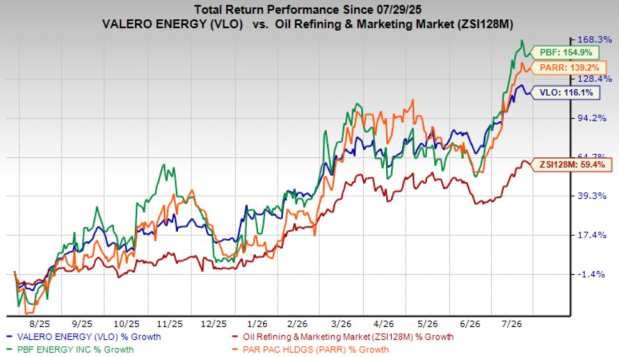
VLO’s stock has soared 116.1% over the past year compared with the 59.4% rise of the composite stocks belonging to the industry. PBF Energy and Par Pacific Holdings, two other leading refining players, have gained 154.9% and 139.2%, respectively.
Image Source: Zacks Investment Research
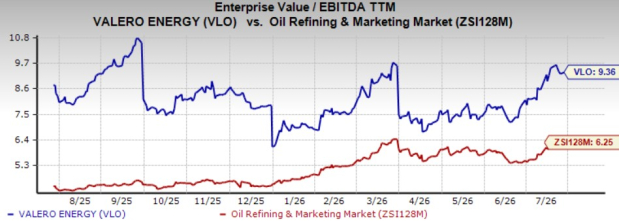
VLO appears relatively overvalued, at a trailing 12-month enterprise value to EBITDA (EV/EBITDA) of 9.36X, above the broader industry average of 6.25X, implying that the stock is currently trading at a premium.
Image Source: Zacks Investment Research
Investment Thesis of Valero Energy
Valero Energy is among the largest independent refiners in the United States, with a combined high-complexity throughput capacity of nearly 3 million barrels per day across its refineries. Its refining footprint is heavily concentrated along the U.S. Gulf Coast, providing feedstock sourcing flexibility and access to high-demand growth markets to sell its refined products. Notably, VLO’s refineries have the operational flexibility to process various kinds of feedstock, including heavy sour, medium/light sour and sweet crude, and shift product yields based on market conditions to capture higher margins.
Valero Energy also boasts a strong financial and liquidity position, with a low debt-to-capitalization ratio of 18%, as of March 31, 2026. Furthermore, its cash and cash equivalents, combined with the liquidity available under its bank facilities, totaled approximately $11 billion at the end of the March quarter. VLO’s healthy financial position also allows it to return excess cash to investors through share buybacks.
However, it should be noted that the refining industry is inherently cyclical and volatile. Margins and crack spreads depend largely on crude oil prices and the overall demand for refined petroleum products, which causes VLO’s earnings to be volatile as well.
Are PBF & PARR Poised to Gain From a Favorable Refining Backdrop?
PBF Energy PBF has a geographically diverse refining network with large-scale processing capacity and a highly complex refining system. It operates six refineries, Delaware City Refinery, Paulsboro Refinery, Toledo Refinery, Chalmette Refinery, Torrance Refinery and Martinez Refinery, which have a combined throughput capacity of 1 million barrels per day and can process a wide range of feedstocks.
Par Pacific Holdings PARR operates an integrated downstream energy business across the United States, with fuel retail operations in Hawaii, Washington and Idaho, refining operations in Hawaii, Wyoming, Washington and Montana, and a supporting logistics network. Its refineries have a combined crude oil throughput capacity of 219,000 barrels per day and produce gasoline, diesel, jet fuel, marine fuels, asphalt and other petroleum products.
PBF currently sports a Zacks Rank #1, while PARR carries a Zacks Rank #2. Both refiners are expected to benefit from strong refining fundamentals and elevated crack spreads, which are likely to support their bottom-line profitability.
Final Verdict
VLO is expected to benefit from strong refining fundamentals, which are currently supported by the disruptions of energy flows through the Strait of Hormuz. Given the business environment and its healthy financial position, investors should consider buying the VLO stock, carrying a Zacks Rank #2, at present.
Beyond Nvidia: AI's Second Wave Is Here
The AI revolution has already minted millionaires. But the stocks everyone knows about aren't likely to keep delivering the biggest profits. AI’s second wave is moving from infrastructure to implementation and these companies are at the forefront of this transition, positioned to become what Amazon and Google were to the internet era.
See Stocks Now >>Want the latest recommendations from Zacks Investment Research? Today, you can download 7 Best Stocks for the Next 30 Days. Click to get this free report
Valero Energy Corporation (VLO): Free Stock Analysis Report
PBF Energy Inc. (PBF): Free Stock Analysis Report
Par Pacific Holdings, Inc. (PARR): Free Stock Analysis Report
This article originally published on Zacks Investment Research (zacks.com).