


The cruise industry has continued to benefit from resilient travel demand, improving onboard spending and strong booking trends, even as consumers navigate a mixed macroeconomic backdrop. Operators have also focused on expanding premium offerings, optimizing capacity and improving operating efficiency, helping support revenue growth and profitability.
Against this backdrop, investors may be weighing two of the industry's biggest names — Carnival Corporation Ltd. CCL and Royal Caribbean Cruises Ltd. RCL. Both companies have delivered solid operational execution, strengthened their balance sheets and capitalized on robust vacation demand. However, differences in fleet strategy, pricing power, profitability and valuation could determine which stock is better positioned to generate long-term shareholder returns. Let's take a closer look at how Carnival and Royal Caribbean compare.
The Case for CCL
Carnival delivered another quarter of strong operational execution, posting record revenues, EBITDA, customer deposits and yields despite a volatile macroeconomic backdrop. In second-quarter fiscal 2026, strong close-in bookings and healthy onboard spending helped the company achieve its 12th consecutive quarter of record yields, while customer deposits reached an all-time high, underscoring sustained demand across its portfolio of cruise brands.
The company is also strengthening its competitive position through disciplined investments in the fleet and destination portfolio. Carnival continues to modernize existing ships while maintaining measured capacity growth, focusing capital on projects expected to generate attractive returns. At the same time, investments in destinations such as Celebration Key, RelaxAway Half Moon Cay and Isla Tropicale are enhancing itinerary appeal and creating differentiated vacation experiences that should support future pricing power and guest demand.
Carnival's financial position has continued to improve as well. Aggressive cost-control initiatives, better fuel efficiency and operational improvements helped offset external pressures during the quarter. The company has also accelerated shareholder returns through share repurchases while steadily reducing leverage, providing greater financial flexibility to invest in growth initiatives without compromising balance-sheet strength.
However, Carnival continues to face pressure from geopolitical uncertainty. The prolonged Middle East conflict reduced demand for European itineraries, particularly in the Mediterranean, while elevated airfares and constrained international flight capacity further affected bookings. Although management believes these challenges are temporary and that booking trends have begun to improve, the disruption prompted the company to moderate its yield outlook for the remainder of the year.
The Case for RCL
Royal Caribbean continues to benefit from strong consumer demand for premium cruise vacations, allowing it to command higher pricing and healthy onboard spending. In the second quarter of 2026, revenues and earnings exceeded management's expectations as close-in bookings, particularly for Caribbean itineraries, remained robust. The company also highlighted record guest satisfaction scores and rising repeat bookings, indicating that its differentiated vacation experiences continue to resonate with travelers.
Another key strength is Royal Caribbean's expanding connected vacation ecosystem. Management noted that its loyalty initiatives, including Royal ONE, Points Choice and Status Match, are driving higher guest engagement and encouraging repeat travel across the brands. Increased use of digital platforms is also enhancing personalization, with more guests booking onboard experiences before sailing, supporting higher onboard revenues while improving the overall customer experience.
Royal Caribbean also remains well positioned for long-term growth through disciplined capital allocation and strategic investments. The company continues to introduce new ships, expand destination offerings such as its Royal Beach Clubs and leverage AI-driven pricing tools to optimize yields. Supported by strong cash generation, an investment-grade balance sheet and shareholder returns through dividends and buybacks, management expects another year of double-digit earnings growth while maintaining healthy booking momentum into 2027.
On the downside, geopolitical tensions in the Middle East continue to pressure European itineraries. Management acknowledged that the prolonged conflict has weakened demand in the Mediterranean, prompting travelers to favor closer destinations and limiting yield growth for Europe sailings. Although Caribbean demand remains healthy, these regional headwinds prevented the company from raising its full-year yield outlook.
How Does the Zacks Consensus Estimate Compare for CCL and RCL?
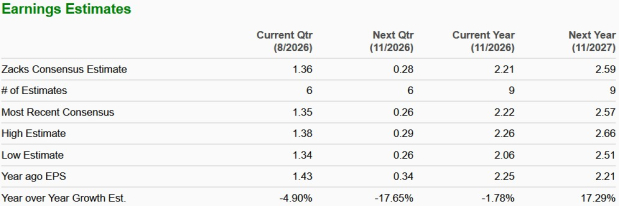
The Zacks Consensus Estimate for Carnival's fiscal 2026 revenues indicates 3.9% year-over-year growth, while earnings per share (EPS) are projected to decline 1.8% from the prior year. Despite the expected earnings dip, analysts have become more optimistic over the past month, with the consensus EPS estimate moving higher.
Image Source: Zacks Investment Research
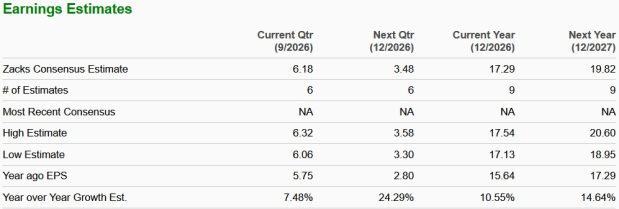
For Royal Caribbean, the Zacks Consensus Estimate calls for 8.9% revenue growth and a 10.6% EPS rise in 2026 compared with the prior year. However, unlike Carnival, analysts have trimmed their earnings expectations over the past 30 days, reflecting downward revisions to the consensus EPS estimate.
Image Source: Zacks Investment Research
Price Performance & Valuation
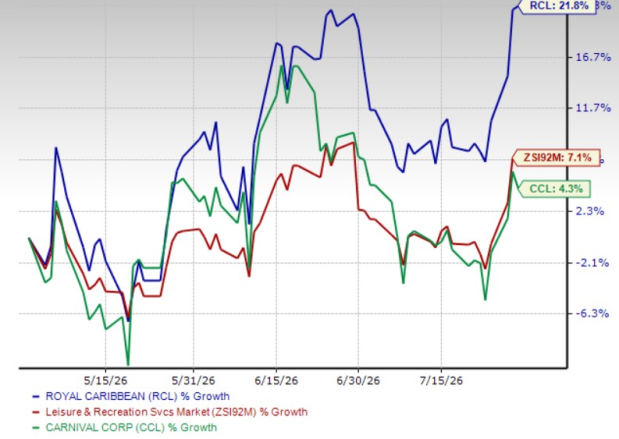
Royal Caribbean stock has risen 21.8% in the past three months, significantly outpacing its industry’s growth of 7.1%. Meanwhile, Carnival’s shares have gained 4.3% in the same time.
Price Performance
Image Source: Zacks Investment Research
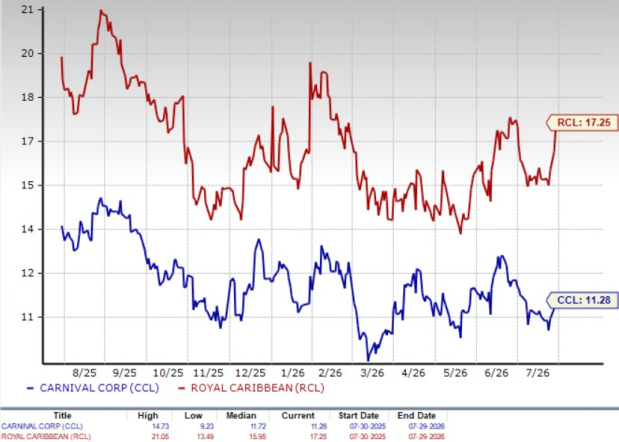
RCL is trading at a forward 12-month price-to-earnings ratio of 17.25X, above its median of 15.92X over the last year. CCL’s forward earnings multiple sits at 11.28X, below its median of 11.72X over the same time frame.
P/E (F12M)
Image Source: Zacks Investment Research
Wrapping Up
While both Carnival and Royal Caribbean have compelling long-term prospects, the latter appears slightly better positioned at present. The company continues to benefit from stronger pricing power, premium vacation offerings, healthy onboard spending and an expanding loyalty ecosystem that supports repeat bookings and long-term customer engagement. Royal Caribbean’s disciplined capital allocation, continued investments in new ships and exclusive destinations, and stronger earnings growth outlook further enhance its appeal.
Carnival, meanwhile, is making meaningful progress through cost-control initiatives, balance-sheet improvement and strategic investments, making it an attractive value opportunity. However, Royal Caribbean's stronger growth profile and operational momentum give it a slight edge. That said, both stocks currently carry a Zacks Rank #3 (Hold). You can see the complete list of today’s Zacks #1 Rank (Strong Buy) stocks here.
Beyond Nvidia: AI's Second Wave Is Here
The AI revolution has already minted millionaires. But the stocks everyone knows about aren't likely to keep delivering the biggest profits. AI’s second wave is moving from infrastructure to implementation and these companies are at the forefront of this transition, positioned to become what Amazon and Google were to the internet era.
See Stocks Now >>Want the latest recommendations from Zacks Investment Research? Today, you can download 7 Best Stocks for the Next 30 Days. Click to get this free report
Carnival Corporation (CCL): Free Stock Analysis Report
Royal Caribbean Cruises Ltd. (RCL): Free Stock Analysis Report
This article originally published on Zacks Investment Research (zacks.com).