

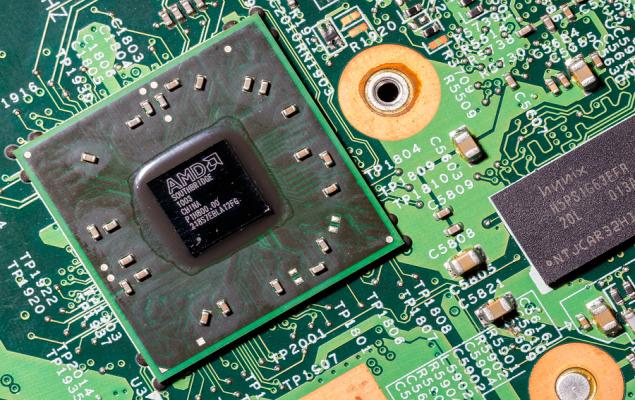
Advanced Micro Devices AMD is expanding its adaptive computing portfolio by bringing native Universal Chiplet Interconnect Express (UCIe) 1.1 connectivity to select Versal adaptive system-on-chips (SoCs). The Versal RF Series will be the first AMD adaptive SoCs to support UCIe, enabling high-bandwidth, low-power communication between AMD devices and specialized co-packaged chiplets. The technology allows customers to combine different silicon components within a single package instead of developing large monolithic SoCs for individual applications.
The Versal RF Series will support as many as four UCIe-SP interfaces and two UCIe-AP interfaces, delivering a multi-terabit-per-second aggregate in-package bandwidth. The devices already combine RF data converters, DSP intellectual property, AI Engines and programmable logic while delivering up to 80 TOPS of heterogeneous DSP compute. UCIe connectivity will allow the platform to connect directly with AI accelerators, CPUs, GPUs, communications processors, security engines and application-specific ASICs. AMD expects production chiplets supporting select Versal RF Series devices to become available in the fourth quarter of 2027.
The move should strengthen AMD’s prospects by broadening Versal’s addressable opportunities across AI, networking, communications, aerospace and defense and other embedded workloads. It is also expected to strengthen AMD’s competitive position against Intel INTC and Microchip MCHP. Moving specialized functions from board-level connections to standardized in-package links can reduce latency, power consumption, footprint and design complexity while allowing customers to reuse proven silicon IP and shorten product-development cycles. This aligns well with AMD’s broader strategy of extending compute leadership across CPUs, GPUs, FPGAs, networking, SoCs, chiplets and advanced packaging.
The latest development bodes well for AMD’s Embedded business, which is regaining momentum. Embedded revenues increased 19% year over year to $977 million in the second quarter of 2026, with demand strengthening across networking, aerospace and defense, test and measurement and communications customers. AMD is also tracking toward another record year of more than $18 billion in new embedded design wins. The latest UCIe initiative therefore enhances its ability to offer customizable chiplet-based platforms as heterogeneous computing becomes increasingly important. Combined with the company’s expanding adaptive and embedded AI portfolio, the technology should support additional design wins and help AMD capture a greater share of next-generation AI and high-performance computing workloads.
Tough Competition Hurts AMD’s Prospects
AMD’s prospects suffer from stiff competition. Intel is challenging AMD in embedded and edge computing by expanding its focus beyond traditional PCs into physical AI and edge applications. Intel recently renamed its PC operation the Client Computing and Physical AI Group to reflect this opportunity and stated that edge and physical AI could eventually represent a market at least as large as its client TAM. The company already has 130 Core Series 3 design wins for edge AI applications, including robotics brain and control deployments. Intel’s broader capabilities in x86 computing, custom silicon, advanced packaging and foundry services add to the competitive pressure.
Microchip poses another significant challenge because of the breadth of its embedded portfolio across microcontrollers, FPGAs, analog, mixed-signal, security, timing, memory and power-management products. Microchip is also strengthening its position in AI-driven embedded applications. The company said AI adoption is expanding in industrial markets, while its planned Hailo acquisition could advance its edge-AI roadmap by roughly five years. Microchip also maintains a strong position in radiation-hardened FPGAs and microcontrollers for aerospace and defense. Its broad product coverage, large installed customer base and growing edge-AI capabilities increase competitive pressure on AMD for long-duration industrial, communications and aerospace design wins.
AMD’s Share Price Performance, Valuation & Estimates
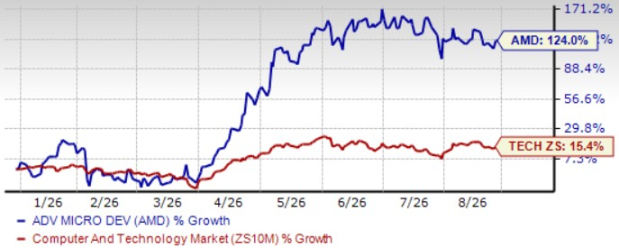
AMD shares have jumped 124% year to date, outperforming the broader Zacks Computer and Technology sector’s return of 15.4%.
AMD Stock’s Price Performance
Image Source: Zacks Investment Research
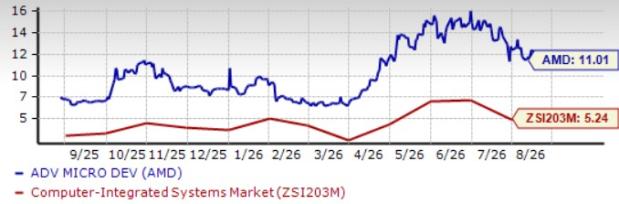
AMD stock is overvalued, with a forward 12-month price/sales of 11.01X compared with the broader sector’s 5.24X. AMD has a Value Score of F.
AMD Valuation
Image Source: Zacks Investment Research
The Zacks Consensus Estimate for 2026 earnings is pegged at $7.49 per share, up 2.6% over the past 30 days, suggesting 79.62% year-over-year growth.
Advanced Micro Devices, Inc. Price and Consensus
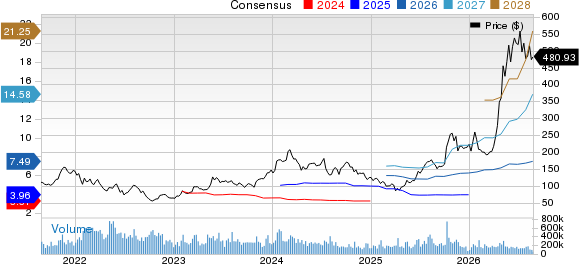
Advanced Micro Devices, Inc. price-consensus-chart | Advanced Micro Devices, Inc. Quote
AMD currently carries a Zacks Rank #3 (Hold). You can see the complete list of today’s Zacks #1 Rank (Strong Buy) stocks here.
7 Best Stocks for the Next 30 Days
Just released: Experts distill 7 elite stocks from the current list of 220 Zacks Rank #1 Strong Buys. They deem these tickers "Most Likely for Early Price Pops."
Since 1988, the full list has beaten the market more than 2X over with an average gain of +23.9% per year. So be sure to give these hand picked 7 your immediate attention.
See them now >>Want the latest recommendations from Zacks Investment Research? Today, you can download 7 Best Stocks for the Next 30 Days. Click to get this free report
Advanced Micro Devices, Inc. (AMD): Free Stock Analysis Report
Intel Corporation (INTC): Free Stock Analysis Report
Microchip Technology Incorporated (MCHP): Free Stock Analysis Report
This article originally published on Zacks Investment Research (zacks.com).