

The online gaming industry is navigating an increasingly competitive environment as operators balance customer acquisition, promotional spending, product innovation and profitability. Within this environment, DraftKings Inc. DKNG and Flutter Entertainment plc FLUT hold leading competitive positions but differ materially in geographic exposure, operating mix and capital-allocation priorities.
DraftKings is leveraging improving customer economics, its nationwide Super App and the expansion of Predictions, while Flutter is relying on FanDuel’s U.S. scale, international diversification and cost-transformation initiatives. With both companies pursuing growth amid regulatory uncertainty and shifting market dynamics, a closer look at their recent performance, strategies and outlook can help determine which stock has stronger prospects ahead.
The Case for DKNG
DraftKings continues to demonstrate solid underlying momentum across its sportsbook operations. Second-quarter sportsbook handle increased 11% year over year, while sports consumer volume rose 15%. Monthly unique payers increased 9%, or more than 6% excluding World Cup-only customers. Sportsbook handle share also improved year over year for the third consecutive quarter, pointing to sustained competitive gains.
Customer-acquisition trends were similarly encouraging. Customer acquisition increased nearly 75% year over year, with DraftKings adding roughly 30% more customers than planned. Although acquisition spending exceeded expectations by approximately 10%, customer acquisition costs were about 25% below projections and reached their most efficient level since the first quarter of 2025. Reported revenues declined 4.6% year over year to $1.44 billion. However, revenues increased 10% on a normalized basis after adjusting for sports outcomes and customer-acquisition effects.
Improving monetization further supports the company’s growth profile. Trailing 12-month net revenue per unique customer increased 14% during the first half of 2026, indicating sustained growth in revenues generated from each customer. A continued increase in parlay handle mix also supports the underlying economics of the sportsbook business.
Predictions represents an additional growth opportunity. More than 600,000 customers engaged with the offering year to date, while annualized total volume traded increased nearly fivefold from $2.3 billion in April to $11 billion in July. The launch of DKeX, approval as a Futures Commission Merchant and the development of in-house market-making capabilities should enable DraftKings to capture a larger share of the platform’s economics as activity migrates to its proprietary infrastructure.
Nonetheless, Predictions remains at an early stage, and its long-term return profile has yet to be established. Customer-friendly sports outcomes created an approximately $80 million second-quarter revenue headwind, while the additional spending required to acquire more customers than planned reduced near-term adjusted EBITDA. DraftKings also expects to invest $200-$300 million in Predictions during 2026, with regulatory uncertainty adding another layer of risk.
The Case for FLUT
Flutter’s international footprint provides meaningful geographic diversification, although performance across markets remains uneven. International revenues increased 10% in the second quarter, including contributions from the Snai and Betnacional acquisitions. Italy recovered strongly following temporary pressure associated with the Snai migration, while Southern Europe and Africa iGaming revenues rose 34%. These gains were partly offset by lower organic revenues in Brazil, continued weakness in APAC racing and profitability pressure from higher U.K. iGaming taxes.
In the United States, FanDuel is taking steps to strengthen engagement following shortcomings in the execution of its generosity strategy during the previous NFL season. Rewards Club reached 70% of customers, while BetProtect+ and SuperSub enhanced the sportsbook proposition. However, U.S. revenues declined 6% year over year, including a six-percentage-point headwind from customer-friendly sports outcomes. Flutter also estimated that the U.S. sportsbook market grew approximately 5% during the first half and incorporated a broadly similar rate into its second-half assumptions.
FanDuel Predicts offers another potential growth avenue, although first-half progress was slower than planned and the regulatory framework remains unsettled. The One App rollout and Crypto.com integration are expected to strengthen the offering, while market-making activities are projected to contribute approximately $50 million to both revenues and adjusted EBITDA in 2026. However, the absence of separately disclosed customer and volume metrics makes the platform’s early traction difficult to evaluate.
At the consolidated level, Flutter’s revenues increased 3%, and second-quarter performance exceeded internal expectations. Profitability and cash generation, however, remained under pressure. Adjusted EBITDA declined 45%, free cash flow fell 56%, and the company recorded a net loss of $296 million compared with net income of $37 million a year earlier. Leverage ended the quarter at 4.3X, above the medium-term target range of 2-2.5X.
Flutter expects approximately $500 million of transaction, restructuring and integration costs in 2026, including initial efficiency program implementation costs and $95 million of historical tax provisions.
How Do DKNG and FLUT Stack Up on Outlook?
DraftKings enters the second half with healthy sportsbook demand, improving customer economics and unchanged full-year guidance. Its core business remains on track to generate approximately $1 billion in adjusted EBITDA in 2026. Including the planned Predictions investment, DraftKings maintained its revenue outlook of $6.5-$6.9 billion and adjusted EBITDA guidance of $700-$900 million.
Flutter plans to increase customer generosity in the United States to strengthen engagement and position FanDuel for potential market-share gains in 2027. Although the investment could benefit the business over time, it will constrain near-term earnings. U.S. adjusted EBITDA is now expected to be approximately breakeven in the third quarter and roughly $500 million in the fourth quarter, down from the previous fourth-quarter expectation of about $700 million.
The midpoint of Flutter’s 2026 revenue outlook was reduced by $395 million to $17.91 billion, while its adjusted EBITDA midpoint was lowered by $210 million to $2.655 billion. The reductions leave Flutter with a less favorable near-term earnings trajectory despite its broader international platform.
The guidance divergence is notable. DraftKings is investing in prediction markets without reducing its consolidated outlook. Flutter, meanwhile, is increasing customer generosity to strengthen U.S. momentum after lowering its full-year expectations. DraftKings, therefore, currently offers greater near-term earnings visibility.
How Does the Zacks Consensus Estimate Compare for DKNG & FLUT?
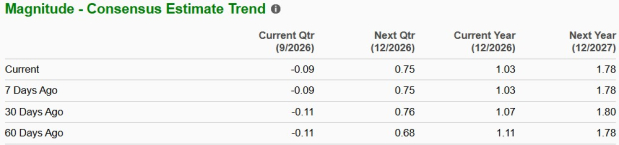
The Zacks Consensus Estimates for DraftKings’ 2026 sales and earnings per share (EPS) suggest year-over-year increases of 11.4% and 56.1%, respectively. In the past 60 days, the consensus EPS estimate for 2026 has declined 7.2%.
DKNG Earnings Estimate Trend
Image Source: Zacks Investment Research
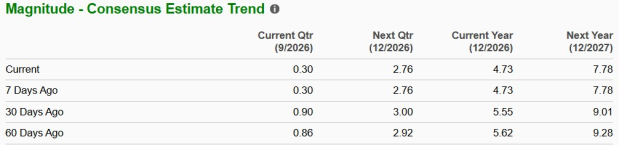
The Zacks Consensus Estimate for Flutter’s 2026 sales suggests year-over-year growth of 9.4%, while the EPS estimate indicates a decline of 40.4%. In the past 60 days, the consensus EPS estimate for 2026 has declined 15.8%.
FLUT Earnings Estimate Trend
Image Source: Zacks Investment Research
Price Performance & Valuation of DKNG & FLUT
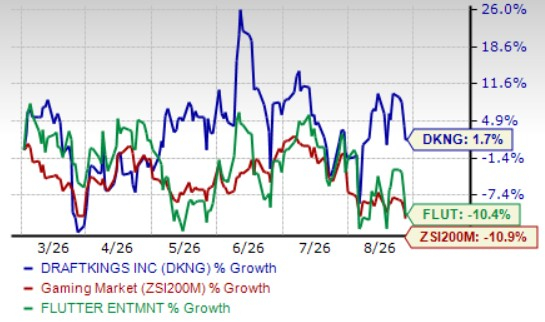
DraftKings’ stock has gained 1.7% in the past six months, outperforming the industry’s fall of 10.9%. Meanwhile, Flutter shares have declined 10.4% over the same period.
DKNG & FLUT Stock Six-Month Price Performance
Image Source: Zacks Investment Research
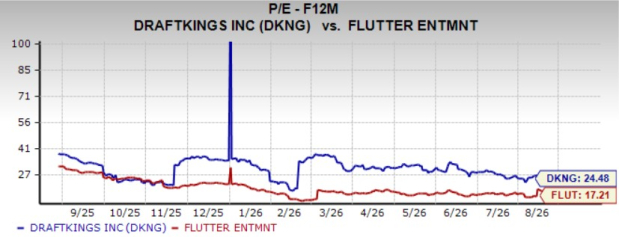
DraftKings trades at a forward 12-month P/E multiple of 24.48X, above the industry average of 21.96X. FLUT trades at a lower forward 12-month P/E multiple of 17.21X.
Image Source: Zacks Investment Research
End Notes
Overall, DraftKings and Flutter are pursuing growth through sportsbook innovation, customer engagement and prediction-market expansion. DraftKings benefits from healthy betting demand, improving customer economics and rapid Predictions adoption, while Flutter offers FanDuel’s scale, international diversification and a lower valuation.
However, DKNG’s stronger consensus earnings-growth outlook, unchanged guidance and superior recent share-price performance currently give it an edge. DKNG currently carries a Zacks Rank #3 (Hold), while FLUT has a Zacks Rank #5 (Strong Sell), reinforcing DraftKings’ relative advantage in this comparison.
You can see the complete list of today’s Zacks #1 Rank (Strong Buy) stocks here.
Beyond Nvidia: AI's Second Wave Is Here
The AI revolution has already minted millionaires. But the stocks everyone knows about aren't likely to keep delivering the biggest profits. AI’s second wave is moving from infrastructure to implementation and these companies are at the forefront of this transition, positioned to become what Amazon and Google were to the internet era.
See Stocks Now >>Want the latest recommendations from Zacks Investment Research? Today, you can download 7 Best Stocks for the Next 30 Days. Click to get this free report
DraftKings Inc. (DKNG): Free Stock Analysis Report
Flutter Entertainment PLC (FLUT): Free Stock Analysis Report
This article originally published on Zacks Investment Research (zacks.com).