


The robotaxi market offers significant growth opportunities. According to Market and Markets, the market, valued at $530 million in 2025, is projected to reach $216.8 billion by 2035, registering a compound annual growth rate of 82% during the 2025-2035 period. This promising growth potential has attracted companies such as Pony AI PONY, a Guangzhou, China-based autonomous-driving technology company, and ride-hailing giant Uber Technologies UBER. Against this backdrop, let us examine the autonomous vehicle ("AV") strategies of these two companies.
Uber's Partnership-Driven AV Expansion
Uber is seeking to establish a strong position in the robotaxi market through strategic collaborations. This partnership-led approach allows the company to avoid the substantial research and development expenses involved in building autonomous-driving technology in-house. Uber divested its self-driving division in 2020. The company remains committed to strengthening its position as a leading ride-hailing super app.
Consistent with this strategy, Uber has recently secured several partnerships to expand its autonomous mobility footprint. Last month, Uber and British AI company Wayve launched supervised autonomous rides in London, marking the first availability of such services in the United Kingdom. Customers booking UberX, Uber Electric or Uber Comfort rides in London may now be matched with a Wayve autonomous vehicle without paying an additional fee. Ride fares are displayed upfront through the Uber app.
Earlier this year, Uber also formed a strategic alliance with Amazon AMZN subsidiary Zoox to introduce the purpose-built robotaxis on its platform. Unlike many autonomous vehicles being developed by modifying conventional passenger cars, Zoox's robotaxis are designed specifically for ride-hailing operations, with an emphasis on passenger comfort and social interaction. Uber and Zoox expect to make these autonomous rides available in Los Angeles next year.
Uber's established leadership in the ride-hailing market provides an additional competitive advantage in autonomous mobility. Its extensive customer and driver network positions the company to rapidly scale robotaxi services as autonomous-driving technology advances. Moreover, Uber's platform is designed to accommodate autonomous vehicles from multiple partners, offering riders greater flexibility and a wider range of transportation choices.
Taking a Look at PONY’s Role in the Robotaxi Field
Supporting its AV expansion strategy, Pony AI and Verne recently commenced fully driverless robotaxi test rides with passengers on public roads in Zagreb, marking the service's European debut. This development represents an important milestone toward the launch of fully driverless commercial operations.
Since unveiling the "dual-engine" growth strategy earlier this year, the Chinese autonomous-driving company has steadily expanded its robotaxi footprint across domestic and international markets. These initiatives support management's objective of deploying 3,500 robotaxis across more than 20 cities by year-end.
In China, Pony AI has strengthened its presence in key markets, including expanded coverage across Guangzhou's urban center. Its operating network now extends throughout the Haizhu District and serves prominent high-traffic locations, such as Canton Tower and the Pazhou business district.
How Do UBER and PONY Compare on Key Metrics?
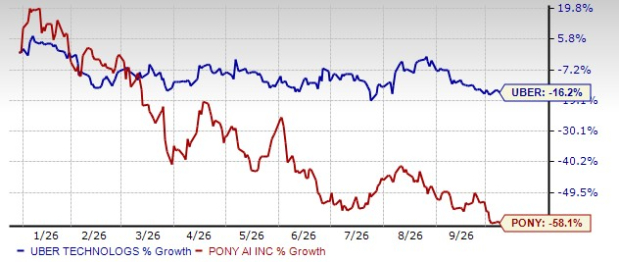
Shares of both PONY and UBER have declined in double digits (% wise) over the past year, even though the latter’s drop is less steep.
1-Year Price Comparison
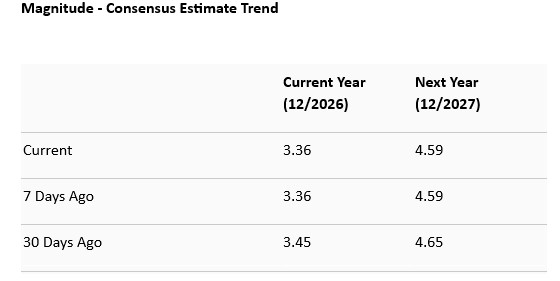
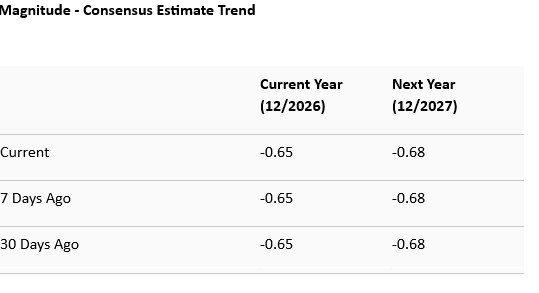
See how the Zacks Consensus Estimate of UBER and PONY’s earnings for 2026 and 2027 has been revised over the past 30 days.
Earnings Estimate Revisions for UBER
Earnings Estimate Revisions for PONY
Conclusion
Although Uber continues to advance its autonomous vehicle initiatives, achieving large-scale commercialization is likely to take considerable time. Regulatory approvals and compliance obligations could delay the broader rollout of its AV services. Moreover, the increasing adoption of self-driving vehicles raises concerns about the long-term need for intermediary ride-hailing platforms like Uber.
In contrast, Pony AI has established itself as a prominent player in the autonomous-driving industry. The company also faces relatively limited exposure to tariff-related uncertainties, given its predominantly domestic supply chain. Additionally, China's rapidly expanding robotaxi market provides a favorable backdrop for Pony AI's growth. Supportive government policies, a substantial addressable market and an efficient domestic supply chain are reinforcing China's emergence as a global center for autonomous-driving innovation and robotaxi commercialization.
Considering these factors, PONY appears to be a more attractive investment option than UBER at present.
While PONY carries a Zacks Rank #2 (Buy), UBER currently has a Zacks Rank #3 (Hold). You can see the complete list of today’s Zacks #1 Rank (Strong Buy) stocks here.
Beyond Nvidia: AI's Second Wave Is Here
The AI revolution has already minted millionaires. But the stocks everyone knows about aren't likely to keep delivering the biggest profits. AI’s second wave is moving from infrastructure to implementation and these companies are at the forefront of this transition, positioned to become what Amazon and Google were to the internet era.
See Stocks Now >>Want the latest recommendations from Zacks Investment Research? Today, you can download 7 Best Stocks for the Next 30 Days. Click to get this free report
Uber Technologies, Inc. (UBER): Free Stock Analysis Report
Pony AI Inc. - Sponsored ADR (PONY): Free Stock Analysis Report
Amazon.com, Inc. (AMZN): Free Stock Analysis Report
This article originally published on Zacks Investment Research (zacks.com).