

Alibaba (BABA) released its fiscal fourth-quarter 2026 earnings before the markets opened on May 13. The company missed estimates for the period, as it did in the previous three quarters of the fiscal year. Now, BABA stock is trading lower as markets weigh strong growth in the cloud and artificial intelligence (AI) business versus sluggishness in its core e-commerce business and increased spending toward AI and quick commerce.
Let's take a look at Alibaba’s Q4 earnings and examine whether BABA stock is a buy today.
More Top Stocks Daily: Go behind Wall Street’s hottest headlines with Barchart’s Active Investor newsletter.
 www.barchart.com
 Key Takeaways From Alibaba's Q4 Earnings
Alibaba’s Q4 revenue rose 11% year-over-year (YOY) to $35.28 billion on a like-for-like basis after adjusting for disposed assets. China e-commerce customer management, which is the company’s biggest revenue driver, posted a 1% YOY increase in revenue. However, the company said that if not for “the contra revenue impact from the new business development program,” the growth would have been 8%.
As has been the case in recent quarters, the cloud segment was a bright spot. The segment’s revenue and adjusted EBITA rose by 38% and 57%, respectively. Within the cloud segment, AI-related revenues rose by the triple digits for the 11th consecutive quarter.
However, Alibaba’s profits continue to nosedive. Adjusted EBITA plunged 84% YOY to $740 million, while the firm barely reached break-even on the adjusted net profit level. The company posted an operating loss of $123 million and burned $2.5 billion in cash during the March quarter, which it blamed on “investment in quick commerce, user acquisition of Qwen app and increase in our cloud infrastructure expenditure.”
Meanwhile, like many U.S. tech companies, Alibaba is unapologetic about its growing capex. “We are confident in our business outlook and will continue to invest in AI [and] Cloud to strengthen our competitive advantages,” said Chief Financial Officer Toby Xu.
U.S. Tech Companies Are Also Spending Big on AI
I am usually wary of stocks that fail to impress with hard numbers in their earnings releases, even as they create a lot of excitement with announcements. Looking at U.S. tech stocks, companies that haven’t been able to justify their burgeoning AI capex have been punished by markets. While there is seldom a perfect correlation between capex and growth — and during the initial period, capex growth invariably exceeds topline growth — markets have been looking for visible signs of capex translating into growth of late.
In Alibaba’s case, the earnings slump has largely been driven by losses in the quick commerce business and higher AI investments. Both quick commerce and AI are fast-growing businesses, though, and could be long-term growth drivers for Alibaba.
Alibaba is among the most notable AI plays in China, offering full-stack operations as well as models, cloud services, and chips. The adoption of its AI chips has been rising in China, and in its earnings release, Alibaba said that more than 100,000 Zhenwu parallel processing units (PPUs) have been deployed on its public cloud platform. The company also added that more than 30 automakers and autonomous driving companies are using its AI chips.
While Alibaba has been on the wrong side of the Chinese government in the past, this time around, its strategic goals align with the powers that be in the world’s second-largest economy. High-end AI chips are a high-focus area for the Chinese government as it pushes for domestic chip production and reduces reliance on imports from U.S. giants like Nvidia (NVDA). While Nvidia CEO Jensen Huang is among the U.S. business leaders that recently visited China with President Donald Trump, it would be folly to expect things to go back to the previous normal anytime soon. The Chinese government will continue to strive to have a domestic tech stack in AI.
Should You Buy Alibaba Stock?
I personally continue to remain invested in Alibaba despite the company’s profits nosediving amid the AI and quick commerce push. While investments in these initiatives are taking a toll on profitability, the company's earnings should increase meaningfully in the coming years as the unit economics in the instant commerce business improve, and its AI investments start paying off.
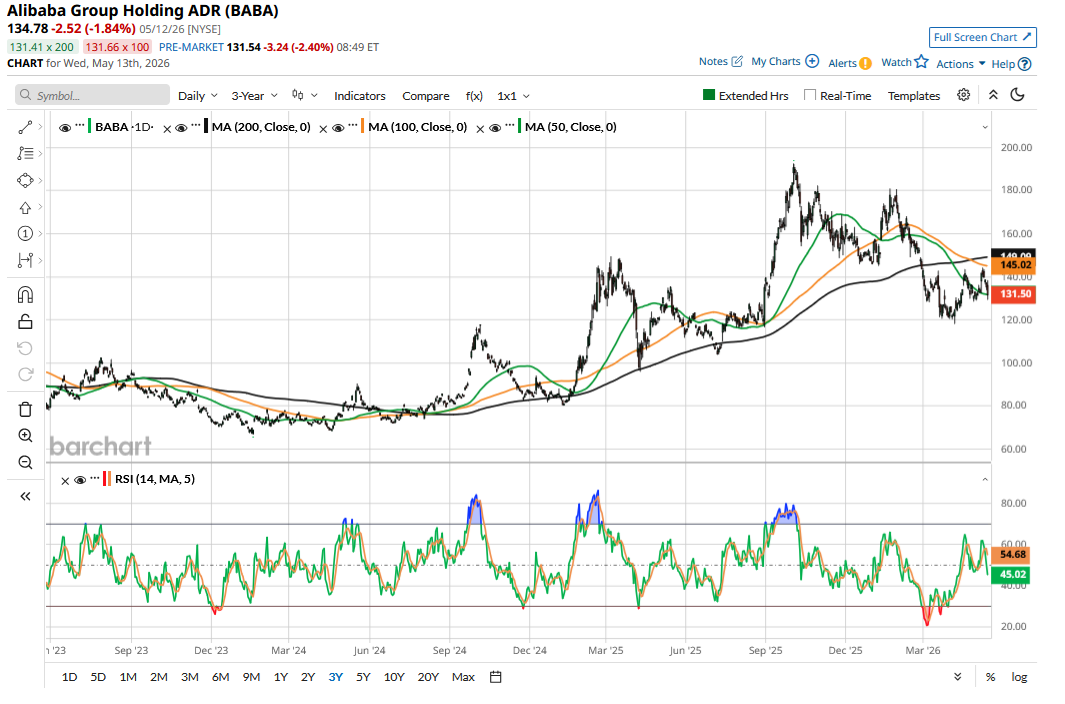
From a valuation perspective, BABA stock looks like a decent buy at a forward price-to-earnings (P/E) multiple of around 21.7 times. I see the post-earnings dip as an opportunity to add more shares.
On the date of publication, Mohit Oberoi had a position in: BABA . All information and data in this article is solely for informational purposes. For more information please view the Barchart Disclosure Policy here.
More news from Barchart
Alexa Is Finally Back in the Spotlight as Amazon Axes Rufus. What the AI Pivot Means for AMZN Stock. Dear Take-Two Stock Fans, Mark Your Calendars for May 18 Alibaba’s AI Growth Fails to Mask Plunging Profits: How to Play BABA Stock After Q4 Earnings Cisco Stock Jumps 13% as the Company Cuts 4,000 Jobs to Pivot Toward AI. Its Growth Story Is Far From Over.