


AbbVie’s ABBV oncology portfolio delivered a slight decline in the first quarter of 2026, as the segment was affected by weak sales of the blood cancer drug Imbruvica. The company generated oncology revenues of $1.63 billion in the quarter, down 3% year over year on an operational basis.
The biggest growth contributor within the segment remained Venclexta, which recorded sales of $770 million, up nearly 10% year over year. The uptick was attributed to strong demand in chronic lymphocytic leukemia (CLL), driven by the combination use with BTK inhibitors. During the earnings call, management highlighted continued momentum for the drug, noting that BTK-based combination regimens are increasingly becoming a preferred treatment approach globally.
AbbVie’s newer oncology products continued to show encouraging growth trends. Sales of ovarian cancer therapy Elahere rose more than 8% year over year to $198 million in the quarter, while lymphoma drug Epkinly recorded revenues of $83 million, up about 58%.
However, these gains were offset by a sharp decline in Imbruvica sales, which fell nearly 25% year over year to $556 million. AbbVie attributed the decline to competitive pressure, as well as the impact of Medicare drug pricing changes under the Inflation Reduction Act. Management stated that newer oncology medicines partially offset the expected decline in Imbruvica sales.
ABBV’s Competition in the Oncology Space
Other bigger players in the oncology space include AstraZeneca AZN, Merck MRK and Pfizer PFE.
For AstraZeneca, oncology sales now account for 44% of total revenues. Sales in its oncology segment rose 16% year over year in first-quarter 2026, driven by strong performance of medicines such as Tagrisso, Lynparza, Imfinzi, Calquence and Enhertu (in partnership with Daiichi Sankyo).
Merck’s key oncology medicines are PD-L1 inhibitor, Keytruda and PARP inhibitor, Lynparza, which it markets in partnership with AstraZeneca. Keytruda, approved for several types of cancer, alone accounted for more than 49% of MRK’s total revenues in first-quarter 2026.
Pfizer’s oncology revenues grew 7% in first-quarter 2026, driven by drugs like Padcev, Lorbrena, the Braftovi-Mektovi combination and Tukysa. The segment now accounts for more than 26% of its total revenues.
ABBV’s Price Performance, Valuation and Estimates
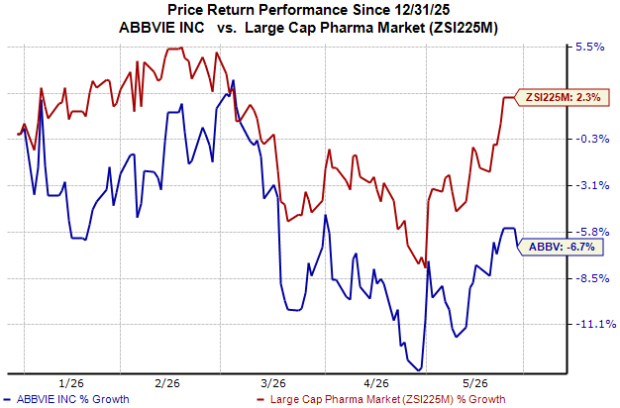
Shares of AbbVie have underperformed the industry year to date, as seen in the chart below.
Image Source: Zacks Investment Research
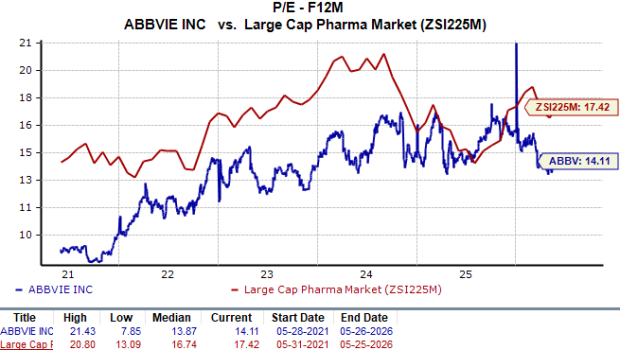
From a valuation standpoint, AbbVie is trading at a discount to the industry. Based on the price-to-earnings (P/E) ratio, the company’s shares currently trade at 14.11 times forward earnings, below the industry average of 17.42.
Image Source: Zacks Investment Research
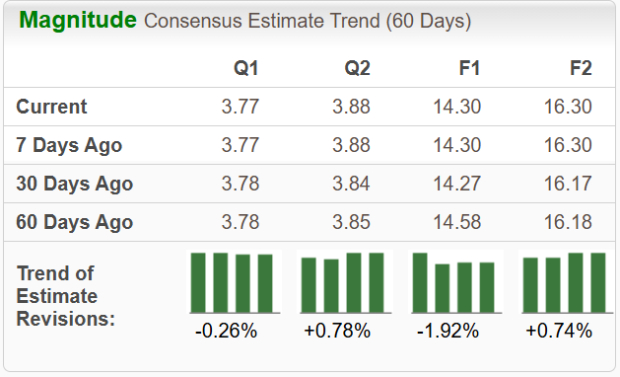
ABBV’s EPS estimates for 2026 and 2027 have increased during the past 30 days.
Image Source: Zacks Investment Research
AbbVie currently carries a Zacks Rank #3 (Hold). You can see the complete list of today’s Zacks #1 Rank (Strong Buy) stocks here.
Beyond Nvidia: AI's Second Wave Is Here
The AI revolution has already minted millionaires. But the stocks everyone knows about aren't likely to keep delivering the biggest profits. AI’s second wave is moving from infrastructure to implementation and these companies are at the forefront of this transition, positioned to become what Amazon and Google were to the internet era.
See Stocks Now >>Want the latest recommendations from Zacks Investment Research? Today, you can download 7 Best Stocks for the Next 30 Days. Click to get this free report
AstraZeneca PLC (AZN): Free Stock Analysis Report
Pfizer Inc. (PFE): Free Stock Analysis Report
Merck & Co., Inc. (MRK): Free Stock Analysis Report
AbbVie Inc. (ABBV): Free Stock Analysis Report
This article originally published on Zacks Investment Research (zacks.com).