


Business restructuring and expansion efforts, along with ongoing digitization, should provide additional support. Major regional banks like State Street Corporation STT and Northern Trust Corporation NTRS are well-positioned to gain.
About the Industry
The Zacks Major Regional Banks industry includes the nation’s largest banks in terms of assets, with most operating globally. The financial performance of these banks largely depends on the nation’s economic health. As banks are involved in numerous complex financial activities, they are required to comply with stringent regulations set by the Federal Reserve and other regulatory agencies. Apart from traditional banking services, which are the source of net interest income (NII), major regional banks provide a wide array of other financial services and products to retail, corporate and institutional clients, both domestic and global. These include credit and debit cards, mortgage banking, wealth management and investment banking, among others. A significant revenue source for these banks is fees and commissions earned from these services.
4 Themes to Influence the Regional Banks Industry's Prospects
No Change in Interest Rates: After the Fed lowered interest rates by a cumulative 175 basis points across 2024 and 2025, driven by easing inflation and weakening labor-market conditions, ongoing geopolitical tensions in the Middle East and the resulting oil-price shock are expected to keep rates unchanged for much of the year. Yet, major regional banks will likely keep benefiting from lower rates (compared with historically higher rates in 2022 and 2023) as deposit and funding costs fall/stabilize and the lending backdrop gradually improves. As such, industry players’ NII and margins are expected to keep expanding.
Rise in Loan Demand: The central bank’s aggressive monetary tightening in 2021 and 2022 weighed on loan demand amid concerns over a potential economic downturn or recession. However, the trend has reversed since then. According to the Fed’s Summary of Economic Projections released in December 2025, U.S. economic growth is expected to improve. This, coupled with declining borrowing costs and greater clarity on several macroeconomic factors, is likely to support loan demand. Major regional banks are expected to see a solid increase in demand for both wholesale and consumer loans.
Restructuring Initiatives: Major regional banks are taking steps to diversify into new business areas and reduce their reliance on spread income. Business restructuring remains essential for supporting technological advancement, expanding domestic and global operations and improving profitability. Industry players are investing in artificial intelligence and other digital platforms while also partnering with or acquiring providers of such services. Several major regional banks are aggressively expanding their footprints both within the United States and internationally. Many are also reassessing their business structures to streamline operations and exit less profitable businesses.
Asset Quality: Mounting worries about the economy and uncertainty around trade policies pursued by the Trump administration have added to inflationary pressure. Renewed Middle East tensions and oil-shock risks are further lifting costs, squeezing household and business budgets and, in turn, weakening borrowers’ repayment capacity. In response, major regional banks are expected to increase loan-loss reserves to cushion against potential defaults and payment delays. While disciplined underwriting and generally resilient borrowers have helped industry players keep asset quality under control, several key credit indicators have drifted above pre-pandemic levels.
Zacks Industry Rank Reflects Bright Prospects
The Zacks Major Regional Banks industry is a nine-stock group within the broader Zacks Finance sector. The industry currently carries a Zacks Industry Rank #51, which places it in the top 21% of more than 240 Zacks industries.
The group’s Zacks Industry Rank, which is the average of the Zacks Rank of all the member stocks, indicates outperformance in the near term. Our research shows that the top 50% of the Zacks-ranked industries outpace the bottom 50% by a factor of more than 2 to 1.
The industry’s positioning in the top 50% of the Zacks-ranked industries is a result of an encouraging earnings outlook for the constituent companies in aggregate. The aggregate estimate revision trend reflects an improving situation. Over the past year, the industry’s earnings estimates for 2026 have been revised 7% upward, and those for 2027 are up 11.3%.
Before we present a couple of major regional bank stocks to bet on, let’s take a look at the industry’s recent stock market performance and valuation picture.
Industry's Stock Market Performance Is Solid
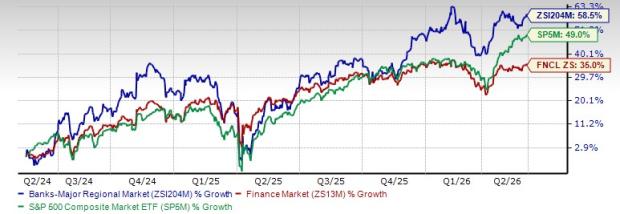
The Zacks Major Regional Banks industry outperformed the S&P 500 composite and the sector over the past two years.
Stocks in this industry have collectively jumped 58.5% over the past two years. In the same time frame, the Zacks S&P 500 composite has surged 49%, and the Zacks Finance sector rallied 35%.
Two-Year Price Performance
Industry's Valuation is Attractive
One might get a good sense of the industry’s relative valuation by looking at its price-to-tangible book ratio (P/TBV), which is commonly used for valuing banks because of large variations in their earnings from one quarter to the next.
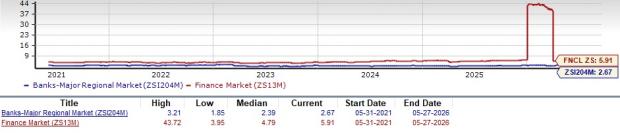
The industry currently has a trailing 12-month P/TBV of 2.67X. This compares with the highest level of 3.21X, the lowest of 1.85X and the median of 2.39X over the past five years. The industry is trading at a huge discount compared with the market at large, as the trailing 12-month P/TBV for the S&P 500 composite is 12.15X, as the chart below shows.
Price-to-Tangible Book Ratio (TTM)

As finance stocks typically have a lower P/TBV ratio, comparing major regional banks with the S&P 500 may not make sense to many investors. However, comparing the group’s P/TBV ratio with that of the broader sector ensures that the group is trading at a solid discount. The Zacks Finance sector’s trailing 12-month P/TBV came in at 5.91X. This is above the Zacks Major Regional Banks industry’s ratio, as the chart below shows.
Price-to-Tangible Book Ratio (TTM)
2 Major Regional Banks to Bet On
State Street: Headquartered in Boston, MA, State Street provides a range of products and services for institutional investors worldwide through its subsidiaries. As of March 31, 2026, State Street reported assets under custody and administration (AUC/A) of $54.5 trillion and assets under management (AUM) of $5.62 trillion.
State Street is continuing with its efforts to strengthen fee income sources. While the company’s total fee revenues declined in 2022 and 2023, the metric saw a four-year (2021-2025) CAGR of 2.3%, mainly driven by higher client activity and significant market volatility. AUC/A and AUM recorded a CAGR of 5.3% and 8.2%, respectively, in the same time frame.
At the end of the first quarter, STT reported $2.7 trillion of AUC/A to be installed and $315 million of servicing fee revenues to be installed. This provides better forward visibility beyond near-term market swings, while continued Alpha mandate wins reinforce demand for integrated front-to-back solutions. State Street remains well-positioned for fundamental business activities, given its global exposure and a broad array of innovative products and services.
This Zacks Rank #2 (Buy) company has been using partnerships, minority stakes and strategic bolt-on acquisitions to expand growth platforms across investment, distribution and technology. Last year, the company expanded through partnerships, minority investments and acquisitions. Despite lower rates, State Street’s NII and net interest margin are expected to witness decent improvements in the near term. You can see the complete list of today’s Zacks #1 Rank (Strong Buy) stocks here.
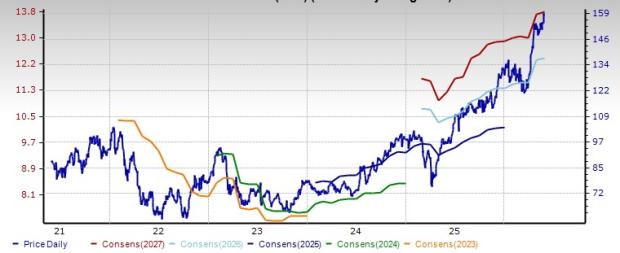
STT has a market cap of $43.7 billion. The Zacks Consensus Estimate for earnings indicates growth of 19.9% for 2026 and 11.8% for 2027. Over the past six months, the stock has gained 33.4%.
Price and Consensus: STT
Northern Trust: With total assets worth $174.6 billion as of March 31, 2026, Northern Trust is a leading provider of wealth management, asset servicing, asset management and banking solutions to corporations, institutions, families and individuals.
Organic growth is the company’s key strength. Its revenues witnessed a CAGR of 5.7% over the last five years (2020-2025), driven by rising non-interest income and NII. As the client base expands, the company expects to see a steady rise in loan activity, particularly as its wealth management services attract more clients. This ongoing focus on wealth management is expected to drive growth in the lending portfolio.
Following the launch of Family Office Solutions for ultra-high-net-worth clients, NTRS’ investment management division, Northern Trust Asset Management, partnered with Envestnet in January to expand access to its tax-managed direct indexing solutions, enhancing distribution reach for this client segment. These initiatives, along with continued asset servicing wins and low double-digit wealth management trust fee growth, are expected to support fee income and strengthen organic growth momentum.
NTRS is undertaking expense management efforts to tackle expense growth and support operating leverage. It focused on disciplined headcount management, vendor consolidation, rationalization of its real estate footprint and process automation. Through such efforts, it will likely improve productivity and meet the financial targets.
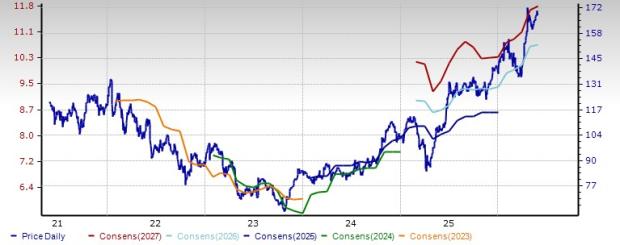
NTRS has a market cap of $31.1 billion. The Zacks Consensus Estimate for earnings indicates 18.5% and 10.6% growth in 2026 and 2027, respectively. The company, which sports a Zacks Rank of 1, witnessed a 28.6% rise in its stock price over the past six months.
Price and Consensus: NTRS
Zacks' Research Chief Names "Stock Most Likely to Double"
Our team of experts has just released the 5 stocks with the greatest probability of gaining +100% or more in the coming months. Of those 5, Director of Research Sheraz Mian highlights the one stock set to climb highest.
This top pick is a little-known satellite-based communications firm. Space is projected to become a trillion dollar industry, and this company's customer base is growing fast. Analysts have forecasted a major revenue breakout in 2025. Of course, all our elite picks aren't winners but this one could far surpass earlier Zacks' Stocks Set to Double like Hims & Hers Health, which shot up +209%.
Free: See Our Top Stock And 4 Runners UpWant the latest recommendations from Zacks Investment Research? Today, you can download 7 Best Stocks for the Next 30 Days. Click to get this free report
State Street Corporation (STT): Free Stock Analysis Report
Northern Trust Corporation (NTRS): Free Stock Analysis Report
This article originally published on Zacks Investment Research (zacks.com).