

Home improvement may not be the flashiest corner of the stock market, but it is one of the most practical. Homes always need repairs, upgrades, and maintenance, which gives this industry a kind of steady demand that investors can understand. And when it comes to this space, two names usually stand out: Home Depot and Lowe’s.
Both companies serve homeowners, the DIY types like myself, and professional contractors, but their stocks do not tell the exact same story.
More Yield, Less Trap: Sign up free to get Barchart’s daily Dividend Investor newsletter straight to your inbox.
So, which is the better dividend stock today: Home Depot or Lowe’s?
Let’s find out.
Home Depot (HD)
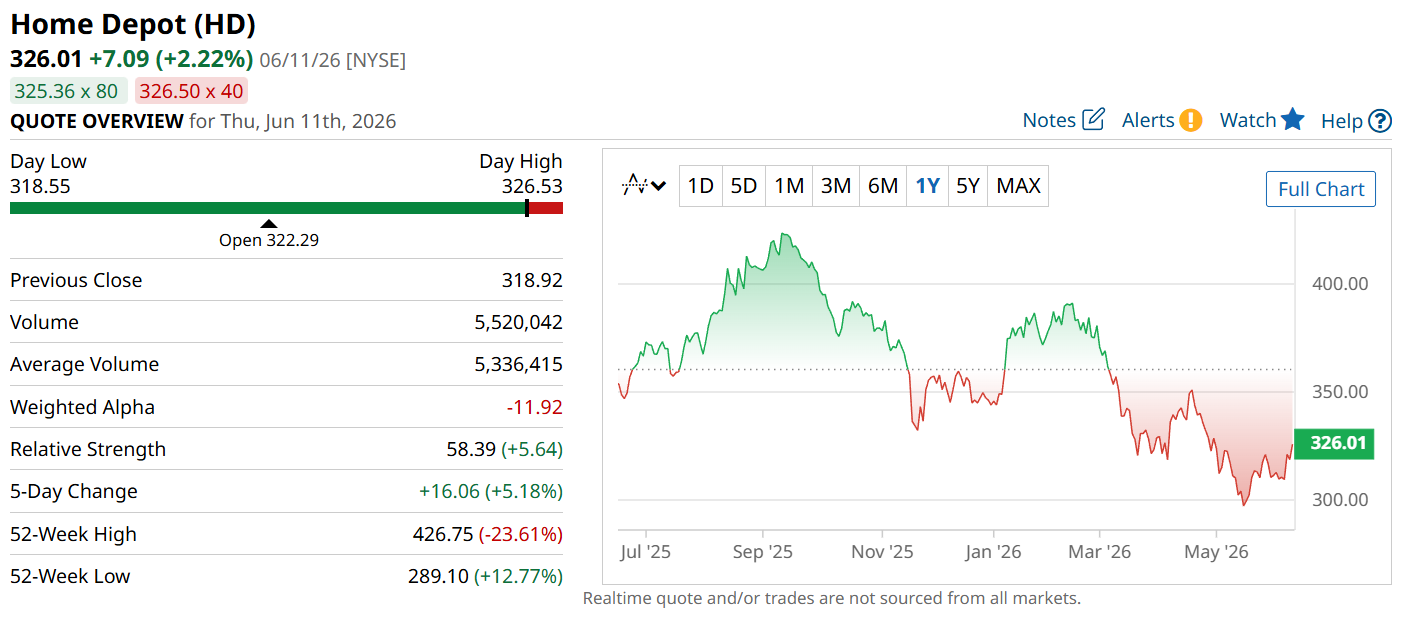
Home Depot is a home improvement retailer selling do-it-yourself (DIY) and professional supplies, tools, and materials for repairs and renovations. Its market spans everyday homeowners and professional contractors, making it one of the biggest names in home improvement.
HD stock has traded between $289 and $427 over the past 52 weeks, and at the time of publication, it trades near the lower end of that range. Actually, with a market cap just north of $300 Billion, the stock is down around 5% year-to-date.
Lowe’s Companies (LOW)
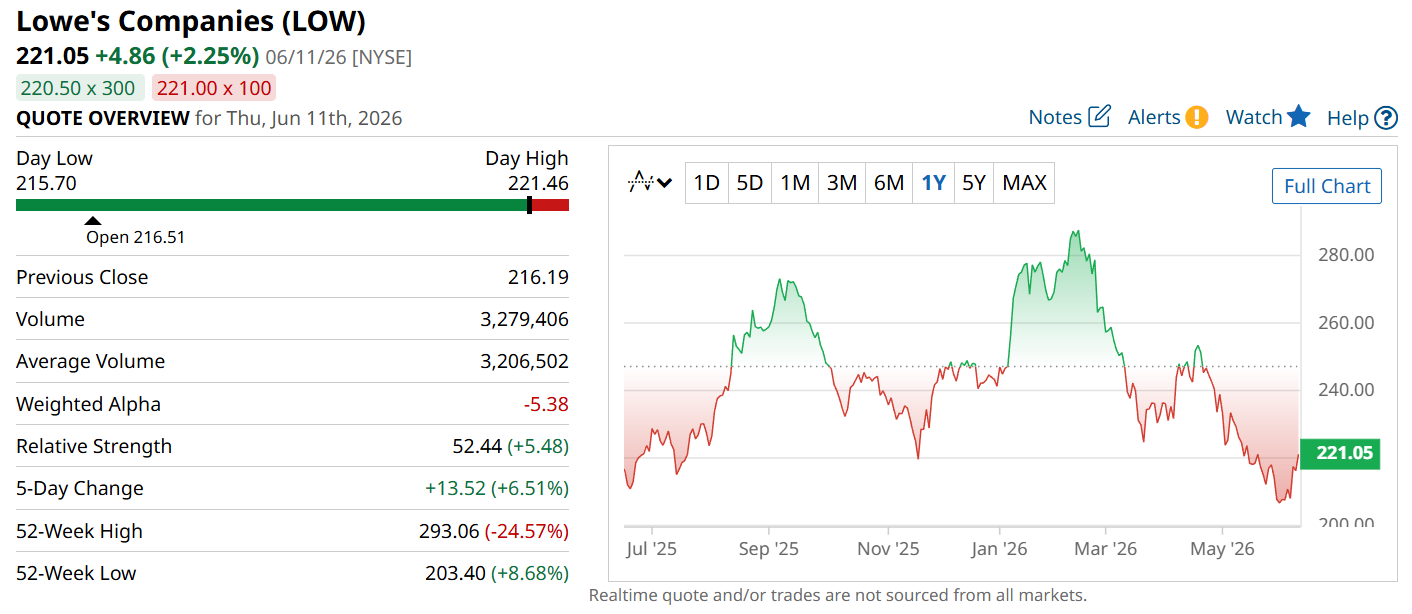
Competing directly with Home Depot is Lowe’s Companies, another major home improvement retailer. It shares the same product portfolio, including tools, appliances, building materials, and more, which are used for home repairs, maintenance, and renovation projects.
Lowe’s is the smaller player in the comparison, with a market cap of around $120 billion, less than half of Home Depot’s. LOW stock has traded between $203 and $293 over the past 52 weeks, and like Home Depot, it's currently trading near the lower end of the range. In fact, year-to-date, Lowe’s stock is down roughly 8%.
Now, let’s get down to business. Literally.
Business model comparison
Home Depot and Lowe's share the same niche and customer base. Both companies also have physical and online platforms.
But the key difference is scale and customer mix. Home Depot has historically had more ties with professional contractors, who typically spend more and buy more frequently. Lowe’s, on the other hand, is known for keeping a strong presence among regular and DIY customers.
This matters because when mortgage rates are as high as they are or when housing activity slows, major renovations tend to get delayed. Even so, demand for repairs, maintenance, and smaller projects can continue.
Simply put, Home Depot has the advantage in its scale and among professional customers, while Lowe’s remains a strong competitor, working to get a larger share of the Pro market.
Financial position
| Metric | Home Depot | Lowe’s |
| Sales | $41.8 billion (+4.8% YOY) | $23.1 billion (+10.3% YOY) |
| Net Income | $3.3 billion (-4.2% YOY) | $1.63 billion (-0.8% YOY) |
| Price/Sales Ratio | 1.95x | 1.41x |
| Forward P/E | 21.40x | 17.42x |
Home Depot’s latest quarterly sales grew 4.8% year over year to $41.8 billion, compared to Lowe’s 10.3% growth to $23.1 billion.
But size alone doesn't tell the whole story. Lowe’s posted the stronger revenue growth, though the same trend did not appear on the bottom line, with Lowe’s net income slipping 0.8% to $1.63 billion. Still, it’s better than Home Depot’s net income, which fell 4.2% to $3.3 billion.
Valuation, however, favors Lowe’s. The price-to-sales ratio shows how much investors pay per dollar of sales, while the forward P/E ratio shows how much they pay for expected future earnings.
Home Depot trades at nearly 2x sales and 21x forward earnings, while Lowe’s trades at 1.4x sales and 17x forward earnings. The Consumer Discretionary sector’s P/E median is 16.68x, so Lowe’s is closer to what would be called “fair” valuation- at least in comparison to Home Depot.
Overall, Home Depot appears to be the stronger business in terms of sheer size. But Lowe’s makes the comparison closer than it looks, with faster sales growth and a cheaper valuation.
Dividend story
So far, the competition between the two is neck and neck, and for many investors, dividends may be the ultimate deciding factor.
Home Depot pays a forward annual dividend of $9.32, translating to a yield of around 3%. The company has also raised its dividends for more than 15 consecutive years.
Meanwhile, Lowe’s Companies has more than 50 consecutive years of dividend increases, qualifying it as a Dividend Aristocrat and King. It pays $5.00 per share per year, translating to a yield of approximately 2.2%.
Wall Street’s opinion
So, for the final metric, let’s see what the pros on Wall Street say.
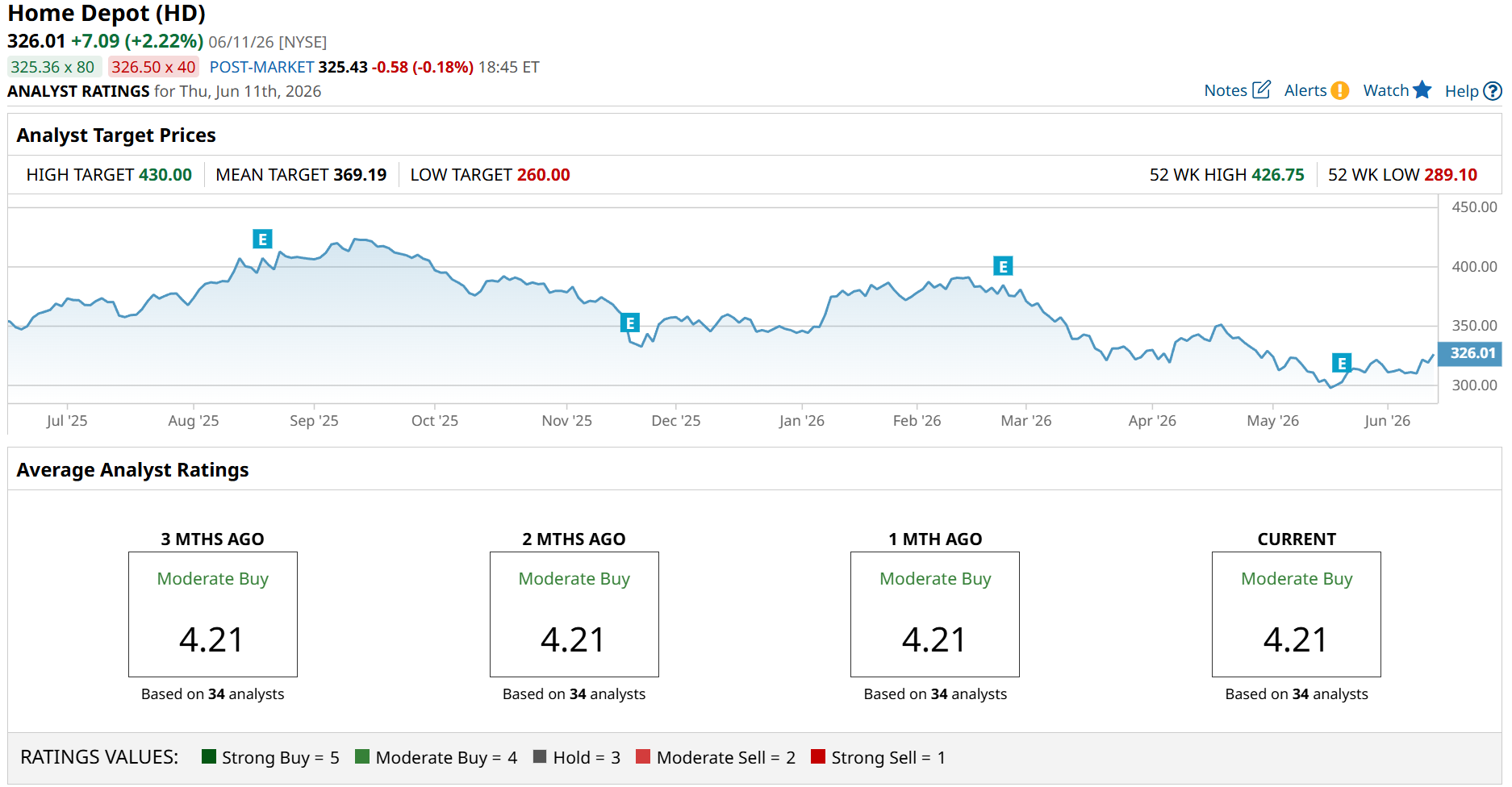
A consensus among 34 analysts rates Home Depot stock a “Moderate Buy,” with a score of 4.21 out of 5. Its mean-to-high target prices suggest between 13% and 32% upside if reached.
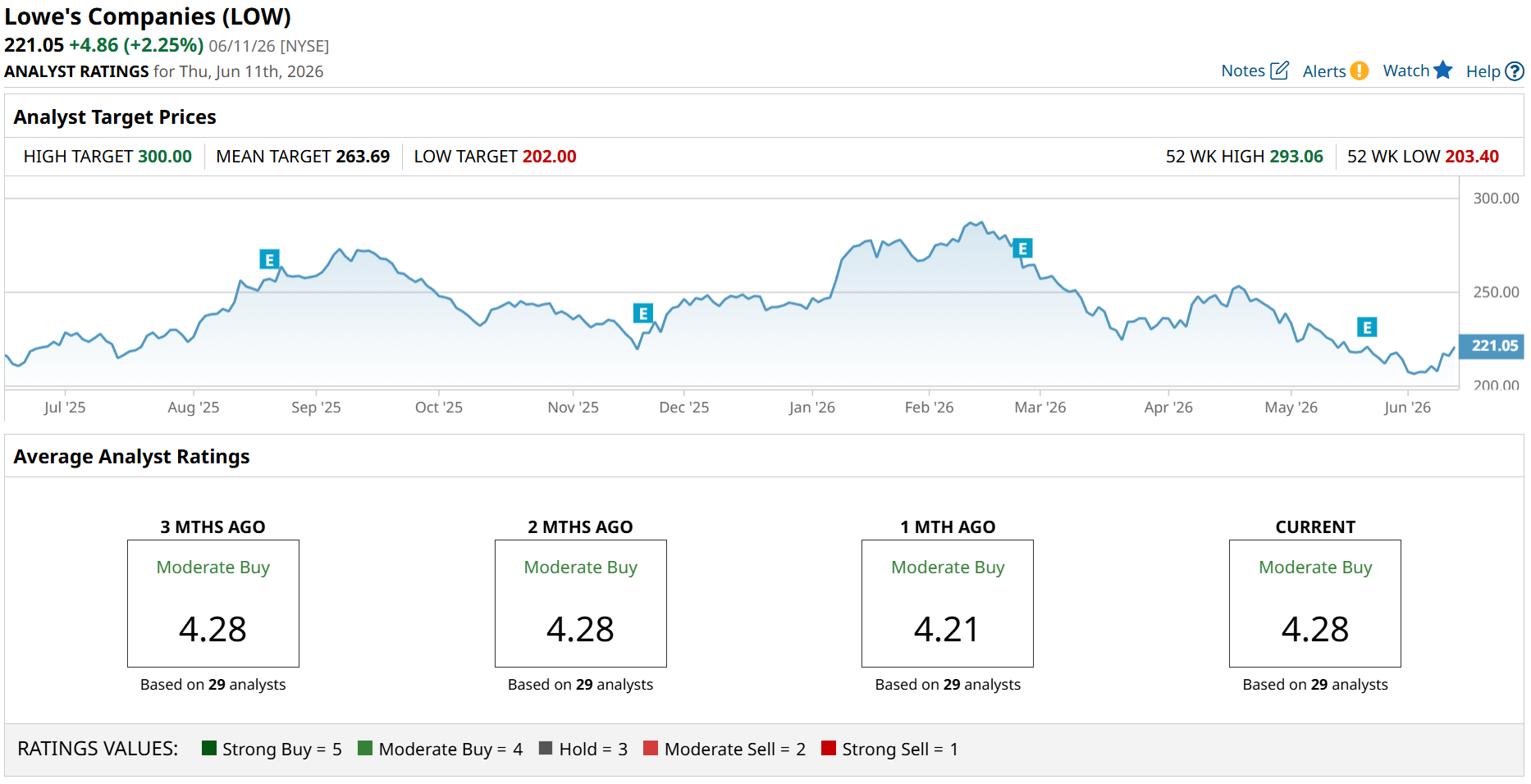
Meanwhile, Lowe’s stock has the same “Moderate Buy” rating, but with a slightly higher score of 4.28 out of 5- based on a consensus from 29 analysts. Its mean-to-high target prices suggest between 19% and 36% potential upside.
Which is a better buy? Home Depot or Lowe's Companies?
Both companies are fairly attractive buys. They both have strong business models, stable financials, decent dividend yields, and supportive analyst ratings.
However, Lowe’s gets a slight edge because it looks cheaper and has a much longer dividend growth streak.
But if you want the bigger company with the higher dividend yield today, Home Depot is still a solid choice. In the end, in a matchup this close, I'm afraid I'll have to call it a tie.
On the date of publication, Rick Orford did not have (either directly or indirectly) positions in any of the securities mentioned in this article. All information and data in this article is solely for informational purposes. For more information please view the Barchart Disclosure Policy here.
More news from Barchart
Home Depot or Lowe’s: 1 Has Raised Its Dividend for 50+ Years. The Other Pays More Now This Analyst Just Upped the Price Target on Carnival Stock. Here’s Why. Markets Are Overreacting to Kevin Warsh. Where the Panic Is Coming From and Why a New Fed Chair Isn’t That Bad. Citi Just Upgraded AMD Stock. Here’s Why.