

While capital markets are holding their breath tracking macroeconomic data, guessing when the Federal Reserve will begin its rate-cut cycle, a far more significant shift has occurred in the U.S. landscape regarding long-term consequences. Specifically, a radical overhaul of the Basel III regulatory standards is set to effectively ease the pressure the U.S. banking system has operated under since 2008.
This move has the potential to jump-start the credit cycle in the U.S. despite a restrictive monetary stance, acting as a powerful fundamental signal for the stock market to re-evaluate the entire financial sector.
More Top Stocks Daily: Go behind Wall Street’s hottest headlines with Barchart’s Active Investor newsletter.
The Regulatory Trap Where Banks Resided
To grasp the magnitude of this event, one must comprehend the mechanics of bank capital in recent decades. After the 2008 global crisis, regulators mandated that major financial entities maintain substantial volumes of their own equity as a buffer against every loan extended.
Regulators gauge each asset via "risk weightings." Commercial and consumer loans — the most margin-rich instruments for a bank — were assigned high weights. This meant that issuing these loans required a massive cushion of safety. Consequently, financial institutions were forced to park billions in risk-free but low-yielding assets, such as Treasury debt or accounts held directly at the Fed.
The initial Basel III draft, proposed back in 2023, envisioned a further hike in capital mandates by an average of 16%. This regulatory noose artificially depressed the capital efficiency of the banking business; banks could not allocate funds into higher-yield lending, keeping their profitability and market valuation under constant strain.
What Is the Pivot Happening Now?
This spring, however, the Federal Reserve executed a turnaround by drafting and releasing a softened suite of rules, officially accessible on the Fed’s portal.
Instead of tightening, regulators proposed cutting core capital mandates for the largest banks by approximately 4.8%. The Fed reworked the table of risk multipliers; the physical volume of bank deposits remains unchanged, yet the "paper weight" of their assets in the eyes of regulators has decreased. As a result, banks unlock a significant volume of free capital that no longer needs to be sequestered in low-yield reserves.
With that said, it is vital to grasp the technical procedure here and the mechanics of adopting these new rules. The document unveiled on March 19 is a re-proposal; following its release, U.S. regulations mandate a 90-day period for public comment. This deadline expires today, June 18. Since the current stage has passed without fierce industry pushback (unlike the 2023 version), the incoming Fed administration will only need to finalize and ratify the concluding text.
Although legally these new standards will take effect later, the stock market trades on the future. Market participants are already baking this inevitable liberation of bank capital into asset pricing today, adjusting models well ahead of actual implementation.
A Double-Edged Sword for the Economy and Inflation
This decision triggers a macroeconomic mechanism that functions in parallel with interest rates.
For one, there's acceleration of the credit multiplier. New rules will empower banks to issue more loans for every dollar of their capital. Lending in the U.S. will receive an impulse to expand, primarily in the consumer segment, where demand for financing remains resilient.
Then, there is the matter of inflationary pressures. Increased lending volumes facilitate the expansion of the money supply (the M2 aggregate). An inflow of new credit funds into the real economy will bolster consumer demand. Under current conditions, that could contribute to keeping inflation at stubbornly high levels.
Why the Banking Sector Wins
For the stock market, this event creates a solid foundation for upward momentum in the financial sector. Historically, U.S. banking giants have traded at a discount precisely because of the heavy-handed regulatory environment. Right now, the sector’s average price-to-earnings (P/E) ratio sits at around 15 times, which looks highly conservative against the backdrop of broader market peaks.
Easing the rules means the noose has been loosened. Unlocking funds allows banks to pivot capital into high-margin lending. As efficiency climbs, they will be able to generate more from their assets, and in turn the fundamental value of their businesses will grow.
 www.barchart.com
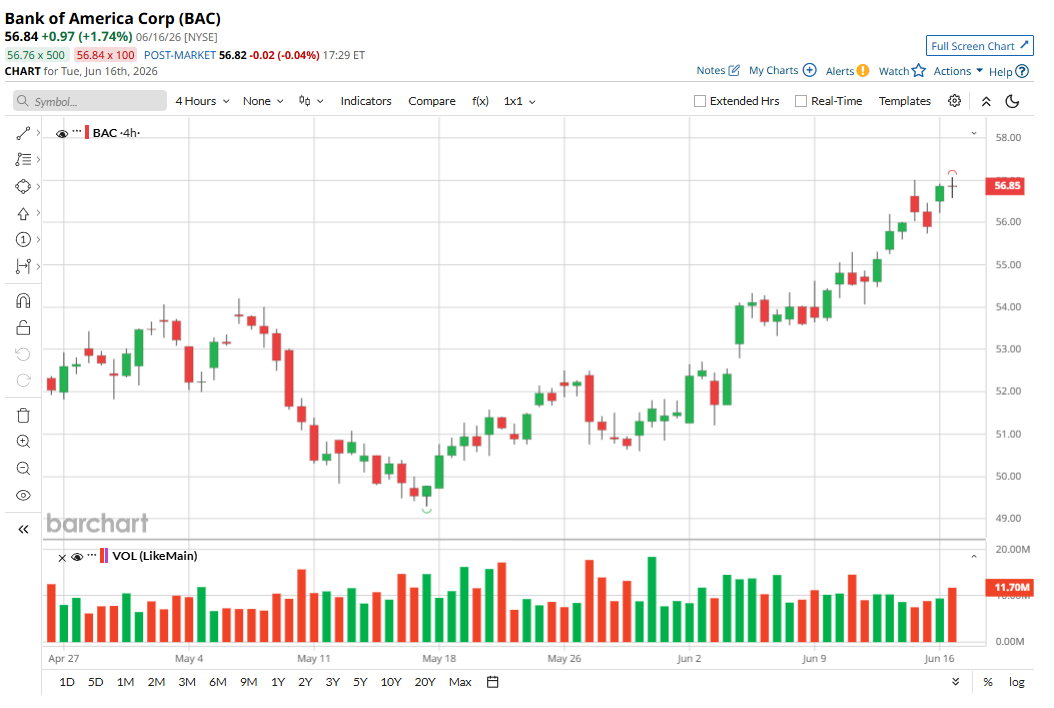
 On the heels of this news, stock prices for lenders such as JPMorgan Chase (JPM), Bank of America (BAC), Wells Fargo (WFC), Citigroup (C), Goldman Sachs (GS), and Morgan Stanley (MS) may pivot upward and form a growth trend. Improved business conditions and rising potential returns serve as a strong argument that the banking sector's multiples may become recalibrated by the market toward the upside. An increase in P/E ratios by even two to three units against a backdrop of lending growth reflects substantial potential for the capitalizations of these firms in the medium term.
On the date of publication, Mikhail Fedorov did not have (either directly or indirectly) positions in any of the securities mentioned in this article. All information and data in this article is solely for informational purposes. For more information please view the Barchart Disclosure Policy here.
More news from Barchart
The Quiet Revolution at the Fed: The U.S. Banking Sector Received a Catalyst More Potent than Rate Cuts Why is Thursday Friday, Technically? Bear Call Spread Ideas for FedEx Earnings Next Week Stocks Rally Before the Open on U.S.-Iran Peace Deal