


Netflix Inc. (NFLX) stock is tanking ahead of its Q2 earnings release on Thursday, July 16. It's now down 32% from a peak price on April 16 ($107.79) right before the Q1 earnings release. However, its FCF is strong and expected to remain high. Value investors are circling as NFLX looks too cheap.
NFLX closed at $73.37 on Friday, July 10. That's well below the 6-month prior low of $76.02 on Feb. 26, when Netflix dropped its Warner Bros. bid. It's only slightly over a recent trough of $70.90 on June 25. Has it gone too far?
Can’t Get Enough Options?: Join the list for Barchart’s daily unusual options report, delivered free.
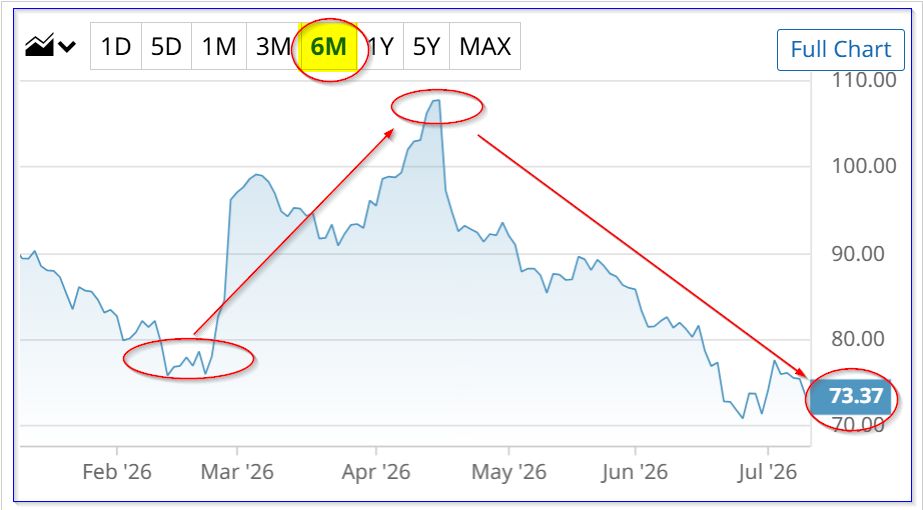 NFLX stock - July 10, 2026 - Barchart
 Some investors may be negative on NFLX, as its market share seems to be eroding. A recent WSJ article (July 9) suggested lower potential customer engagement, including the lowest level of TV viewership at 7.8% since May 2025, according to Nielsen.
But the company is still expected to produce strong revenue and free cash flow (FCF). That was despite lower operating margin guidance in its Q1 earnings release, which disappointed the market.
For example, its Q2 2025 operating margin was 34.1%, but the April 16 shareholder letter showed management forecast just 32.1% for Q2.
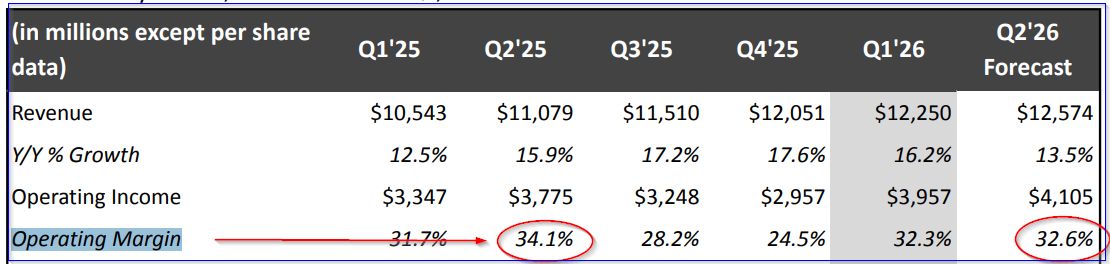 NFLX Q1 earnings release and Q2 operating margin forecast - April 16 shareholder letter
 So, if management beats the lower Q2 forecast in the July 16 earnings release and its Q3 operating margin forecast is higher than 28.2% (Q3 2025), it's possible NFLX stock could rebound.
Strong FCF Forecasts
However, the market is forgetting that Netflix is still expected to generate strong free cash flow (FCF) over the next 12 months. This is because analysts project higher revenue, and Netflix has consistently generated 20% FCF margins.
For example, Seeking Alpha shows that analysts forecast revenue of $51.39 billion this year. That's up 13.75% from 2025 ($45.18 billion) and +9.6% over the $46.89 billion for the trailing 12 months (TTM), according to Stock Analysis.
In addition, for 2027, analysts are projecting $57.4 billion, giving it a next 12 months (NTM) average of $54.4 billion.
Moreover, over the last 4 quarters, Stock Analysis shows Netflix has generated high TTM FCF margins: 25.37% in Q1, 20.94% in Q4 2025, 20.67% (Q3), 20.39% (Q2). (The Q1 FCF had a one-time $2.8 billion breakup fee from Paramount, so the adjusted FCF margin was 19.4%, as I pointed out in my April 19 Barchart article."
So, the average trailing 12 months (TTM) FCF margin has been 20.345%. Investors can use that to project its NTM FCF.
Here's how. Multiply the NTM revenue forecast by the average TTM FCF margin:
$54.4 billion NTM revenue x 20.345% FCF margin = $11.07 billion FCF
That will be almost $2 billion more than the TTM $9.094 billion (in Q1, after deducting the one-time payment, i.e., $11.894b - $2.8b), or +21.8% more.
In other words, at some point, the market may have to adjust its valuation for NFLX stock.
Valuing NFLX Using FCF Yield
As of Friday, July 10, Netflix's market capitalization was $308.95 billion (Yahoo! Finance). That implies if the company were to pay out 100% of its FCF (theoretically), the dividend yield would be:
$9.094 billion (Q1 TTM adj. FCF) / $308.95b = 0.0294 = 2.94% FCF yield
Just to be conservative, let's use a 2.95% FCF yield to determine the fair market value (FMV) using our NTM FCF estimate:
$11.07b NTM FCF / 0.0295 = $375.3 billion FMV
That is 21.5% higher than its present market cap ($308.95 billion). In other words, the price target (PT) is 21.5% higher than Friday's close:
$73.37 x 1.215= $89.14 per share PT
Analysts on Wall Street have higher price targets. For example, Yahoo! Finance reports the average PT of 50 analysts is $113.15. Similarly, Barchart's mean survey PT is $112.75. These average $112.95 and are 53.9% higher than Friday's close.
My PT could be similar to that if I used a lower 2.30% FCF yield metric. For example, $11.07b / 0.0230 = $481.3 billion, or 55.8% higher (i.e., PT = 73.37 x 1.558 = $114.31.
So, you can see a lot will depend on the FCF multiple or FCF yield. If the market is more confident about Netflix's prospects, it will increase the valuation metric.
So, there is no guarantee that NFLX will reach these high PTs. One way, therefore, to play the stock is to short out-of-the-money (OTM) puts.
Shorting NFLX Puts
This play allows an investor to earn income while also setting a potential lower buy-in point.'
For example, the August 14 expiry period shows that the $70.00 put option strike price has a midpoint premium of $2.57. This means a short-seller of this put can make a one-month yield of 3.67% for a 4.5% lower strike price:
$2.57/$70.00 = 0.0367 = 3.67% short-put yield (one-month)
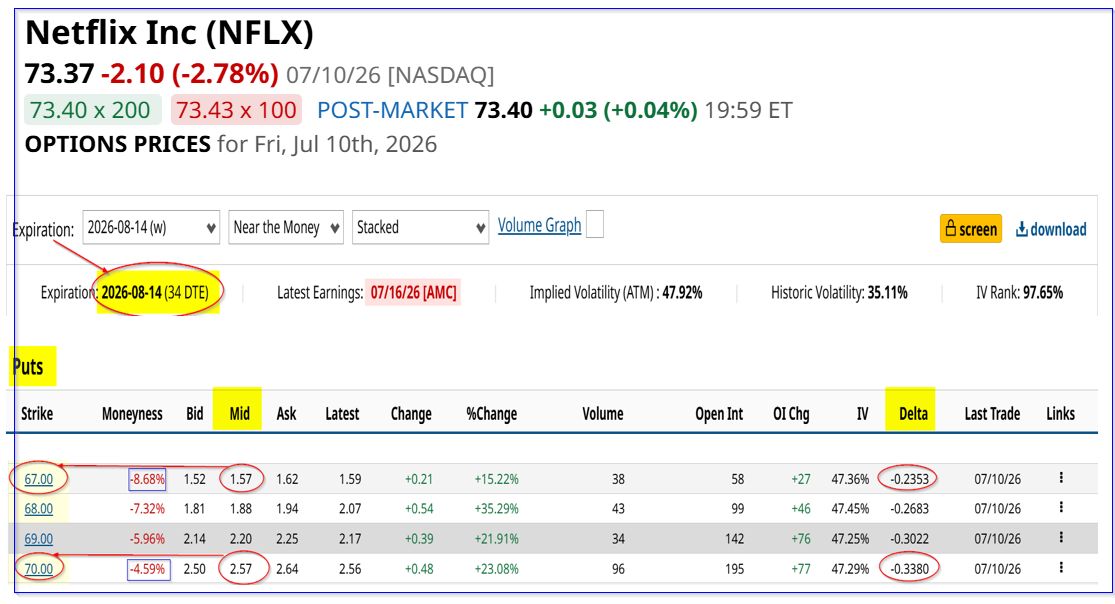 NFLX puts expiring Aug. 14 - Barchart - As of July 10, 2026
 That means an investor who secures $7,000 with their brokerage firm can enter an order to “Sell to Open” 1 put at $70.00. This is collateral to buy 100 shares at $70.00 should NFLX fall to $70.00 on or before August 14, and the account is assigned to buy 100 shares.
Then, after entering an order to “Sell to Open” 1 put at $70.00, the account will receive $257.00. That's why the yield is 3.67% (i.e., $257/$7,000).
However, the delta ratio is relatively high at -0.338, implying over a one-third chance that the stock will drop to $70.00. So, more risk-averse investors can short the $67.00 put, which has a lower 0.235 delta ratio.
That premium is $1.57, so the short-put yield is 2.34% (i.e., $1.57/$67.00). Moreover, doing both would provide an investor with an average yield of 3.02% (i.e., $2.07/$68.50). That is a very attractive way to play NFLX.
For example, the breakeven average, after income, would be $68.50 - $3.02 = $65.48, or 10.75% below Friday's close.
The bottom line is that NFLX stock looks cheap here. One way to play it is to short out-of-the-money puts for income and to set a lower potential buy-in.
On the date of publication, Mark R. Hake, CFA did not have (either directly or indirectly) positions in any of the securities mentioned in this article. All information and data in this article is solely for informational purposes. For more information please view the Barchart Disclosure Policy here.
More news from Barchart
Netflix Stock is at New Lows, But Its FCF Is Strong - Is NFLX Too Cheap? Wheat's Bullish Fundamentals Are Growing—So Why Do Prices Keep Falling? Option Volatility And Earnings Report For July 13 - 17 Nvidia Stock Has Been Flat, But NVDA Price Targets are Higher - Shorting Puts Works