


The wheat market remains supported by several bullish fundamental factors, yet prices have steadily declined since May 2026. That disconnect between supportive fundamentals and weakening prices is worth paying attention to. Markets often move ahead of the news, and when prices continue to fall despite fundamentally bullish developments, it can signal that sellers remain firmly in control and that wheat may have further downside before a meaningful bottom is established. Even so, the underlying supply-and-demand picture suggests there are still reasons to watch for a shift in sentiment.
One of the biggest supportive factors is the weather in France, a world leader in wheat exports and the European Union's largest producer. An extended heat wave across key growing regions has increased concerns about both yields and crop quality. If French production ultimately falls short of expectations, global exportable supplies would tighten, forcing importers to seek wheat from other origins. That scenario would strengthen demand for wheat from competing exporters and provide a fundamentally bullish backdrop for prices.
Don’t Miss a Day: From crude oil to coffee, sign up free for Barchart’s best-in-class commodity analysis.
The export picture in the United States also remains constructive. Weekly export sales throughout June consistently exceeded or matched trade expectations, pointing to solid international demand as the 2026/27 marketing year begins. While the USDA still projects U.S. wheat exports to decline from last year because of tighter domestic supplies, the strong start suggests buyers continue to view U.S. wheat as an attractive source. At the same time, ongoing tensions around the Strait of Hormuz have increased fuel, shipping, and logistics costs across global grain markets. Although the conflict has not created a shortage of wheat, higher transportation and production costs add inflationary pressure throughout the supply chain, providing another underlying support for prices. Together, these factors present a bullish fundamental outlook. Still, until the market begins responding to them, the prevailing downtrend suggests traders should remain cautious and respect the possibility of further price declines.
Technical Picture
Source: Barchart
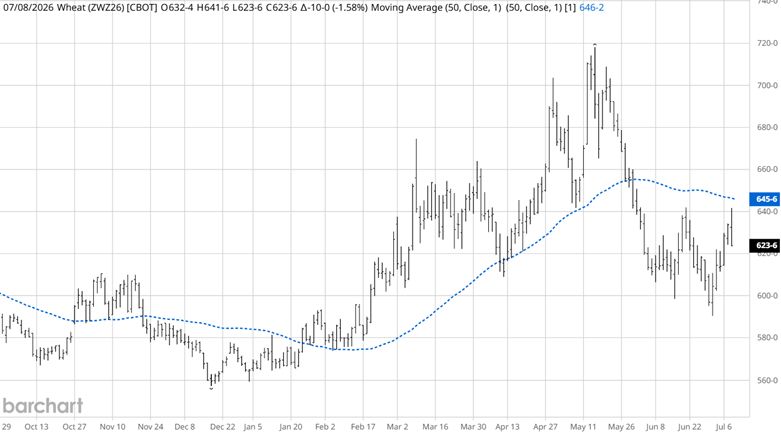
Since peaking, the daily December Wheat futures contract has traded lower, trading under the 50-day simple moving average (SMA) and staying there long enough to turn the average down. Price has now come back to test that down-sloping SMA and is finding resistance there, with price being rejected. The disparity between fundamentals and technicals suggests wheat prices may have further to fall before finding significant support.
Seasonal Pattern
Source: Moore Research Center, Inc. (MRCI)
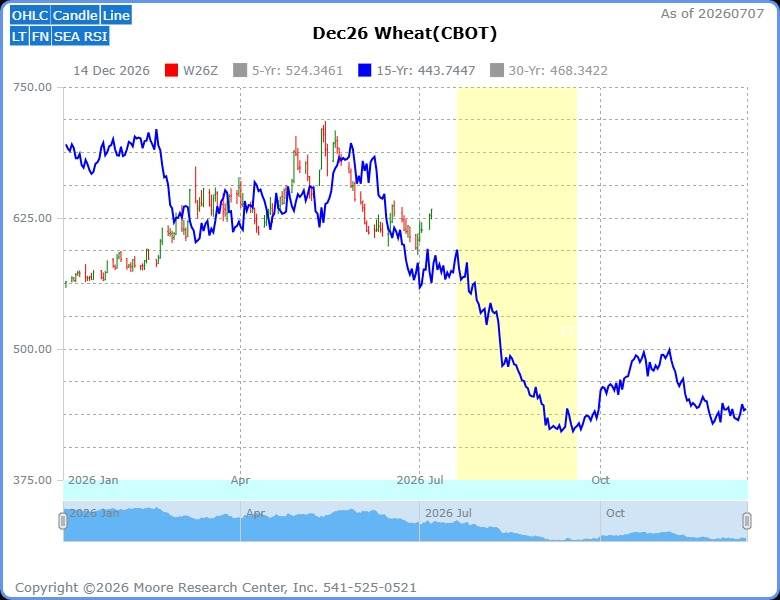
The December wheat futures have been following their seasonal pattern since peaking in May. Currently, the market is correcting some of its downtrend. MRCI research has identified a significant price move down that has usually carried December futures to their contract low for the year.
The yellow box indicates the optimal seasonal window for bearish wheat prices. The left side represents the optimal entry period, and the right side, the optimal exit period. Remember that seasonal patterns are not an exact science. There can be a range of days before and after the optimal entry and exit dates.
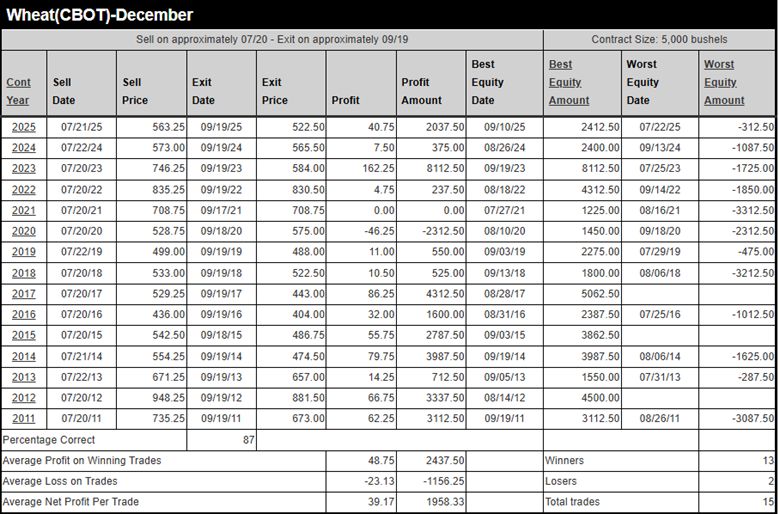
For this year's trade, MRCI research has found, through hypothetical testing, that December wheat futures closed lower on September 19 than on July 20 in 13 of the past 15 years, a 87% occurrence rate. During this period, the average profit per standard-size contract was .39'2 or $1,958. Another occurrence was three years with no daily closing drawdowns.
As a crucial reminder, while seasonal patterns can provide valuable insights, they should not be the basis for trading decisions. Traders must consider technical and fundamental indicators, risk management strategies, and market conditions to make informed, balanced trading decisions.
Source: MRCI
Assets to Trade the Wheat Market
While CBOT futures are the most direct vehicle for wheat exposure, several related markets provide alternative or complementary trading avenues:
Futures: Standard-size contracts (ZW), the mini contract (XW), or the new micro contract (WT). Wheat ETFs: WEAT (fund that tracks CBOT wheat futures) enables portfolio investors to express long or short views without futures margins. Options on wheat futures offer a way to hedge or express directional bias with defined risk. Spread trades between wheat and other grains, such as corn or soybeans, can capture relative value shifts when supply/demand dynamics differ (intermarket spreads). Traders can also trade different calendar months of wheat futures, referred to as intramarket spreads.In Closing…
The wheat market presents an interesting case in which bullish fundamentals and bearish price action tell two different stories. Weather concerns in France, stronger-than-expected U.S. export demand, and rising global transportation costs all point to a supportive longer-term fundamental backdrop. However, the technical picture remains firmly bearish, with prices trading below a declining 50-day moving average and seasonal tendencies favoring additional weakness into September. When fundamentals and technicals disagree, it's often the market itself that deserves the most attention. Price is the market's final vote, and persistent weakness despite supportive news can signal that lower prices are still ahead. Traders should continue monitoring both the evolving fundamental landscape and the technical trend, as the eventual alignment of the two often signals the next meaningful move.
On the date of publication, Don Dawson did not have (either directly or indirectly) positions in any of the securities mentioned in this article. All information and data in this article is solely for informational purposes. For more information please view the Barchart Disclosure Policy here.
More news from Barchart
Netflix Stock is at New Lows, But Its FCF Is Strong - Is NFLX Too Cheap? Wheat's Bullish Fundamentals Are Growing—So Why Do Prices Keep Falling? Option Volatility And Earnings Report For July 13 - 17 Nvidia Stock Has Been Flat, But NVDA Price Targets are Higher - Shorting Puts Works