

SpaceX’s (SPCX) blockbuster stock market debut was met with enormous fanfare, as investors rushed to buy into Elon Musk’s space empire, betting on a company many believe could reshape the future of space exploration and commercial aerospace. But as every space mission reminds us, even the best-laid plans don’t always leave the launch pad on schedule. That reality came into focus last week when SpaceX’s highly anticipated next chapter hit an unexpected pause.
Investors had been watching closely as the company geared up for the first test flight of its upgraded Starship V3 rocket, hoping the mission would reinforce the excitement that surrounded SpaceX’s public debut just weeks ago. Instead, the countdown ended in disappointment. Just minutes after a 90-minute launch window opened on Thursday evening, the company called off the launch after an automatic system detected that some of the Raptor engines failed to ignite properly, forcing an abort before liftoff.
More Top Stocks Daily: Go behind Wall Street’s hottest headlines with Barchart’s Active Investor newsletter.
CEO Elon Musk quickly reassured followers on X that the issue appeared manageable, explaining that two Raptor engines would be replaced before another launch attempt, which could come as early as this week. Still, the setback was enough to shake investor confidence. Shares of SpaceX fell 8.51% since Thursday, pushing the stock even further below its $135 IPO price, and Friday’s dip marked the sixth-straight losing day.
While launch delays are hardly unusual in the space industry, the timing matters. Starship V3 represents the company’s next major leap in reusable rocket technology, and investors are eager for proof that the ambitious program remains on track.
With sentiment cooling and volatility picking up, how should investors approach SPCX stock for the rest of the third quarter?
About SpaceX Stock
Founded in 2002 by Elon Musk, SpaceX has grown from an ambitious startup chasing what many considered an impossible dream into one of the world’s most influential tech companies. Now headquartered in Texas, the company has built a business that stretches well beyond rockets, operating at the crossroads of space transportation, satellite communications, and artificial intelligence.
Its reusable Falcon rockets and Dragon spacecraft have transformed the economics of spaceflight, while the next-generation Starship program aims to push the boundaries of deep-space exploration. Meanwhile, its Starlink business has become a global force in satellite broadband, delivering high-speed internet to consumers, enterprises, and governments across the world.
Following its acquisition of xAI, SpaceX has also expanded its footprint in AI, pairing advanced AI software with large-scale computing infrastructure. Taken together, these businesses have turned SpaceX into far more than a launch company and are increasingly being viewed as a technology ecosystem with multiple long-term growth engines.
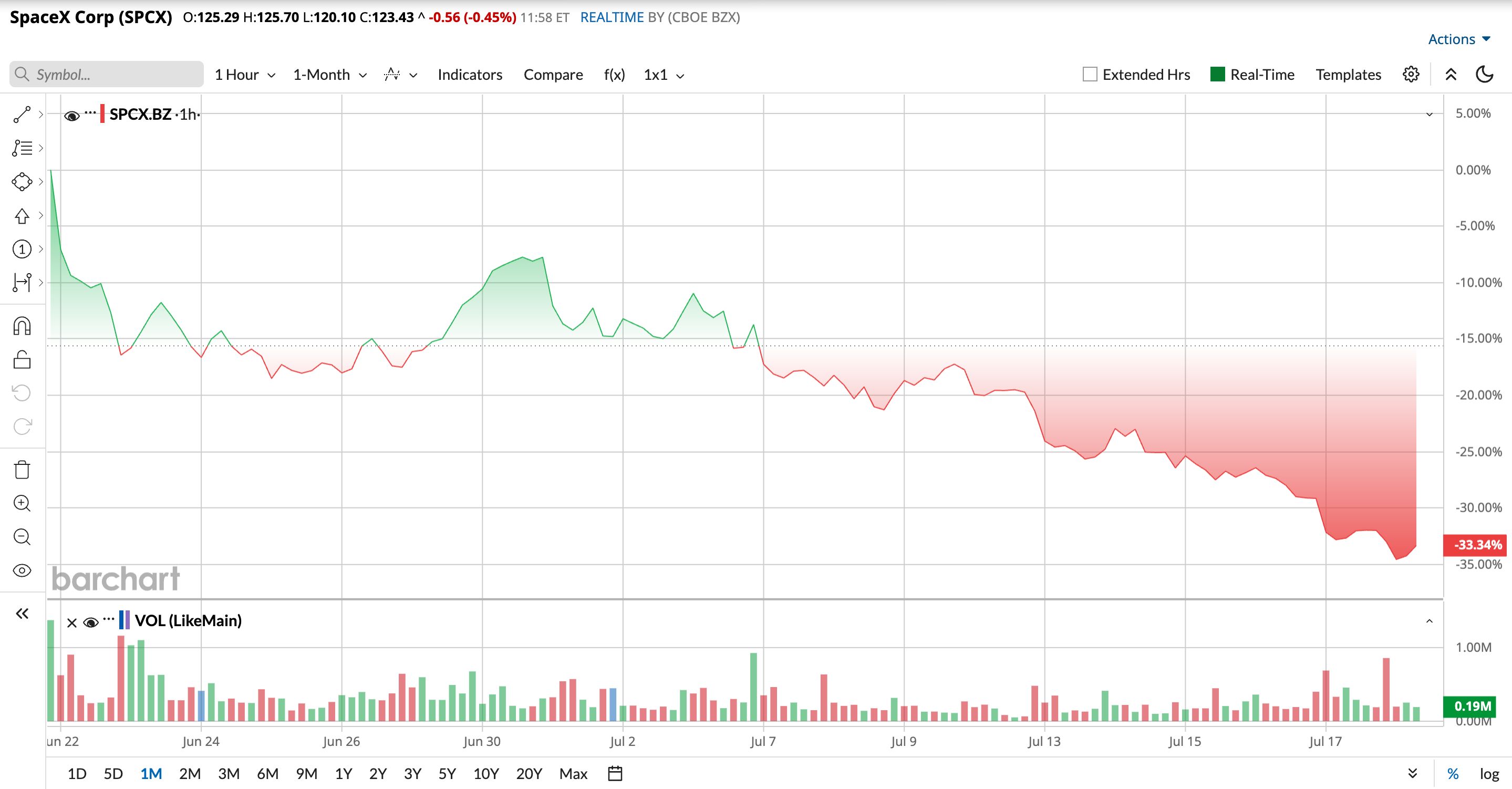
Even so, Wall Street has learned that every rocket does not travel in a straight line – and neither does a stock. Just over a month after its blockbuster IPO, SpaceX's shares have surrendered much of their early gains. The stock has tumbled 33.6% over the past month, including a sharp 11.7% slide in the last five trading sessions, hitting an intraday low of $122.12 on July 17.
The pullback has not erased the company’s stature. SpaceX still boasts a market capitalization of $1.62 trillion, keeping it among the 10 most valuable publicly traded companies in the United States.
But the recent weakness reflects a perfect storm of fading post-IPO euphoria, investors locking in profits after the stock’s blistering debut, concerns surrounding the upcoming August lock-up expiration, and growing scrutiny over its premium valuation and hefty capital spending needs. Throwing in the recent Starship launch aborts, the market suddenly found another reason to tap the brakes.
 www.barchart.com
 A Snapshot of SpaceX’s Q1 Numbers and Outlook
For the first quarter of fiscal 2026, the company generated $4.7 billion in revenue, marking a healthy 15.4% year-over-year (YOY) increase. The biggest tailwinds came from its rapidly expanding Starlink subscriber base and growing demand for AI offerings tied to X and Grok. However, its traditional Space business did not fire on all cylinders, with launch timing and the pacing of certain government contracts keeping growth more measured than investors had hoped.
Meanwhile, profitability remains the elephant in the room. SpaceX posted an operating loss of $1.94 billion and a net loss of $4.3 billion for the quarter as it continued pouring money into future growth. Still, beneath those headline losses, the business showed signs of underlying strength. Adjusted EBITDA reached $1.1 billion, suggesting the company’s core operations are still generating solid cash flow even as spending ramps up.
SpaceX poured a staggering $7.7 billion into its AI initiatives during the quarter, dwarfing the $1.33 billion invested in its Connectivity segment and the $1.05 billion allocated to its Space business. That’s a pretty clear signal about where management sees its next big opportunity. To bankroll those ambitions, the company finished the quarter with roughly $15.9 billion in cash and cash equivalents alongside $29.1 billion in long-term debt – a balance sheet that underscores both the scale of its financial firepower and the hefty price tag of chasing tomorrow’s breakthroughs.
Analysts covering SpaceX anticipate the company’s fiscal 2026 revenue to be around $39.1 billion and then rising to $72.3 billion in the next fiscal year. Fiscal 2026 losses are anticipated to be $0.66 per share, and then shrink by 181.8% YOY to earnings of $0.54 per share in fiscal 2027.
What’s Wall Street’s Take on SpaceX Now?
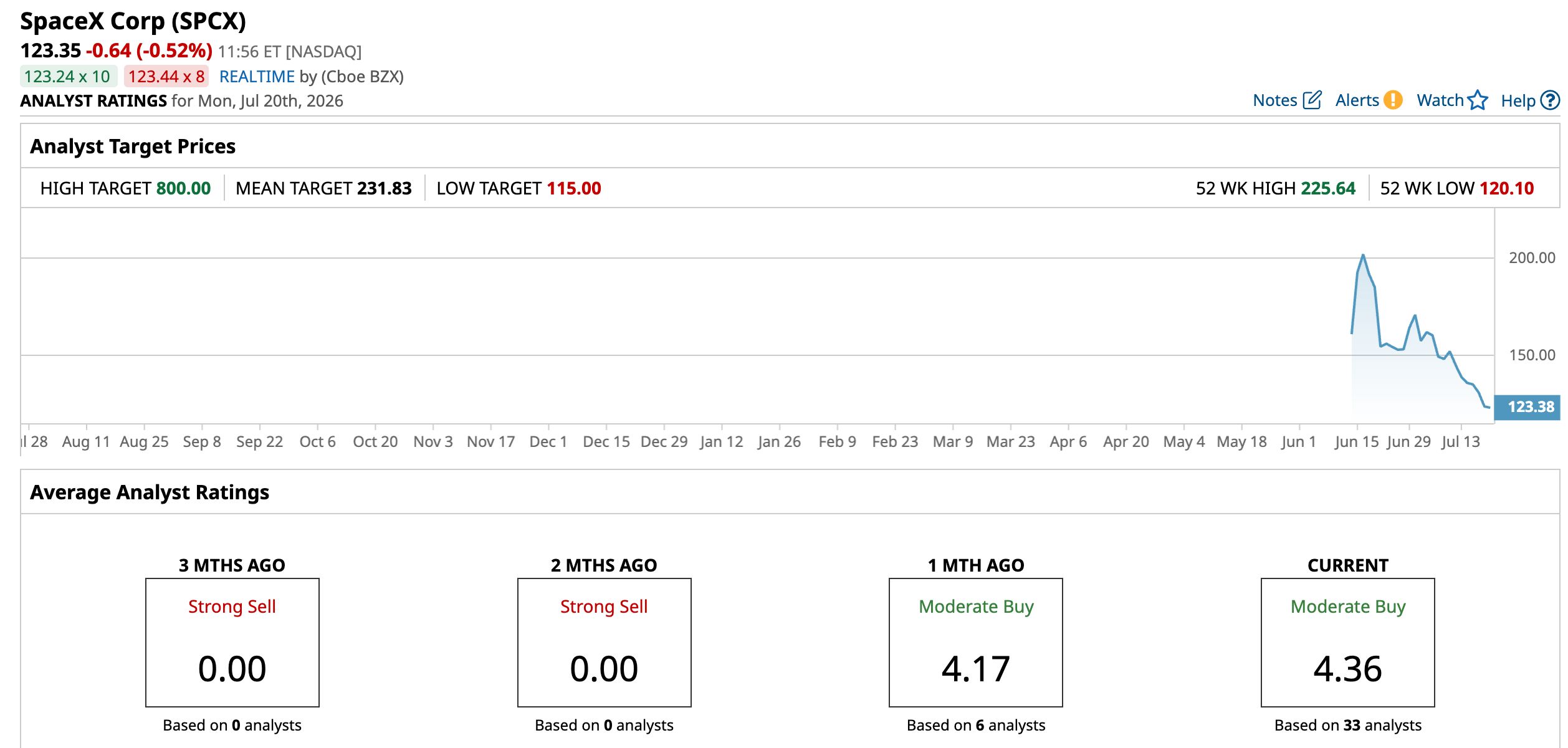
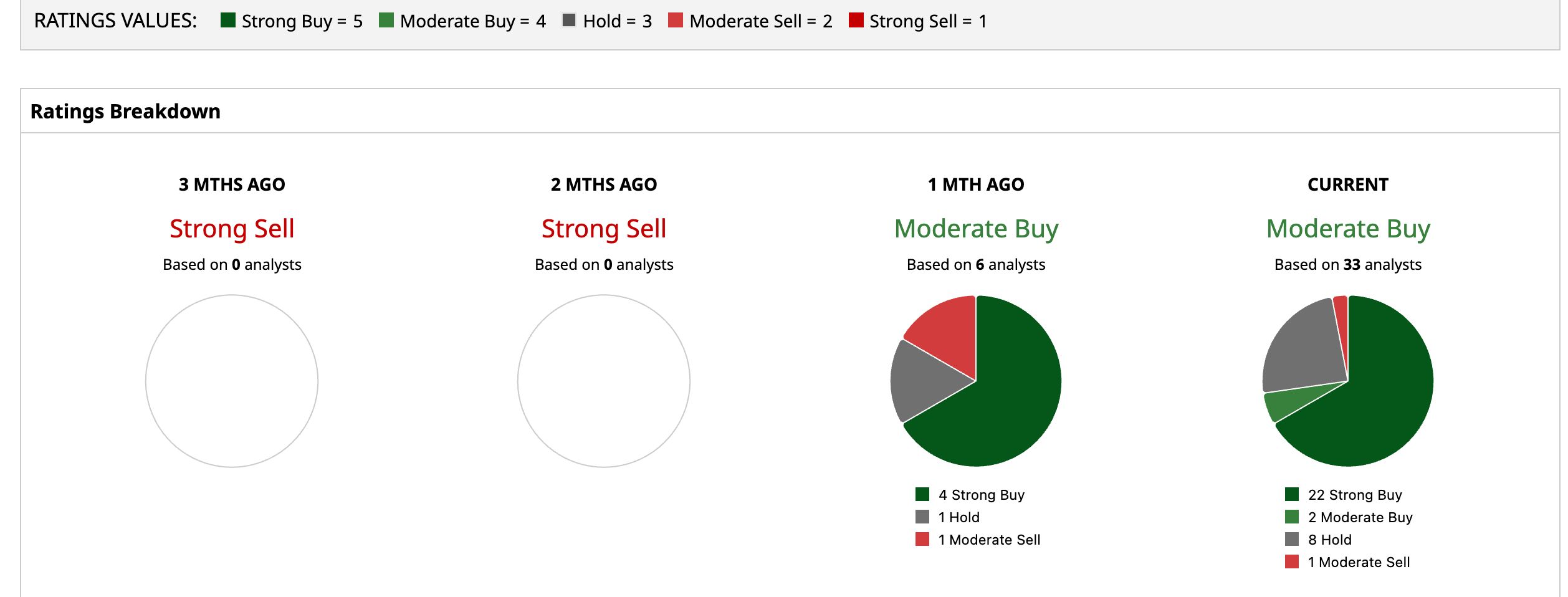
Overall, SPCX stock carries a “Moderate Buy” rating. Of the 33 analysts covering the stock, 22 recommend a “Strong Buy,” two have a “Moderate Buy,” eight are playing it safe with a “Hold,” and the remaining one is advising a “Moderate Sell.”
At current levels, the average price target of $231.83 suggests that SPCX stock has rebound potential of 88%. Meanwhile, the Street’s highest price target of $800 implies SPCX could rally as much as 548.6%.
 www.barchart.com
  www.barchart.com
 Final Thoughts on SPCX Stock
If there’s one thing SpaceX has taught investors over the years, it’s that building the future rarely follows a straight flight path. The aborted Starship launch may have rattled nerves and weighed on the stock in the short term, but it’s important to separate a temporary setback from a broken investment thesis.
In this case, the launch never failed in the air – it never got that far. SpaceX has already identified the issue, plans to replace the affected engines, and is targeting another launch attempt soon.
That matters because Starship is the centerpiece of SpaceX’s next chapter. The fully reusable launch system is expected to dramatically lower launch costs, carry much heavier payloads, accelerate Starlink satellite deployments, support NASA’s Artemis lunar missions, and eventually power the company’s long-term ambitions in AI infrastructure and even interplanetary transportation. Starship probably sits at the heart of nearly every major growth story investors are buying into today.
Of course, execution risk should not be brushed aside. SpaceX is simultaneously scaling Starship, expanding Starlink, and investing aggressively in AI, all while capex continues climbing. Extended delays could push back commercialization timelines, giving rivals additional room to strengthen their foothold. But SpaceX still holds a commanding lead, having completed roughly 650 orbital launches and delivering over 80% of the world’s mass to orbit since 2023 through its unmatched launch cadence and reusable rocket technology.
For investors, near-term volatility is likely to remain elevated, especially with SpaceX set to report its first quarterly earnings as a public company and the August lock-up expiration fast approaching. The next Starship launch will likely be a key catalyst. A successful liftoff could reignite optimism, while another setback may extend the recent sell-off.
For now, the long-term growth story appears intact, but execution is everything. The market will likely reward execution rather than promises.
On the date of publication, Sristi Suman Jayaswal did not have (either directly or indirectly) positions in any of the securities mentioned in this article. All information and data in this article is solely for informational purposes. For more information please view the Barchart Disclosure Policy here.
More news from Barchart
ACHR Stock Alert: What to Know as Archer Aviation Unveils Anduril Partnership SpaceX Stock Sinks on Aborted Starship Launch. How to Play SPCX Stock for the Rest of Q3. Jim Cramer Says Intel Is His No. 1 Stock. Here’s Why. AMC Stock Skyrockets on Record Quarterly Revenue